



Out of the Darkness (lección)

Lesson time: (10min 29sec)
En esta lección, Doug Smith te enseña a tocar el tema Out of the Darkness a la guitarra acústica.
Course preview
This lesson is part of the course Guitarra instrumental contemporánea
Watch a preview of the full course below.
Lesson transcript:
Out of the Darkness: Music Lesson
This next tune is called Out of the Darkness. I've had people ask me what that means. Essentially, it's just the main part of the tune is in D minor, and all of a sudden I go to D major. Whenever I do that, it sounds like you're coming into the light, you know, from... Sorry, that type of thing.
You know what they used to say in grade school:
"Minor chords are sad, major chords are happy."
That type of thing.
Introduction to the Tune
This starts off with a series of, I guess you could say, dramatic flourishes. One might say cheesy flourishes. But that's okay because I like cheesy, too.
Forward Rolls
In banjo terms, these are referred to as forward rolls. Essentially, let's start here:
- The thumb on the third string,
- Index and middle on the second and first, respectively.
Just play thumb, index, middle. Okay? That's pretty straightforward.
Try to do that a little faster. Then try to just do a string of them together and speed up. If you put a little weight behind the thumb, it's a little easier to get done.
Now, what I'm doing at the beginning of this tune is that type of forward roll, starting my thumb on the fourth string. I and M are still where they are, then the third string. So you get this:
[Play Example]
Okay, so that's what's happening in the right hand.
What's happening in the left hand is just octaves playing a melody that's part of the melody later on. When you put the two together, you get this:
[Play Example]
And that finishes out with the same forward roll through the whole thing.
Digression: Connecting to Renewal
If I might digress for just a second and show you how that worked at the end of Renewal, since we're in the same tuning. I'm doing a forward roll, the same type, except I'm avoiding the third string. So I'm just doing this:
[Play Example]
So at the very end of the song, Renewal, it's like this forward roll.
Another Cool Riff
Okay, so that's how that fits into Renewal. And if I can digress for just another second, this is kind of a cool riff based on the same type of forward roll.
Harry Chapin's first guitarist, his name was Doug Walker. He used to do this a lot, and I just love it because it's a great little flourish, and you can end songs with it.
What you do is start a forward roll with P, I, M:
- Thumb, index, middle on the sixth string (6, 5, and 4).
- Then move that up to 5, 4, and 3.
And then just do it like that and finish with a chord and that little riff. It's a cool way to end a song.
Transition to the Next Section
So, okay, enough of that. We ended here.
Second Introduction
Now, the next section of the song. This is kind of like a second introduction. It involves, with the left hand, just placing your pinky finger (your fourth finger) over the twelfth fret harmonic, and it just stays there.
The right hand does a Travis pick:
- Alternating thumb pick: thumb, middle, thumb, index, thumb, middle, thumb, index on the upper four strings.
I do a fairly quick pick and then hit the 12th fret harmonic.
Harmonics Technique
Now, what's kind of neat about that is when you do a harmonic at the 12th fret (or a harmonic anywhere), try to bring your finger away so the harmonic, you know, grows. But when you're laying it down like this, you can't pull away unless you... which I'm not fast enough to do.
So it ends up sounding almost like a kalimba or a thumb piano.
Melody Underneath
Now, I play a melody underneath this. The trick is to keep this going. The thumb is going to alternate always with that third string there, okay? But as the melody dictates, it will go between the fourth string, the fifth string, or the sixth string.
But while you keep this going, the melody goes like this:
[Play Example]
Now, I wanted the melody to go "bom, bom, bom," right there. The way to do that is to reach over with the fourth finger really quick and catch that harmonic, then go back to where you were.
[Play Example]
And then it keeps going, kind of a long stretch there.
Continuing the Melody
Now, the same thing has to happen here. I wanted the melody to go "da, da, da, da, da."
The way to do that is to catch this time a sixth string harmonic to get that melody in there. So it goes like this:
[Play Example]
And that happens again. Then, at the end of this, I move up to the seventh fret:
[Play Example]
And again.
Conclusion on the Main Points
So that's really the main point of the song. I wanted to get across a couple of other things. When it goes into the first verse:
- Now, the Travis pick goes to the I and M fingers being on the second and third strings in the left hand.
You have to have your first and second strings... well, you don't have to right at the moment, but when you play that first melody note, then you have to switch with your left hand there and go to a bar.
The second time I play this, I throw in this little flourish. It kind of jumps out at you almost like another guitar.
Right Hand Technique
To get that effect, I like to bring my fingers back towards the bridge a little bit with the right hand to bring that out.
[Show Right Hand Example]
So, watch the right hand here. I'm pretty much where I usually am and then back where it was.
That's pretty much what I wanted to cover in this tune, especially those forward rolls and the harmonics at the beginning.
Give that a try! Remember, the entire thing is based on a Travis pick, so have fun with that.
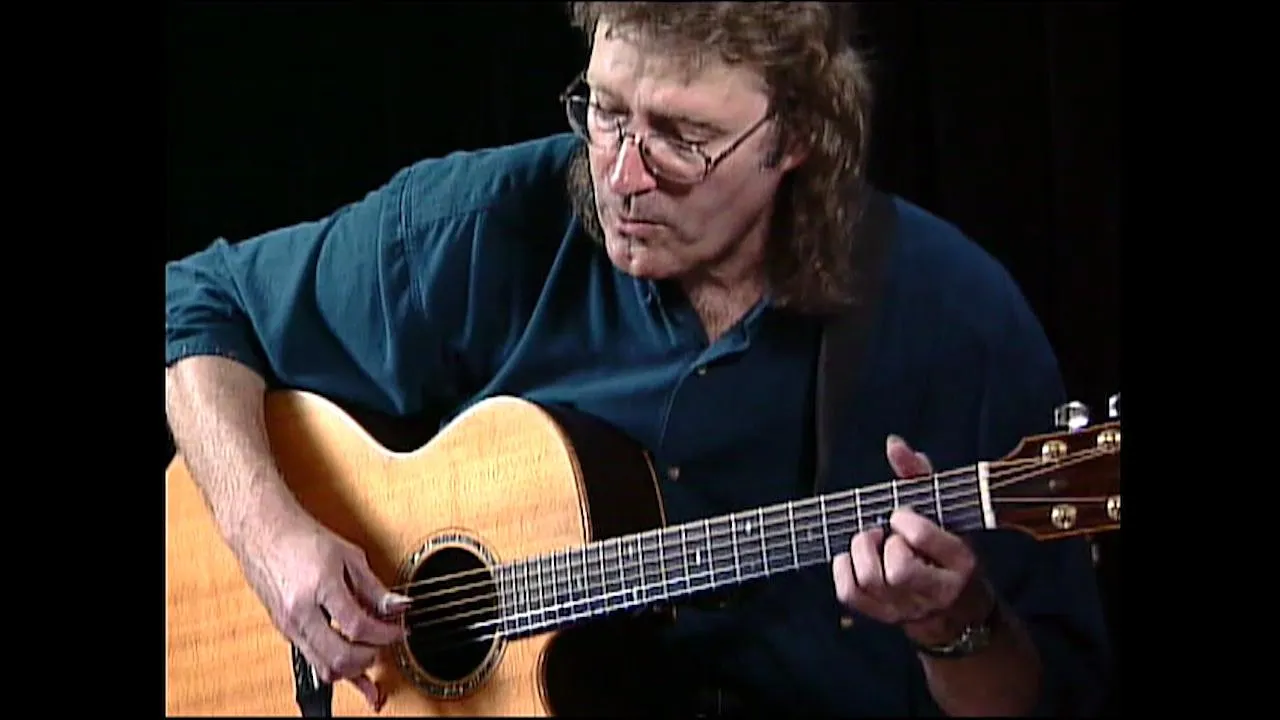
About the instructor
Doug Smith es un guitarrista acústico de fingerstyle ganador de un Grammy y antiguo vencedor del Winfield International Fingerstyle Guitar Competition, cuya forma de tocar apareció en la película August Rush. Su estilo bebe del folk, el clásico y el jazz, y ha compartido escenario con intérpretes como Tommy Emmanuel, Laurence Juber y Andy McKee. En su curso de MusicGurus "Contemporary Instrumental Guitar" desglosa las técnicas que hay detrás de sus arreglos a solo. read more