



3 ejercicios de bending con válvula
Con
PT GazellPT Gazell repasa ejercicios de bending con válvula que trabajan el draw bend del agujero siete, el valve draw bend y el blow bend del agujero seis, buscando bends limpios y relajados.
Qué incluye el curso
10 lecciones (0h 50m) · 1 gratis
01. Cómo enfocar y afinar nuestra técnica de bending
5:35
02. Entender los bends con válvula
Lección gratis4:59
03. Otro ejercicio de bending con media válvula
5:09
04. 3 ejercicios de bending con válvula
Estás aquí4:45
05. Usar bends con y sin pistones para explorar todo el instrumento
3:54
06. Usar un valve blow bend dentro de una melodía (My Romance)
6:05
07. Aprovechar la emoción extra que aporta el método Gazell
6:59
08. La menor en 5ª posición como alternativa a la menor en 3ª posición
5:07
09. Aprende el tema de la canción “Sugar” en 5.ª posición menor
3:40
10. Aprender un solo para “Sugar” y cómo tocar la canción completa
4:11
Transcripción de la lección
Valved Bending Exercises
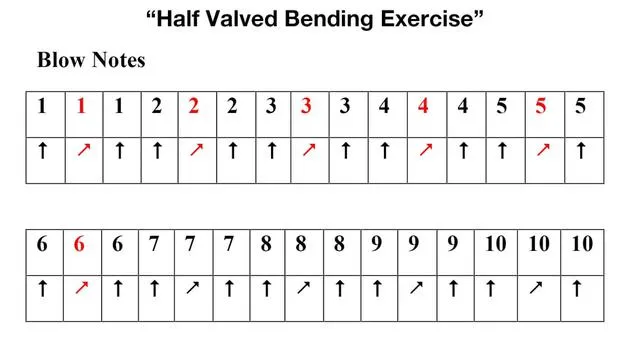
Alright, I'd like to play another valved bending exercise that I want you guys to practice. This one starts on the seven draw bend and ends up using the seven draw bend, valve draw bend, and the six blow bend.
Exercise Overview
- Starting Note: Seven valve draw bend
- Ending Note: Sixth valved blow bend
Listen to what I play.
I'll play it again. The important thing here is to get good clean bends again.
- Don't force it.
- Stay relaxed.
- Use the increments of your mouth and that focused stream that we talked about to be able to execute the seven draw bend and the six blow bend.
Key Points
- Remember: the valve bends happen more towards the front of the mouth, similar to our conventional blow bending at the top of the harmonica, but even up one more notch is probably a good way to think about that.
I'll play this exercise one more time, and you can check that, of course, on your PDF and practice it on your own as well.
Second Valved Bending Exercise
Okay, here's the second valved bending exercise. This is another good little routine for you to start to get the feel for how to:
- Move around
- Connect the valved bends as half steps into the riffs that you already know
This one employs:
- Six blow bend
- Five blow bend
- Seven draw bend
- Eight draw bend
Listen to me play it. I'm going to play it slower. Follow along on the PDF so you can see how I'm playing the notes.
- Remember, the ones in red are the valved bends.
Third Valved Bending Exercise
Great. And finally, here's the third valved bending exercise. This one's not only designed to get you used to playing some of the valved bends, both blow and draw, but it's also designed for you to utilize:
- A conventional blow bend at the top
- A valved blow bend at the bottom
It covers running from the top of the harmonica all the way to the bottom. It's a great exercise.
Let me play it for you at speed and then we'll slow it down and I'll play it again. Follow your tab.
- Remember: the red indicates that it's a valved bend that I'm doing.
I'm going to play it slow now, so we're starting on nine blows.
One more time slowly. Listen for that number two valved blow bend at the bottom. The valve bend was the second last note.
I'll play it one more time.
Practice that one hard. Because you're not only using valve bends and conventional bends, but you're going from the top of the harmonica all the way to the bottom.
It's a great exercise that really gets you familiar with where all the notes are on the harmonica.
10 lecciones
0h 50m de lecciones en vídeo estructuradas
Funciones de vídeo avanzadas
Ralentiza, repite un pasaje, sigue la partitura
Móvil, tablet y ordenador
Practica donde quieras
Garantía de satisfacción 100%
30 días de garantía de devolución
Conoce a tu gurú
Conoce a tu gurú
PT Gazell se ha ganado su posición como maestro de la armónica diatónica. Tras años como codiciado músico de acompañamiento y de sesión para algunos de los más grandes de Nashville, PT descubrió el half-valving y su música literalmente alcanzó nuevas cotas.
Ningún otro intérprete combina su fraseo, su estilo melódico, su elección de temas y sus habilidades de improvisación como él lo hace: en definitiva, es un estilo completamente suyo. Usando su propio instrumento signature, la diatónica Gazell Method fabricada por Seydel, PT demuestra que la armónica es capaz de mucho más de lo que la mayoría creemos.
¡Disfrútalo!
En sus cursos, PT enseña el half-valving directamente desde la fuente, para que puedas empezar con el Gazell Method, dominar los bends valvulados e incorporarlos a tus propias canciones.







