



Lay Down The Bass (análisis)

Con
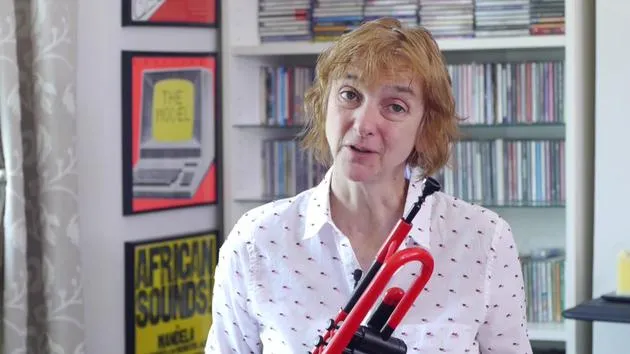
Kay CharltonKay Charlton desglosa Lay Down the Bass, un tema construido a partir de las cuatro notas Do, Re, Mi y Fa subiendo por la escala sobre un groove bailaón.
Qué incluye el curso
16 lecciones (0h 51m) · 1 gratis
01. Bienvenido a Are You Ready
1:17
02. I Can Play In Three (interpretación)
1:36
03. I Can Play In Three (análisis)
Lección gratis3:16
04. How Many Bars in a Blues (interpretación)
1:40
05. Cuántos compases tiene un blues (análisis)
6:23
06. Lay Down The Bass (interpretación)
2:51
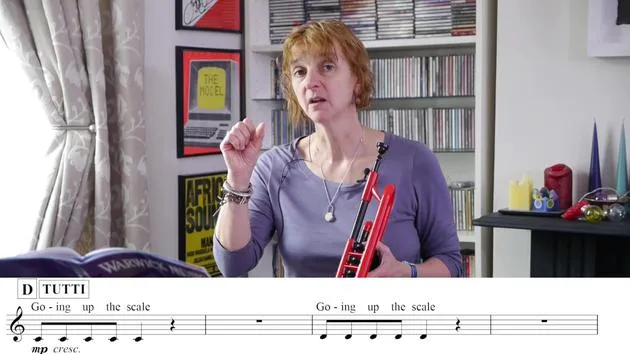
07. Lay Down The Bass (análisis)
Estás aquí5:01
08. Eastern Promise (interpretación)
2:23
09. Eastern Promise (análisis)
4:40
10. Are You Ready (interpretación)
2:32
11. Are You Ready (análisis)
5:49
12. Scale It (interpretación)
2:48
13. Scale It (análisis)
2:03
14. Question and Answer (interpretación)
2:52
15. Pregunta y respuesta (análisis)
6:05
16. ¡Enhorabuena por terminar el curso!
0:40
Transcripción de la lección
Music Lesson: Bass Scale and Dynamics
Lay Down
The bass is just about playing a scale, really consolidating the notes. We've learned C, D, E, and F. We're leaving B aside for the moment.
Finger Movement
Don't forget: when you're changing between notes, move your fingers smartly from one note to the next.
- Avoid picking your fingers up in between, as that will slow you down.
Note Sequence Practice
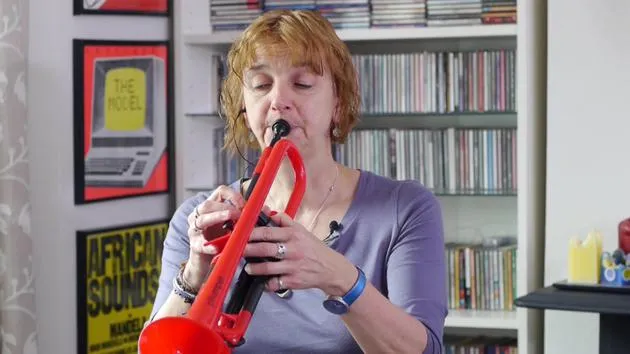
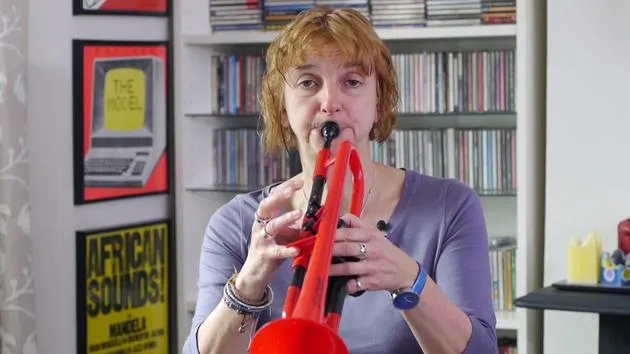
Listen, I'll play the four notes in sequence, moving my fingers quite quickly.
- One, two, three.
- So that was quite smooth, wasn't it?
- Moving my fingers quickly when I tongue the notes.
Common Mistake
This is what happens if we don't really move our fingers as cleanly as that:
- Here we go.
- So it's a bit messy in between, isn't it?
- I'm doing that all in one breath.
If you can't do that yet, of course, you could:
- Take a breath at the end of each note
- Try putting two notes together and then taking a breath.
Key Focus
The main thing is to make it sound smooth.
Dynamics
The other thing we're talking about in this tune is dynamics. This means playing softly or loudly and moving gradually from soft to loud.
As we play our four-note scale, we can crescendo.
- That means making the sound grow, making it go louder.
- Start as soft as you can, then blow harder as you go up the scale.
Helpful Reminders
- Low to Higher - This refers to the pitch.
- Soft to Louder - This helps you remember the dynamics.
Next Section: Lay Down the Bass
The next section of the piece features the words lay down the bass. If you find that too much to do, you could just do the first section of that little phrase:
- You could just go lay it down and then play the notes.
- If you're getting more confident, you could add in the other little bits as well, which is lay it down the bass. Play the notes in time.
You can miss off those quick notes if it's too much for you, and that bit goes around twice.
Playthrough Example
I'll just play this section for you. So I'll do it without the quick notes first of all:
- Starting on E: 1, 2, 3, 4.
Okay. Now I'll add in the quicker notes:
- If you're getting more confident at moving your fingers, you could try adding in these notes.
- That all goes round twice.
Quick Scale Practice
The third section for this piece is going quicker up the scale.
-
Play: 1, 2, 3, 4, 5. Just like we did on one of the other songs.
-
C, C, C, C, C.
-
Rest for four beats, then de de de de dee.
-
Rest for four beats and then going up the scale.
-
Rest for four beats, and then going up the scale.
See if you can get louder.
I'll play this last section now:
- 1, 2, 3.
- 1, 2, 3.
- One, two, three.
- One, two, three.
Improvisation
In this song, we haven't put in an improvisation or copyback section, but what you could do is:
- Use the whole track and just have some fun improvising with your four notes.
A nice, easy way to get into that could be taking those long notes of the scale and making up some rhythm patterns.
Key Words for Inspiration
Remember all those words we were thinking of:
- Questions
- Your name
- Rhythm
On this one, make something up by changing those long notes to some rhythms. And when you get better at that, you could try improvising over the whole track.
Example of Improvising
So I'll just show you the four notes:
- With some improvising rhythms on those notes instead of four plain long notes.
- 1, 2, 3, 4.
- So I'm still using the same four notes, but I'm adding in some rhythms.
Have fun improvising on this piece!
16 lecciones
0h 51m de lecciones en vídeo estructuradas
Funciones de vídeo avanzadas
Ralentiza, repite un pasaje, sigue la partitura
Móvil, tablet y ordenador
Practica donde quieras
Garantía de satisfacción 100%
30 días de garantía de devolución
Conoce a tu gurú
Conoce a tu gurú
Kay es trompetista, compositora y profesora de metales y de música curricular, especializada en la enseñanza en el aula de primaria - KS2, First Access/WCET (enseñanza de conjunto para toda la clase, en la que un grupo entero aprende un instrumento a la vez) y CPD del profesorado (desarrollo profesional continuo). En 2018 completó un máster en Educación Musical - 'Teaching Musician' en el Trinity Laban Conservatoire.
Kay toca la trompeta con la Bollywood Brass Band, una banda de 9 miembros de metales y percusión cuyo CD de 2017 Carnatic Connection fue nominado a un 'World Music Award' de la revista Songlines y recibió una reseña de 5 estrellas en el London Evening Standard. Kay compone y arregla para la banda y dirige su labor educativa, fundando la Bollywood Brass Academy en 2017.
Kay ha presentado su investigación sobre la enseñanza para toda la clase en el Music Education Expo y en el First Access Forum. Ha diseñado y dirigido CPD para LSO Discovery, Trinity College London, Music Education Solutions y la Bollywood Brass Band, y es consultora educativa para Warwick Music.
El libro de repertorio para principiantes de Kay, 'Are You Ready?', está publicado por Warwick Music; en 2017 Warwick Music y Music Education Solutions encargaron a Kay la composición de canciones para un nuevo programa de KS1 para el pBuzz, que fue nominado como 'Education Resource of 2018' por los 'Education Awards'.
Otras publicaciones incluyen piezas para los programas de piano Initial (2015/2018) y Grade 1 (2018) de Trinity, Bollywood Blast! (Spartan Press) - una serie de libros didácticos de metales y viento con pistas de acompañamiento en estilo Bollywood - y Whole Class Bollywood Blast con David Rose (Bedford Music Hub), dirigido a profesores de clases instrumentales para toda la clase e incluye un programa Arts Award Discover.
Sus cursos de MusicGurus te traen directamente esa experiencia de aula: desde tu primerísima clase de trompeta y a lo largo de dos conjuntos de melodías para principiantes, Kay expone exactamente qué tocar y cómo tocarlo.







