



Unterschied zwischen den Geschwindigkeits- und Druckübungen
Lesson time: (6min 56sec)
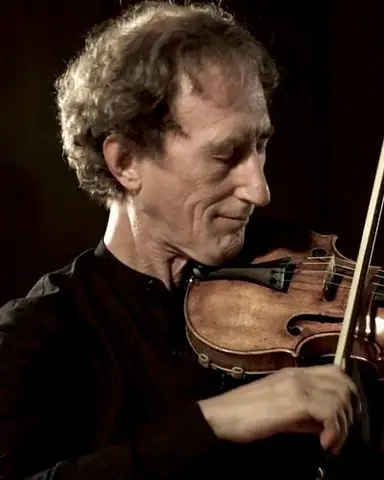
Simon Fischer stellt die beiden Bogenübungen gegenüber: die Haare für den Druck tief in die Saite sinken lassen versus schnelles Bewegen entlang der Saite für die Geschwindigkeit.
Course preview
This lesson is part of the course The Secrets of Tone Production, Teil 4: abschließende grundlegende Tonübungen
Watch a preview of the full course below.
Lesson transcript:
Music Lesson: Bowing Techniques
The exercises do sound quite different from each other.
Differences in Exercises
-
Pressure Exercise:
- Feel the contact of the hair with the string deep down into the string.
- Use "Release," "Deep release," and then "Deep, deep, deep, deep" when there are many in the bow.
-
Speed Exercise:
- The feeling is fast along the strings: slow, fast, slow and then fast, fast, fast, fast.
- Rhythm:
- Pressure exercise: heavy, light, evenly spaced.
- Speed exercise: fast, slow, fast, slow.
Bow Application
- Use a little more bow on the fast strokes.
- Focus on differentiating between the pressure and speed exercises.
- In the speed exercise, use as little extra pressure as possible.
- Use "some" pressure in the fast part of the stroke, but only as much as necessary.
- Avoid combining the two exercises.
Technique Practice
- Aim to play to the ends of the bow, as close to the bridge as possible.
- "Now get the sound resonating, make it go wide."
- For the third exercise:
- Go deeper in the string and fast, fast, fast, wide, wide.
Experimentation
- Experiment with extremes to discover capabilities:
- Observe variations in speed: fast, slow and fast, slow.
- Even if it doesn't work, you learn for next time.
Further Instructions
- Aiming for Weight:
- Combine fast, slow rhythms. Sustaining the sound offers a better result.
- Remember the pulse:
- "Fast, slow, fast, slow."
Changing Direction
-
The most helpful technique in changing direction is to slow down in the last tiny bit of the bow.
-
Execute strokes as:
- Fast, slow, stop (though you don't actually stop).
-
Maintain rhythm:
- "Bum, bum, bum, bum, bum, bum, bum, bum, bum, bum."
Common Issues
-
Up Bow:
- If the sound on the up bow lacks clarity:
- "Not enough pressure" or "not enough weight."
- Try two strokes with an emphasis on rhythm:
- "Bump, bum, bum, bum, along, along."
- If the sound on the up bow lacks clarity:
-
Observe strokes:
- The first fast stroke on the up bow may not have enough weight; also be aware of bow usage.
-
Conclude with:
- "Slow down at the end of the bow."
About the instructor
Simon Fischer verfügt über eine herausragende und vielseitige Karriere als Interpret, Pädagoge und Aufnahmekünstler. Er ist weltweit als Rezitalist aufgetreten und hat drei Brahms-Sonaten eingespielt, eine Aufnahme, die im Gramophone-Magazin hohes Lob erhielt. Simon gilt als einer der besten Lehrer der Welt. Er ist Professor an der Guildhall School of Music und hatte Positionen an der Yehudi Menuhin School, der Wells Cathedral School und der Purcell School inne; 15 Jahre lang war er Gastprofessor an der Royal Scottish Academy of Music. Nach seinem Studium in London bei Yfrah Neaman und in New York bei Dorothy DeLay vereint Fischers Ansatz die besten Elemente der französischen, russischen und amerikanischen Violintradition. Fischers publizierte Werke prägen den Violinunterricht maßgeblich. Seit 1991 schreibt er für das Magazin The Strad, und seine monatlichen Artikel haben weltweit eine treue Leserschaft gefunden. Seine bei Edition Peters erschienenen Technikbücher Basics and Practice (übersetzt ins Koreanische, Italienische und Deutsche), Scales und The Violin Lesson sowie die DVD The Secrets of Tone Production (nun über MusicGurus als Stream verfügbar) sind auf vielen Kontinenten zu Standardwerken geworden. Sein Buch und die DVD Warming Up wurden vom Magazin The Strad als „23 Seiten purem technischem Gold“ beschrieben. 2014 wurde Simon Fischer mit dem Preis der European String Teachers Association „in Würdigung eines lebenslangen Beitrags zum Streicherunterricht“ ausgezeichnet. In seinem vierteiligen Kurs Secrets of Tone Production führt dich Simon zunächst dazu, dein Instrument kennenzulernen, und arbeitet dann Schritt für Schritt seine grundlegenden Klangübungen mit dir durch, damit du auf der Violine einen volleren, kontrollierteren und schöneren Klang erzeugen kannst. read more