



Über Akkordtöne improvisieren
Lerne, über eine Akkordfolge zu improvisieren, indem du Akkordtöne anvisierst - spiel eine Melodie, die den Wechseln C, a-Moll, F und G folgt, statt einer einzigen Tonleiter.
Das steckt im Kurs
43 Lektionen (3h 11m) · 1 gratis
01. Einführung in die Ansätze zur Improvisation
1:00
02. Erste Schritte mit der Improvisation
9:22
03. Über Akkordtöne improvisieren
Du bist hier10:18
04. Aufgabe: Akkordtöne finden
4:05
05. Deinen Soli rhythmisches Interesse verleihen
4:11
06. Aufgabe: Improvisieren über einen Akkordwechsel
2:52
07. Challenge: Reiche deine Improvisation ein
0:24
08. Eine Melodie verzieren
5:36
09. Challenge: Reiche deine Melodie ein
0:26
10. Rhythmische Improvisation und Comping
9:55
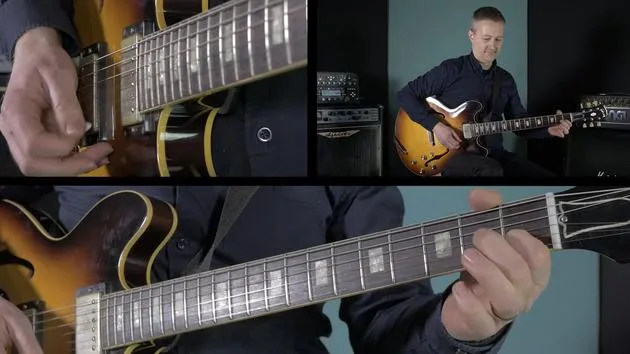
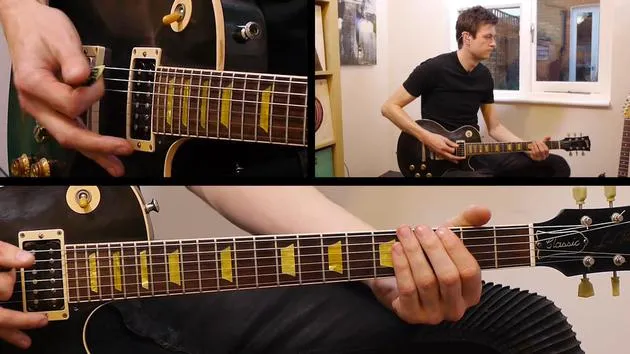
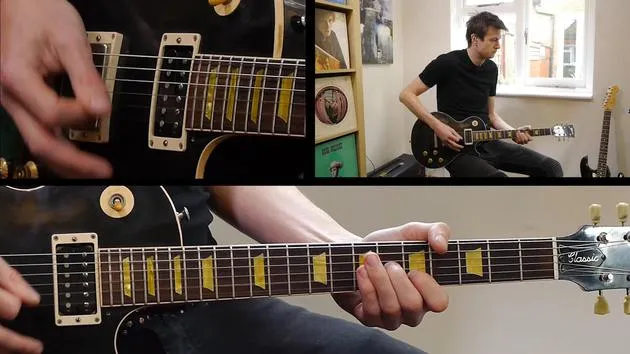
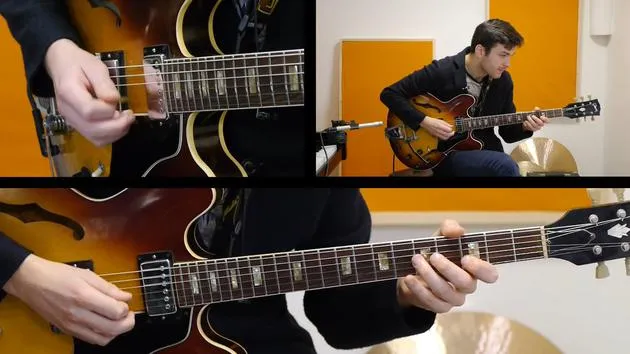

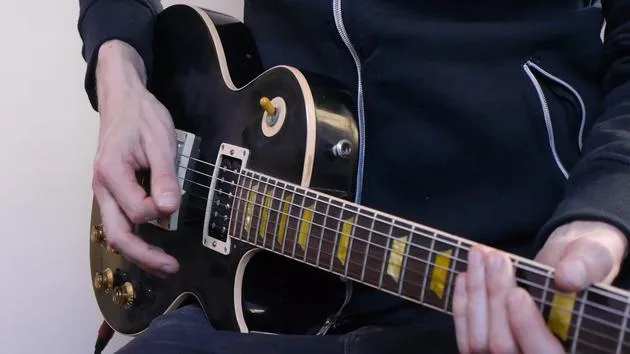
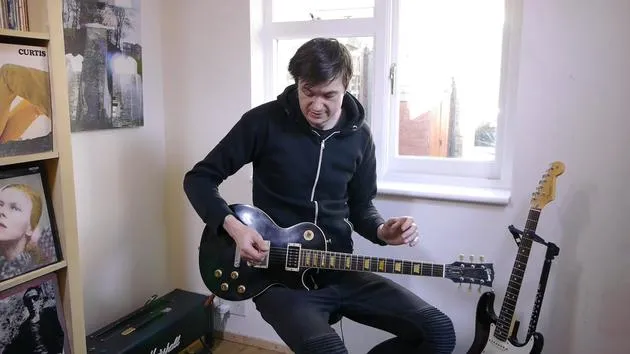
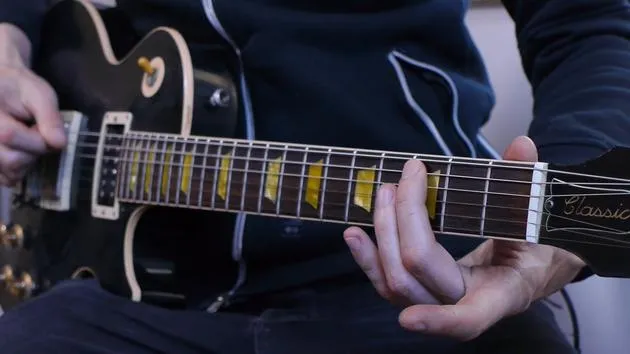
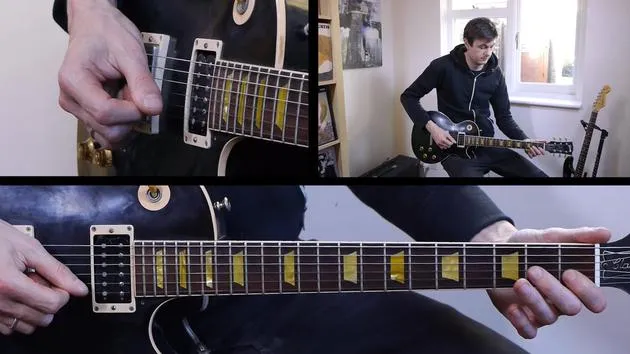
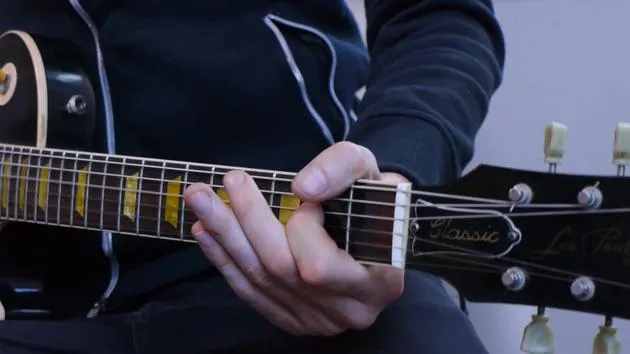
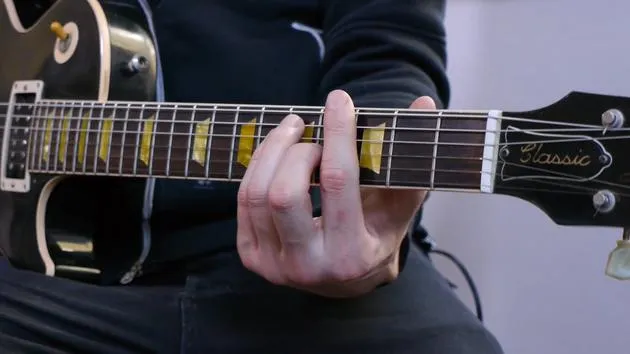
Transkript der Lektion
Music Lesson: Chord Tones and Improvisation
Okay. So, if you listen to any popular song, you're likely to hear that, in fact, there are more than one chord featured underneath a melody or an improvised section. This is really important. We need to be comfortable playing over more than one chord, not just one chord at a time.
The Chord Tone Idea
We're going to tackle that now using exactly the same idea that we've just discussed, the chord tone idea.
Example 1: Chord Progression in C Major
Let's take a look at Example 1 on the PDF. This is a four-chord, four-bar chord progression in the key of C major. It features the chords:
- C
- A minor
- F
- G
We're just going to loop that round.
Playing the C Major Scale
To start with, I'll play the C major scale over that chord progression so you can hear how that scale works at some points and not at others. Then, I'll play a melody that targets specific chord tones in these chords. This is a really great exercise that you can do. We'll simplify this in a second as well.
Let's have a go at it now. Here we go:
1, 2, 3. Here's chord one.
So we can definitely hear that the scale is the correct choice for this progression.
Targeting Specific Notes of the Chord
Now, let's play a little melody where we target the specific notes of the chord. If you remember, we had three notes in each chord:
- For a major chord: a root, a third, and a fifth.
- For the A minor chord: a root, flattened third, and a fifth.
I'm going to play some really simple melodies now.
What I've basically done there is improvised a really simple melody using arpeggios.
Understanding Arpeggios
If "arpeggio" is a term that's new to you, it simply means the notes of a chord played individually. This aligns with what we've been talking about regarding chord tones.
- If we join chord tones together, we are playing arpeggios.
- It's a fantastic way of approaching improvisation because you can't fail to play great notes over the chord at that point in time.
- By playing notes that feature in that chord, you can't really go wrong.
Key Takeaway: Arpeggios are a powerful tool for improvisation.
Exploring Arpeggio Shapes
Now, at the early grades, you might not have access to arpeggio shapes, but it's worth exploring these tools. They are just as useful as scales.
Jamming with Arpeggios
Let's put that back on again and have a little jam.
Remember: You don't need to come up with new ideas for every single bar.
A lot of these chords, when they belong to a diatonic chord progression like this (meaning they all come from the same scale), will feature the same notes.
We can actually play the same notes over different chords, and that note will have a different relationship to that chord as the chord changes.
Demonstration: Playing a C Note
Let me demonstrate this for you. I'm going to play a C note over this chord progression, and you'll see how the sound of that C has a different relationship as the chords go by underneath.
1, 2, 3, 4.
Hopefully, you heard that I played the C over every single chord.
- Over chords 1, 2, and 3 (the C, A minor, and F), it worked great.
- In the C major chord, it's the root note.
- In the A minor chord, it's the flattened third.
- In the F major chord, it's the fifth.
So, it had a different relationship to each of those chords but worked because it's a chord tone for each.
Conclusion on the G Chord
Now, over the G, it didn't necessarily sound bad, but it had a more pensive, tense sound. That's because it's not a chord tone of G; in fact, it's the fourth degree of G. I thought it sounded really cool!
On the repeat, I lowered the C note to a B, which is a chord tone of G. This just maintains that kind of resolved sound.
Note: This is another good example of not having to get too technical with improvisation.
Moving Forward: Octave Chords
If we had a bit of distortion on that, we could apply a restriction and say, "Right, we're going to improvise using octave chords over that chord progression."
Let's try that out.
Okay, so that's just me using one technique there, the octave shape, to come up with a melody. You might notice a few fluffs in there, but that's part of improvisation; you just keep going.
Playing on a Single String
Now, I'd like to talk about playing in that manner on a single string. If you're new to the theory behind scales, it can be tricky to visualize where the notes are within a particular scale shape across the strings.
A Helpful Technique
A great practice is to pick any string on the guitar and play in this direction along the string rather than across. This helps you get a better sense of the distances between the notes in the scale.
Let's pop that loop back on, and I'll play the C major scale up the B string.
- We'll start on this C, and if we do it right, we'll end up an octave higher on the 13th fret of the B string.
Let's try that out!
Sliding Melodies
You can start to play with kind of slidy melodies. This is another way of coming up with melodies along a single string. You have the added bonus of sliding in and out of those notes, which can sound really cool.
So, that's just another idea you can try.
Final Thoughts
This works really well, and I hope that was useful. Let's check out another idea!
43 Lektionen
3 Std. 11 Min. strukturierte Videolektionen
Erweiterte Videofunktionen
Verlangsamen, Passagen loopen, mitlesen
Handy, Tablet & Desktop
Üben, wo du willst
100 % Zufriedenheitsgarantie
30 Tage Geld-zurück-Garantie







