



Intro & Einzelschläge
Mit
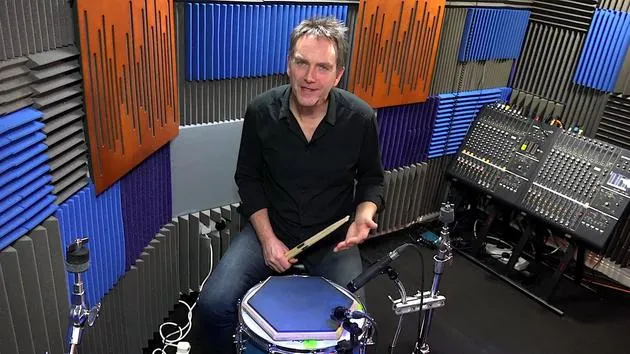
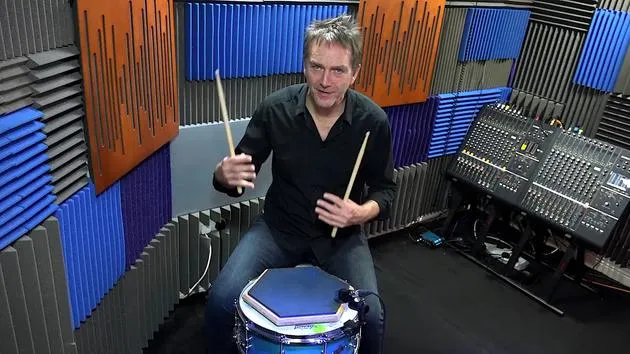
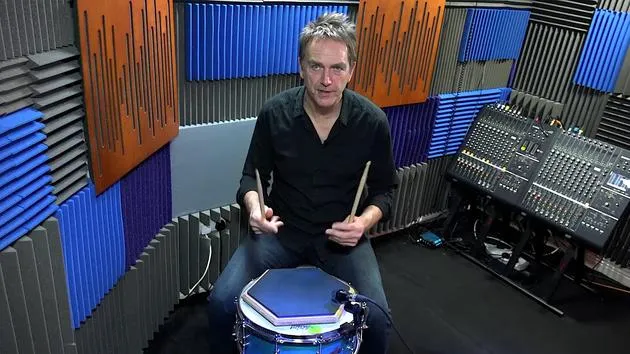
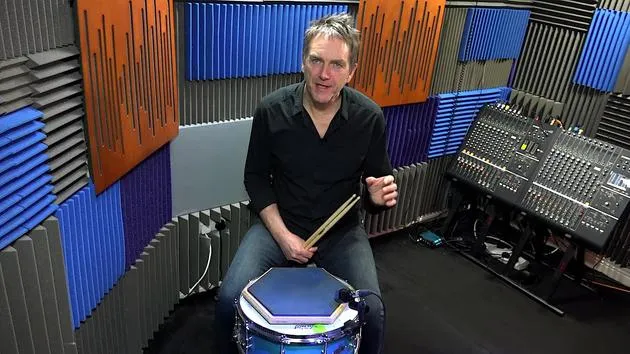
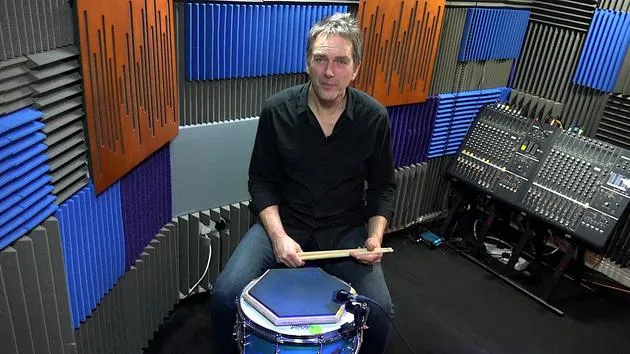
Paul ElliottPaul Elliott stellt die technischen Übungen von Rockschool vor – Dynamik, Akzente und Flams – und erklärt den Einzelschlag-Wirbel.
Das steckt im Kurs
11 Lektionen (0h 48m) · 1 gratis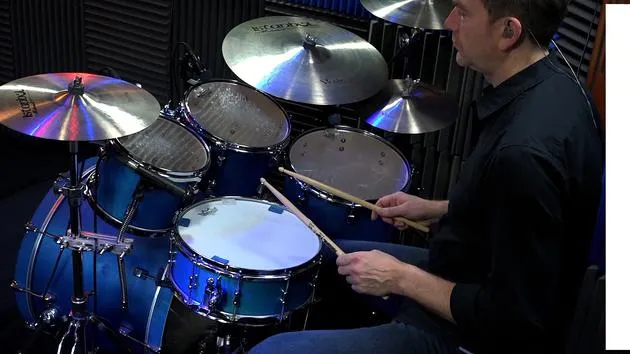
01. Demonstrationen der technischen Anforderungen für Grade 0
0:53
02. Demonstrationen der technischen Anforderungen für Grad 1
1:07
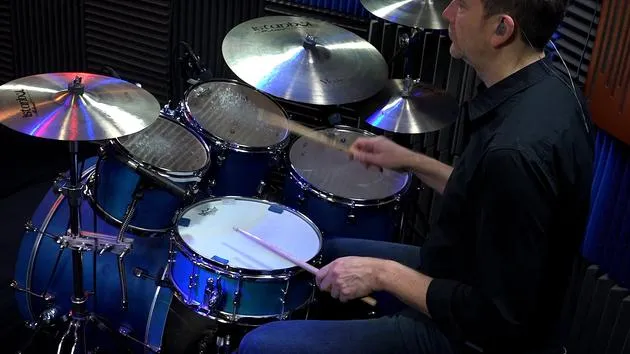
03. Demonstrationen der technischen Anforderungen für Grade 2
1:25
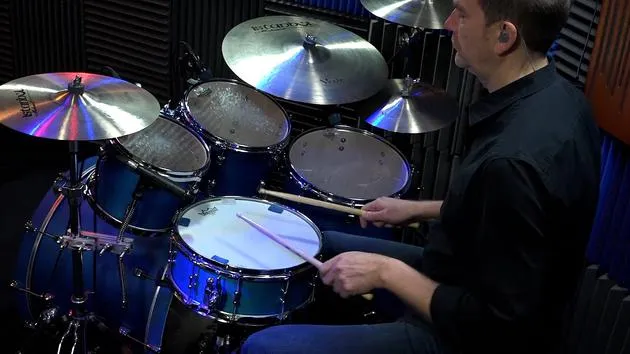
04. Demonstrationen der technischen Anforderungen für Grad 3
2:05
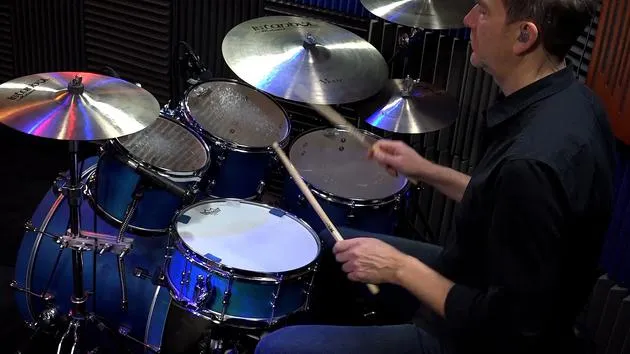
05. Demonstrationen der technischen Anforderungen für Grade 4
3:34
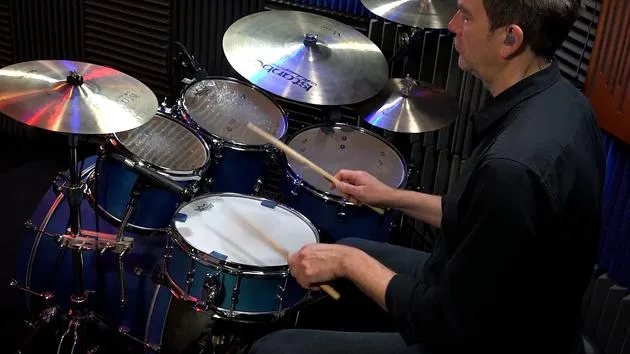
06. Demonstrationen der technischen Anforderungen für Grade 5
3:14
Transkript der Lektion
Top Tips for Approaching Technical Exercises
Okay, here we go with some top tips on how to approach and practice your technical exercises. Now, I'm not going to give a detailed technical lesson here. It's more a case of going through the technical sections in the Rock School books and breaking down the key components.
Key Components to Consider
What I feel to be most important when you're approaching those exercises includes:
- Dynamics
- Physical techniques to use
- Getting a nice flow of notes
- Using accents appropriately
- Understanding what to do when we flam
So, it's just an overview of the things that I think will give you an easier technical ride through your Rock School journey.
Grouping the Exercises
I'm going to break that down into different family groups, including:
- Singles
- Doubles
- Paradiddles
- Flams
- Drags and ruffs
- Linear applications
- Stroke rolls
There's quite a lot to look at there, but I'll give you as much information as I can in a short space of time.
Single Strokes
Let's get started with single strokes. Single strokes can be played with or without accents, and that's a key consideration because that will affect the physical technique used. We need to pay attention to that physical technique at all times, as it provides:
- Sound
- Timing
- Flow of notes
- Dynamics
Overall, we're trying to achieve a nice, efficient feel. We want to feel like we're playing the right notes and moving in the correct way to get that sound. Technique is all about sound and feel. The end result is how it sounds, and as a drummer, you need to feel as good and as efficient as you can.
Classical Single Stroke Roll
If I was playing a very typical classical single stroke roll (right, left, right, left), without accents, I would play like this using a natural bounce technique. In many of the technical study exercises, you're required to play through a range of subdivisions.
- When the subdivision is slow, it's not absolutely necessary to bounce the stick.
- As things get faster, it becomes difficult to maintain that without utilizing bounce technique.
In my technical demonstrations, I approach everything, even the slow rates of notes, with a bounce technique. So, if you start at a slower tempo, you might end up faster while using that same technique.
Patterns with Accents
Moving on to the patterns that have accents requires a different physical technique. If I was playing a group of three or four or more notes, as you'll see in the later grids, you might go from one note per beat up to ten notes per beat (including deck tuplets).
Incorporating Accents
We're required to play accents, most typically on downbeats. This requires us to employ a sequence of stroke techniques (sometimes called stroke sequences). Each of those strokes has a dedicated name that has evolved from other techniques.
For example, if I play a group of three notes, I'm going to play these as triplets at this tempo:
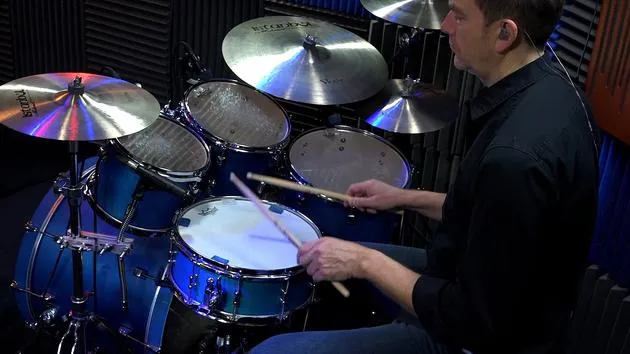
You can see I'm playing an accent on the downbeat on the quarter note, incorporating different physical motions to achieve the required dynamics.
Molar Technique
Now, we're incorporating accents and quiet strokes. It's not possible to just bounce the sticks because we won't be able to create that dynamic difference. The same goes for working through 16th notes, quintuplets, or 16th triplets, where we incorporate a series of stroke sequences.
These strokes are given names, such as:
- Down
- Tap
- Up
This evolved from the molar technique, a very common concept. It's something you should research further or discuss with your teacher. The terminology has evolved through generations of drummers, and familiarity with it is crucial.
Example Sequence
So, what I'm playing here in a group of three is:
- Down
- Up
- Tap
This sequence gives me a nice flow of notes and the required dynamics:
- Down, up, tap
- Down, tap, up, tap
General Tips for Single Strokes
It's very important to understand that the stroke sequences provide those dynamics, and there's a physical motion attached to every sequence. As a summary:
- Always check if you need to play an accent or not.
- If you don't play an accent, your best bet is to use natural rebound techniques; it makes life easier.
- You can use that technique with wrists or fingers (I was using wrists in my examples).
If you play accents, do some research or discuss it with your teacher. Think about how you're going to move the sticks and the specific motions to produce specific sounds.
Conclusion
That's it! Here are the technical exercises for your grade, played at the tempo stated in the book. I wish you good luck!
11 Lektionen
0 Std. 48 Min. strukturierte Videolektionen
Erweiterte Videofunktionen
Verlangsamen, Passagen loopen, mitlesen
Handy, Tablet & Desktop
Üben, wo du willst
100 % Zufriedenheitsgarantie
30 Tage Geld-zurück-Garantie
Lern deinen Guru kennen
Lern deinen Guru kennen
Paul Elliott ist ein angesehener Schlagzeugpädagoge und Clinician, dessen Schüler in der ganzen Branche Spitzenjobs innehaben, darunter die Schlagzeuger von Kylie Minogue (Tom Meadows), Ricky Martin (Laura Fares) und The Cure (Jason Cooper). Er hat sich Clinic-Bühnen mit Steve Smith, Manu Katché, Simon Phillips und Gary Husband geteilt, und seine eigene Spielerkarriere umfasste Arbeiten mit Frank Gambale, Guthrie Govan und Shaun Baxter. Schlagzeuger wie Phil Selway (Radiohead) und Ash Soan (Adele) kommen für technischen Rat zu ihm. In seinen Kursen arbeitet er die technischen Anforderungen Grade für Grade durch, demonstriert jedes Rudiment und erklärt nicht nur, wie man es spielt, sondern was es dir am Schlagzeug ermöglicht, wenn du es beherrschst.







