



Einführung in Kreuz- und B-Vorzeichen

Mit
Talia Girton
Das steckt im Kurs
19 Lektionen (0h 33m) · 1 gratis
01. Was ist eine Tonleiter & Demonstration
Gratis-Lektion2:27
02. Call & Response
0:58
03. Call-and-Response-Beispiel 1
1:09
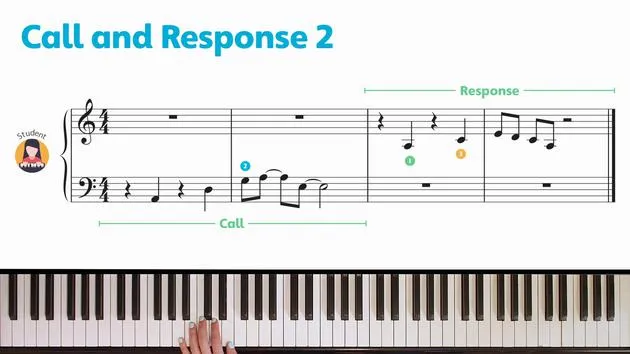
04. Call & Response Beispiel 2
1:25
05. Jammen mit der Dur-Pentatonik
1:49
06. Jam mit Dur-Pentatonik (Performance)
1:05
07. Jammen mit der Moll-Pentatonik
1:48
08. Minor Pentatonic Jamming (Interpretation)
0:49
Transkript der Lektion
Introduction to Sharps and Flats
So far, we've been working only with the white keys on the piano, also known as naturals. Now, we're going to look at the black keys, which we refer to as sharps and flats.
Understanding Sharps and Flats
- Sharps are represented on the stave by a number sign (‚ôØ) or a little hash sign.
- Flats look like a little B (b).
Example on the Keyboard
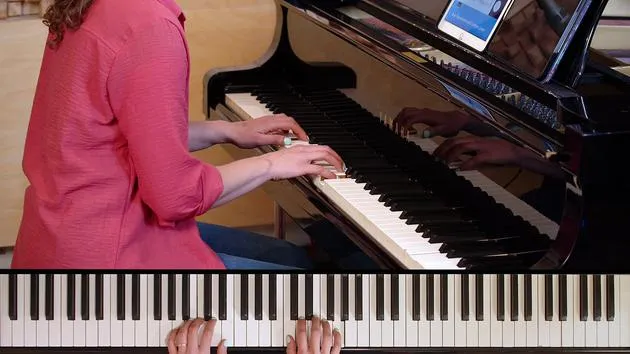
If we look at the keyboard, I'll give you an example of what each of those looks like:
-
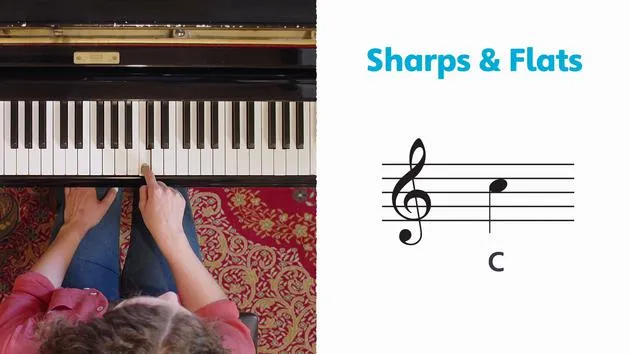
C: This note is a C.
-
C‚ôØ: If I go to the note directly to the right, this is a C sharp.
- Remember: If you step on something sharp, you jump up, and on the piano, we're moving up a semitone.
-
D: We know that this note is D.
-
Db: The note directly to the left is D flat.
- Remember: When a tire is flat, it moves down towards the ground, so we are moving down by a semitone.
Enharmonic Equivalents
I already know what you're thinking: How in the world is this note both C sharp and D flat? The answer is that they are enharmonic equivalents.
You don't need to remember that big fancy word; just remember:
- When you're moving to a black note on the right, it's going to be A sharp (from here to here).
- When you're moving to a black note on the left, it will be A flat (from here to here).
Sharps and Flats with White Keys
There are also some places where we have white keys that are named flats and sharps. This occurs when there is no black key in between two white keys:
- Between E and F
- Between B and C
Notes Related to Sharps and Flats
-
If you were to ask me what E sharp is, I would tell you that it's this note (the note above E).
- Reason: We are moving up a semitone.
-
Similarly, if you asked me about F flat, I would move down to this note (the note below F).
- Reason: We are moving down a semitone.
Conclusion
We'll have a look at using sharps and flats in a song in our performance piece a bit later on.
19 Lektionen
0 Std. 33 Min. strukturierte Videolektionen
Erweiterte Videofunktionen
Verlangsamen, Passagen loopen, mitlesen
Handy, Tablet & Desktop
Üben, wo du willst
100 % Zufriedenheitsgarantie
30 Tage Geld-zurück-Garantie
Lern deinen Guru kennen
Lern deinen Guru kennen
Talia Girton ist Musikerin und beim HCPC registrierte Musiktherapeutin sowie Gründerin von The Cycling Music Teachers. Ihre Arbeit verbindet Musiktherapie, Beratung und Pädagogik, und sie unterrichtet international im Musiktherapie-Ausbildungsgang der UDELAS in Panama und wirkt zudem an der beruflichen Weiterbildung mit der European Piano Teachers Association (EPTA) mit. Auf MusicGurus unterrichtet sie die Kurse Piano Method und Piano Foundations und führt absolute Anfänger von den ersten Schritten über Rhythmus, beide Hände, Theorie bis zur Aufführung.







