



Lerne, den Bass zu slappen
Mit
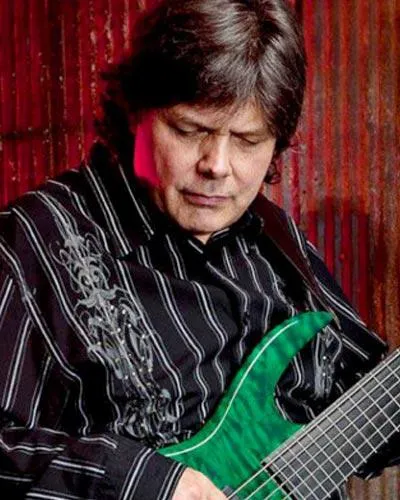
Roy VogtRoy Vogt vermittelt die Grundlagen des Slap-Basses: Daumentechnik, Handposition und die Backstops, die Slap und Pop ihren Punch geben.
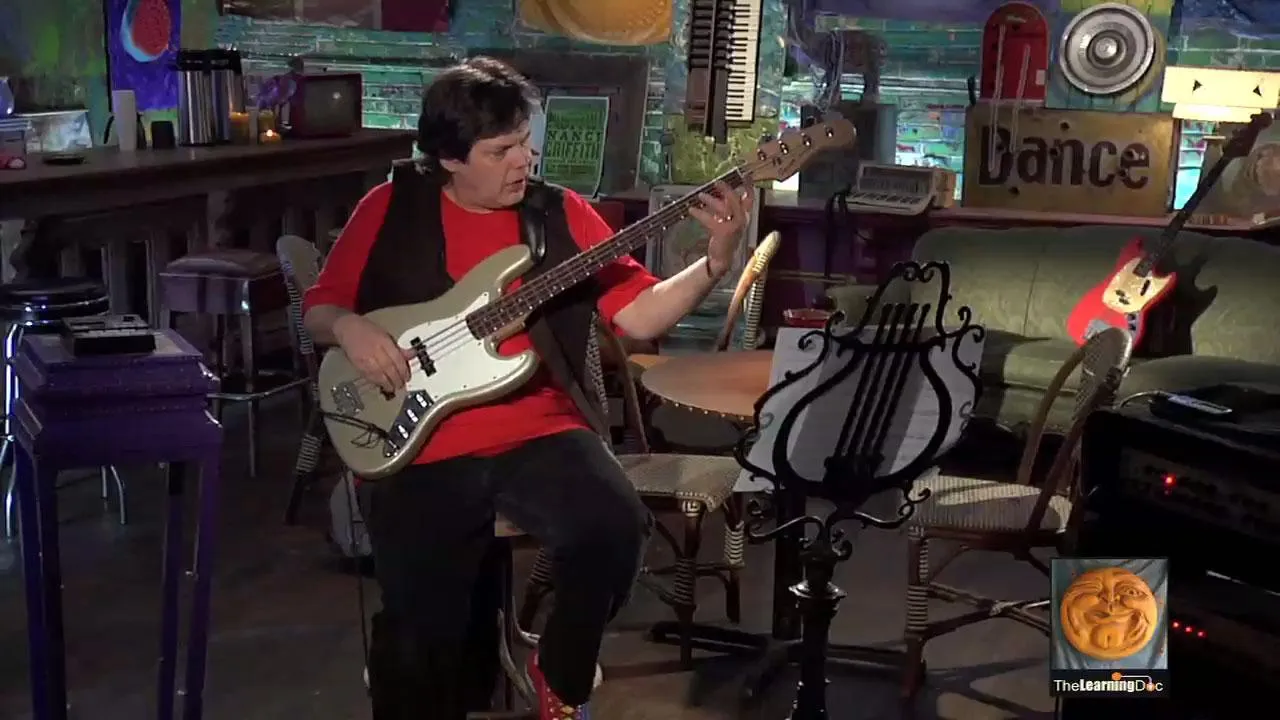
Das steckt im Kurs
5 Lektionen (3h 17m) · 1 gratis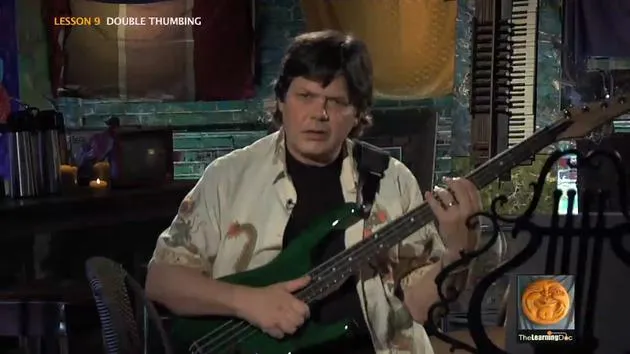
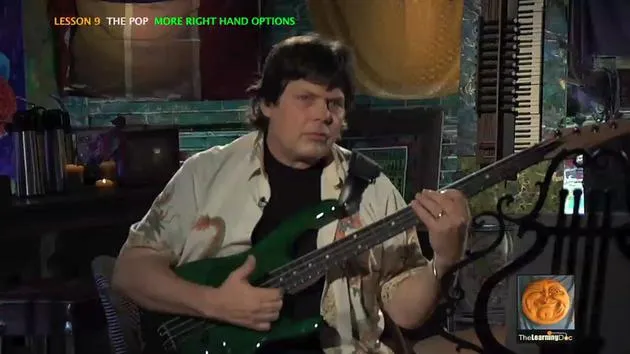
Transkript der Lektion
Welcome Back to Chateau Groove: Learning Slap Bass
Introduction to Slap Bass
Alright, welcome back to Chateau Groove. Today, let's look at how to play slap bass.
Using Your Thumb
I'm going to show you how to use your thumb and then we're going to incorporate that for the warm-up.
What is Slap Bass?
When you're playing slap bass, what you're really doing is hitting the strings with your thumb and then hitting the fingerboard.
- I could do anything to hit the fingerboard and I would get a slap sound like that, ow! Maybe that wasn't so smart.
- Typically, I use the thumb.
Hand Position
- My hand position for the thumb is as follows:
- I hold my thumb in a thumbs-up position.
- I hook these fingers into a little curve.
Now, I'm going to drop that thumb down. Remember when we were playing pick style and I had the thumb going parallel to the string? I'm going to apply the same concept here.
Backstops
- I'm putting the thumb right up against the end of the fingerboard.
- This creates two backstops with what I'm doing:
- If I hit the E string, one backstop is the next lower string.
- The second backstop is the fingerboard.
You can see that the thumb is making contact with both the fingerboard and the lower string.
Moving Across Strings
Let's look at that again as I move to different strings:
- A string: Same technique
- D string: Same technique
- G string: Here, I don't have any backstops available, so I use the body of the bass guitar as a backstop.
First Exercise: The Four by Four
Now, let's revisit that very first exercise we did in lesson one: the four by four.
Count:
1, 2, 3, 4.
1, 2, 3, 4.
1, 2, 3, 4.
1, 2, 3, 4.
Now, I'm going to use downstrokes with my thumb.
- It goes like this:
1, 2, 3, 4.
I'm starting with half notes, just getting used to this.
Notice Your Technique
I want you to notice something:
- I'm not using my thumb muscle at all.
- If you're watching my right hand, the thumb is like a drumstick.
- I'm just letting my wrist rise up and curve, then hitting the thumb into the string.
Now, I'll do that again with half notes.
Moving to Quarter Notes
Let's do quarters:
1, 2, 3, 4.
Double Thumbing Technique
Now, I'm going to treat that thumb like a guitar pick.
- I'll perform: downstroke with the thumb and upstroke with the thumb.
This technique is called double thumbing. Notable players who use this style include:
- Victor Wooten
- Stanley Clarke
- Marcus Miller
Actually, it'll feel like I'm playing with a guitar pick. The same movements apply: down, up, down, up, down, up.
Key Point
- The only difference is that I'm using just my thumb and not a pick.
- Remember, what creates the sound of the slap is really the string hitting the fingerboard, so I'm utilizing those backstops.
Eighth Notes Exercise
I'll do eighth notes now. This is kind of advanced. You might want to save this and work on it a little bit later as you get more comfortable with slap bass.
Here's the four by four exercise with double thumbing!
5 Lektionen
3 Std. 17 Min. strukturierte Videolektionen
Erweiterte Videofunktionen
Verlangsamen, Passagen loopen, mitlesen
Handy, Tablet & Desktop
Üben, wo du willst
100 % Zufriedenheitsgarantie
30 Tage Geld-zurück-Garantie
Lern deinen Guru kennen
Lern deinen Guru kennen
Roy Vogts Karriere umspannt eine außergewöhnliche Bandbreite an Bühnen, von MTVs Headbanger's Ball, dem Montreux Jazz Festival und dem Montreal Jazz Festival bis zum London Palladium, der Grand Ole Opry und dem Kreml. Von Punk bis Funk, von der Schlichtheit von Country und Blues bis zur Komplexität von HyperJazz und World Beat - er hat alles gespielt.
Roy war der erste Mensch, der an der renommierten Musikhochschule der University of Miami einen Master in E-Bass-Performance erwarb, und er widmet sich seit über vierzig Jahren der Kunst des Basses. Er war Mentor Dutzender erfolgreicher Profis, darunter der legendäre Willie Weeks. Elektrisch, bundlos, Kontrabass - was auch immer: Wenn es tiefe Töne spielt und Saiten hat, ist Roy ein Meister darin, es zu spielen und anderen beizubringen, dasselbe zu tun.
Im Laufe seiner vier Jahrzehnte währenden Karriere hat Roy mit einer erstaunlichen Liste von Topstars aufgenommen oder gespielt, darunter Larry Coryell, Victor Wooten, Dave Weckl, Tom Scott und der LA Express, Chester Thompson, Miroslav Vitous, Glen Campbell, BJ Thomas, Chet Atkins, Engelbert Humperdinck, Dickey Betts, Tony Joe White, Charlie Daniels, Jerry Reed und viele Dutzend mehr.
Roy unterrichtet seit dreißig Jahren auf Hochschulniveau. Seit 1983 hat er den Lehrstuhl für Bass an der renommierten Belmont University (Nashville, TN) inne, einer der ganz wenigen Hochschulen, die einen Studiengang in kommerzieller Musik anbieten, der darauf ausgelegt ist, Studierende zu professionellen Musikern an der Spitze der Branche zu machen. Roys Studenten sind mit namhaften Stars wie Trisha Yearwood, Faith Hill, Little Texas, Michael W. Smith, Lady Antebellum, Chick Corea, Sir Tom Jones, Blood Sweat and Tears, Yanni und unzähligen weiteren Musikikonen getourt und haben mit ihnen aufgenommen.
Seine Serie Teach Me Bass Guitar bringt dir genau diesen Ansatz auf Hochschulniveau nahe und führt dich vom Schnellstart für absolute Anfänger (Vol. 1) über Rhythmusgrundlagen (Vol. 2), das Finden deines eigenen Stils (Vol. 3) und ernsthafte Musikalität (Vol. 4) bis hin zu einem Werkzeugkasten für Profispieler (Vol. 5), damit du Schritt für Schritt echte Fähigkeiten aufbaust.







