



17. bis 20. Bund, Doppel- und Dreifachgriffe
Lesson time: (36min 11sec)
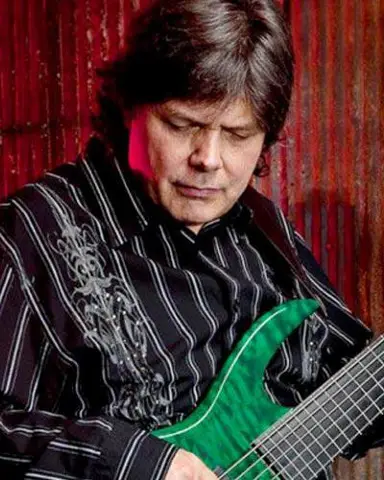
Roy Vogt führt dich in die Region vom 17. bis 20. Bund des Basses und in Doppel- und Dreifachgriffe im Stil von Roscoe Beck und Chuck Rainey ein, um deine R&B- und Blueslinien aufzupeppen.
Course preview
This lesson is part of the course Teach Me Bass Guitar vol.3: Finde deinen eigenen Stil
Watch a preview of the full course below.
Lesson transcript:
Music Lesson
Introduction
Alright, welcome back! Now we've learned all the notes on the bass up to here. We're going to finish the job today. But first, let's warm up.
Warm-Up
What I'm going to do is play all the notes on the bass hand over hand. I'm just doing a straight chromatic run up the neck. When I get to the end with my fourth finger, I'm going to start all over again, back down.
- Don't worry about what we're playing right now. Just kind of get this movement going.
- Let's do the same thing on the A string.
Remember, even if you've acquired a pretty good set of technique from the first 10 lessons, when you warm up, you always want to warm up slowly. This is not about speed.
Going to the D String
- Now, let's go to the D string, do the same thing, and let's finish on the G.
Now we've already talked about how the notes from the 12th fret to the 17th fret are the same as the notes from the open string to the fifth fret. So, if we're looking at 17 to 20, those are the same notes that are down here on the fifth fret to the eighth. We're just taking them up an octave.
Positioning on the Neck
If you have a bolt-on neck on your bass like this one, just kind of park your thumb at the end of the neck, see? Then you reach around. That's really our best way to do that. Don't try to go through any undue contortions.
Basically, when I get up there, my thumb just kind of turns sideways and I start pivoting forward.
Learning the Notes
Okay, let's learn these notes. We'll do quarter note equals 60, and I'll call them:
- A
- A sharp
- B
- C
- D
- E sharp
- E
- F
- G
- D sharp
- A
- A sharp
- C
- C sharp
- D
- D sharp
- Back down
- E flat
- D
- D flat
- C
- B flat
- A
- A flat
- G
- F
- E
- C
- B flat
- A
Alright, that covers the whole range of the bass if you're playing a conventional 20 fret model. There are some models that have more frets, and some models that have fewer. But this is pretty much the norm for a standard four-string bass.
Introducing Triple Stop Arpeggio Chords
Alright, we'll come back and look at how to take the chord arpeggios we've learned in earlier lessons and play chords on the bass, as well as do double and triple stops. See you soon.
Student Interaction
Alright, we're back with my student Cody, and we're going to learn how to play triple note and triple stop arpeggio chords.
C Major 7 Chord
Okay, Cody, I know we've worked before on four-note chords. So let's go ahead and play a C major 7 chord down here.
- Good.
- Now, let's take that up an octave and do the same voicing.
- Good.
Now let's hold down the first one, the third one, and the seventh. I'm using 2, 1, 3 as my fingering. Let's do thumb, index, middle, and just kind of fingerpick this.
- There you go.
Expanding Chord Voicings
Now that is a triple stop C major 7 chord. If I want a more open sound, let's try this one: C, G, and B.
- Yeah, see, that's a little more open sound. It doesn't have the third, so I could actually use that with a minor major seven or a major seven, whichever.
Morphing the Chord
Okay, let's go ahead and morph this around. Let's do a C7 chord: C, E, G, B flat.
- Let's take this up an octave.
- Now let's play the root, third, and seventh.
- Yeah, there's our C7 chord.
If I want a more open sound, I can put the fifth in there. Once again, because of the fact that we don't have a third, that could be either a C7 or a C minor 7.
C Minor 7
Alright, now let's change up and use a kind of stretch finger for the C minor 7.
- I don't generally use this, but since we're doing triple stop chords, this one actually is more practical.
- C, I'll reach all the way back here for G and then B flat.
Let's take that up an octave: C, E flat, G, B flat.
Creating a C Minor 7 Chord
Now, if I want to do a triple stop chord there, you can use all sorts of fingerings. I found I can use three on the root note, reach back for the E flat, and there's my B flat.
- Let's put them all together.
So that's a C minor 7 chord. If I do that C5 7, that could be either major or minor because there's no third in there.
Diminished Chord
Now, if I want to do a minor 7 flat 5, I just flat that fifth.
Once again, if I were running the arpeggio down here, this would be C, E flat, G. Right?
Then if we take that up an octave, it would be C, E flat, G flat, B flat.
- If I put these together, there's a sound.
Now, there's going to be one more that I'll play around with, and this is diminished. A diminished has a flat 3, flat 5, and a double flat at 7.
- So C, E flat, G flat, and then B double flat or A.
Voice Up the Diminished Chord
There you go. That's it.
- Now, let's take it up an octave.
If I want to do a diminished chord, there you go. The cool thing about this diminished voicing is if I want to play around with it, I can move three frets, which is just a minor third.
- Because the diminished is built on minor third intervals, you get a lot of mileage out of that.
Split Voicing Chord
Okay, now let's take a kind of a split voicing. I'm going to put my E over here, and I'm going to reach up here and grab the D.
- I'm going to grab a G sharp.
There you go. Now let's play all those together.
That's an E7 chord. If I want to get more spread than just this seventh, I can drop down to the open string.
- Right. Now let's move these top two notes back.
- And I get C sharp and G, and let's put the A on the bottom.
There you go. Just go back and forth between the two.
1, 2, 3, 4. Good.
Now let's go up here. What we're going to do is take the D and this G sharp and move up.
- We're going to put that G sharp.
- There you go.
Final Expression in Blues
Now we can get an even further spread.
Let's play the open string. There you go. That's it. Go to the A. Back up to the. Cool.
Yeah, you can use these in all sorts of tunes and in all sorts of styles. What I'm getting ready to do is to use them in a kind of a Roscoe Beck style tune. It's a 12-bar and it's called Austin Bound.
- So we'll all check that out here in a second.
Double Stop Chords
Alright, let's take those double stop chords I was playing around with , the E7, the A7, and these lower octaves. Then I'm going to add and take this E7 chord down here to a C7, down here to B7.
We're going to get to that. That's a B7.
Sharp Nine
And I put that sharp nine we were talking about in the earlier section as a chord tone. Got it.
Alright, now the whole idea of this is that you're covering a lot of ground at the same time. What makes this work is using the open strings to pivot back and forth.
First Measure
Here's the first measure:
1, 2, 3, 4.
See how that worked? Now, that's one reason why this is a good one to play on a 20 fret bass instead of a 24 fret bass.
Sliding Up
Because quite naturally, it's kind of right where the neck body joint is, so you can just slide up and get this nice little bit of grease on the tenths.
Okay, let's try it again. 1, 2, 3, 4.
From there, I am going to be jumping back down here, B flat to the D, but on either ends of that, I'm going down to this low E.
Pivoting
So I'm always pivoting back and forth between these open strings. Check it out. This is how it works:
1, 2, 3, 4.
What I just did was do the first four bars of the tune. The thing that makes this style work is moving back and forth between the open strings.
See, the first three bars are the same. When I get to here, I play those thirds and sevenths twice and then hit that open E again and walk up to the A.
Transitioning
Now when you're on the A, those are the thirds and sevenths you're going to use for that, the A7: A, G, C sharp.
The way that this pattern works in the tune is somewhat like this. 1, 2, 3, 4.
Once again, I'm using the open A to do my shifts and pivots for me.
And that puts me right back down to the E. Now the E, we've already played this pattern before.
Then I'm using a C7 chord.
Chord Manipulation
What I'm doing here is just reaching across C, B flat, E.
Then I move back one and here's that sharp nine chord.
All I'm going to do is start from this B and slide all the way up. That's D, A, G sharp and then back to.
Final Slide
Then, I'm walking up from the E, A sharp, B.
And what I'm going to do is just slide up.
These are the top two notes on my bass guitar with a 20 fret neck.
So, I have to kind of reach up and around to get that.
Okay, let's try this at 60 and then we'll take it over to the club and jam with the band. 1, 2, 1, 2, 3, 4. S.A. S.A.
Bringing It All Together
Alright, now let's go over to the club and jam on some blues.
Building a 12 Bar Blues
What we're going to do is take those double-stop chords and build a 12-bar blues in the style of either Chuck Rainey or Roscoe Beck.
This is a little tune I call Austin Bound.
Alright guys, that was good and greasy. Now it's your turn.
Speeding Up the Pace
Alright, now let's take that Austin Bound and we'll go a little quicker down Interstate 35. Here we go.
Alright guys, that was cruising right along. Now it's your turn. S.A. S.A.
Alright, so how was that blues with all those sevenths and double stops? That was pretty cool, wasn't it?
I love that kind of style. If I'm playing in a three-piece band, especially, and it's just me and a guitar player and a drummer, I'll do that to fill up a lot of sonic space, and it sounds really funky too.
Influential Players
A couple of my favorite guys that use those kinds of patterns or ideas are Roscoe Beck, who is a great player. You can check him out on some Robin Ford CDs or also with this amazing Texas guitar player Eric Johnson, whom I'll talk about a little later.
And then also Chuck Rainey, who's an absolutely legendary session player. You can hear him on records and CDs with people like Steely Dan and Aretha Franklin.
Chuck's career goes back over 40 years or more. So those are two great examples of how to use this.
Next Tune: Trouble with the Truth
Now the next tune that I'm going to do is called Trouble with the Truth. It was written by a friend of mine in Nashville, Gary Nicholson.
And you'll meet another friend of mine, Jonel Mosser, in a minute. We're going to do a band version of this with vocals.
But let's talk about what I'm doing to make that work. This is something that's going to surface later in chapter 13 when we talk about modes and diatonic harmony.
Diatonic Harmony
Let's look at diatonic harmony. You know, we've been playing around with these major tenths and minor tenths.
Chord Progressions
- G major 10th.
- G minor 10th.
The standard kind of diatonic chord progression that happens in a major key is:
- Major, minor, minor, major, major, minor, minor major.
So basically, the first step, the fourth step, and the fifth step , the 1, 4, and 5 , are major tenths. Everything else is going to be A minor of some sort.
If we put them all together, we get:
- G major
- A minor
- B minor
- C
- D
- E minor
- F sharp minor
- G.
Playing Through the Progression
Let's play those at whole notes at 60. I'll count you in:
1, 2, 3, 4.
There's G major, A minor, B minor, C major, D major, E minor, F sharp minor, G major.
Now I'm going to add the seventh of each of these chords. This gives me:
- G major 7
- A minor 7
- B minor 7
- C major 7.
Remember when I was talking about all this cadencing stuff in the earlier lessons? This is a cadence; there's that D7, there's the V7 chord.
We're going to look at that in the next chapter when we talk about walking bass lines.
Whole Note Practice
This is a 5, 7, 6 minor 7, 7 minor 7.
Actually, this has a flat 5, but I'm not going to play the flat 5. I just wanted to keep the sound open.
Let's do this in whole notes. I'll count you in:
1, 2, 3, 4.
Alright, now when you watch me playing Trouble with the Truth with Jonel, there's a chord progression I have to play during the breakdown, which is E to B minor to A.
Chord Breakdown
That's exactly what I do. If you watch the way I'm playing in the video and then also look at the bass line at that point:
1, 2, 3, 4. 1, 2, 3, 4. 1, 2, 3, 4.
I'm going from an E major 10th to a B minor 10th to an A major 10th.
Let's do that in whole notes at 60:
1, 2, 3, 4.
There's E. Slide down to the B minor A. Do it again.
2, 3, 4.
To the Club
Alright, now let's take it to the club and jam with Jonelle Mosser.
Bringing the Lyrics
The trouble with the truth is it's always the same old thing. It's so hard to forget, so impossible for me to change.
Every time I try to fight it, I know I will be left to blame. The trouble with the truth is it's always the same old thing.
The trouble with the truth is it's just what I need to hear. Oh yeah, yeah, ring and so right deep down inside of my ear.
It's everything I want, Lord, it's everything I feel. The trouble with the truth, guess it's just what I need to hear.
Continuing the Lyrics
It has ruined the taste of the sweetest light. Burn down my very best.
All that I deny keeps hanging around my door. Oh, the trouble with the truth is it's always me.
That's the trouble. The trouble with the truth is it's never gonna let me rest.
I can run, I can fight, but it's always one more test. And I know now I know that it won't let me be until I have given it my best.
Wrapping Up
Yes, trouble with the truth is it's never gonna let me rest. That's the trouble.
The trouble with the truth.
Alright, well, that was fun. You notice it's a little different when you're playing with a singer than when you're just playing with instrumental musicians.
You have to really be aware of what they're singing and not play all over the lyrics and all over the vocal line.
That's part of being a good sideman.
Transition to Next Lesson
That was fun.
Okay, now this next session that we're getting into will be walking bass, and we're going to take a little bit further look into jazz standards.
Everybody has to have some standards, so I guess we'll have jazz standards.
As far as the cool down on this video, let's go back to the stretch here.
Stretching
I'm going to take my fingers and lace them together. Stretch out. Stretch forearms out. Just stretch it out.
You can raise them over your head, then back down.
Okay, let's shake it out. Alright.
Good job! That's a lot of work to cover, but you're getting closer to the professional grade with every lesson you take.
I'll see you in lesson 12.
About the instructor
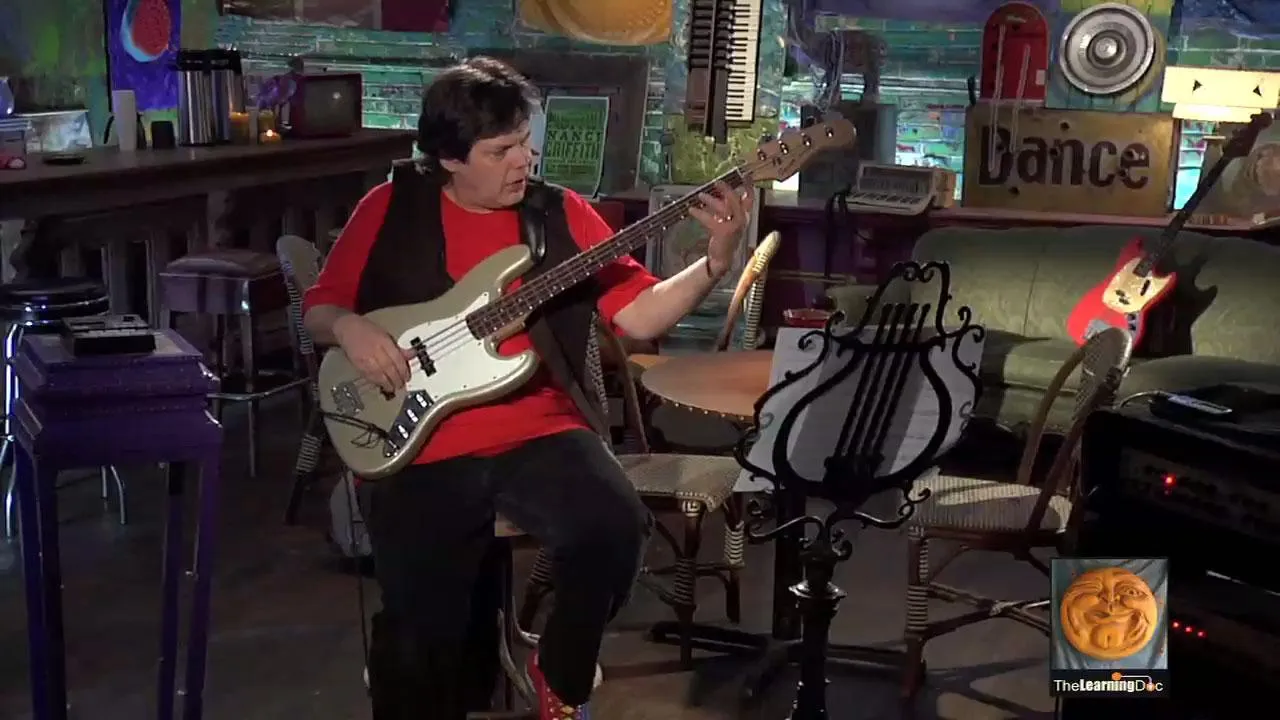
Roy Vogts Karriere umspannt eine außergewöhnliche Bandbreite an Bühnen, von MTVs Headbanger's Ball, dem Montreux Jazz Festival und dem Montreal Jazz Festival bis zum London Palladium, der Grand Ole Opry und dem Kreml. Von Punk bis Funk, von der Schlichtheit von Country und Blues bis zur Komplexität von HyperJazz und World Beat - er hat alles gespielt. Roy war der erste Mensch, der an der renommierten Musikhochschule der University of Miami einen Master in E-Bass-Performance erwarb, und er widmet sich seit über vierzig Jahren der Kunst des Basses. Er war Mentor Dutzender erfolgreicher Profis, darunter der legendäre Willie Weeks. Elektrisch, bundlos, Kontrabass - was auch immer: Wenn es tiefe Töne spielt und Saiten hat, ist Roy ein Meister darin, es zu spielen und anderen beizubringen, dasselbe zu tun. Im Laufe seiner vier Jahrzehnte währenden Karriere hat Roy mit einer erstaunlichen Liste von Topstars aufgenommen oder gespielt, darunter Larry Coryell, Victor Wooten, Dave Weckl, Tom Scott und der LA Express, Chester Thompson, Miroslav Vitous, Glen Campbell, BJ Thomas, Chet Atkins, Engelbert Humperdinck, Dickey Betts, Tony Joe White, Charlie Daniels, Jerry Reed und viele Dutzend mehr. Roy unterrichtet seit dreißig Jahren auf Hochschulniveau. Seit 1983 hat er den Lehrstuhl für Bass an der renommierten Belmont University (Nashville, TN) inne, einer der ganz wenigen Hochschulen, die einen Studiengang in kommerzieller Musik anbieten, der darauf ausgelegt ist, Studierende zu professionellen Musikern an der Spitze der Branche zu machen. Roys Studenten sind mit namhaften Stars wie Trisha Yearwood, Faith Hill, Little Texas, Michael W. Smith, Lady Antebellum, Chick Corea, Sir Tom Jones, Blood Sweat and Tears, Yanni und unzähligen weiteren Musikikonen getourt und haben mit ihnen aufgenommen. Seine Serie Teach Me Bass Guitar bringt dir genau diesen Ansatz auf Hochschulniveau nahe und führt dich vom Schnellstart für absolute Anfänger (Vol. 1) über Rhythmusgrundlagen (Vol. 2), das Finden deines eigenen Stils (Vol. 3) und ernsthafte Musikalität (Vol. 4) bis hin zu einem Werkzeugkasten für Profispieler (Vol. 5), damit du Schritt für Schritt echte Fähigkeiten aufbaust. read more