



Groove Etude (Lektion)
Mit
David Cullen
Das steckt im Kurs
14 Lektionen (1h 37m) · 1 gratis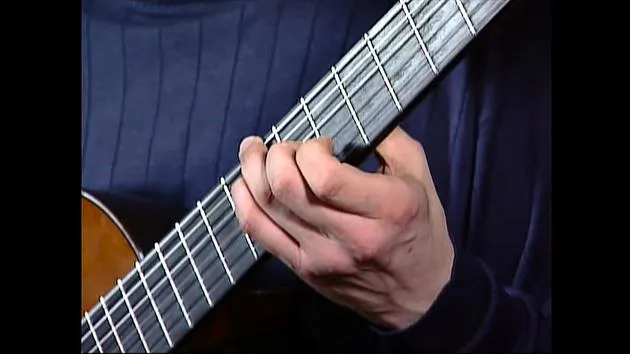
01. Blue Counterpoint (Performance)
Gratis-Lektion4:09
02. Blue Counterpoint (Lektion)
9:44
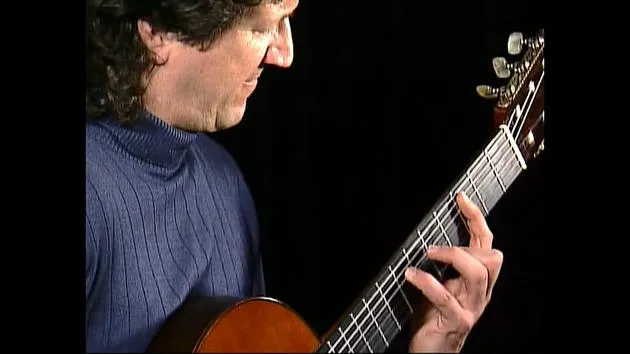
03. Indigo Blue (Performance)
4:32
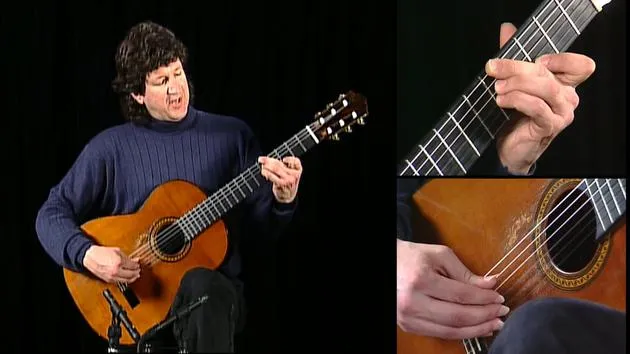
04. Indigo Blue (Lektion)
10:56
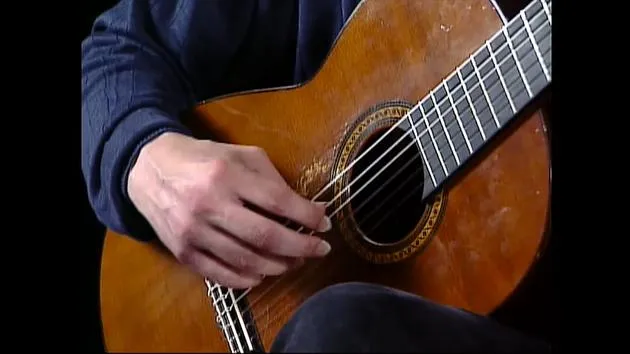
05. Groove Etude (Interpretation)
4:09
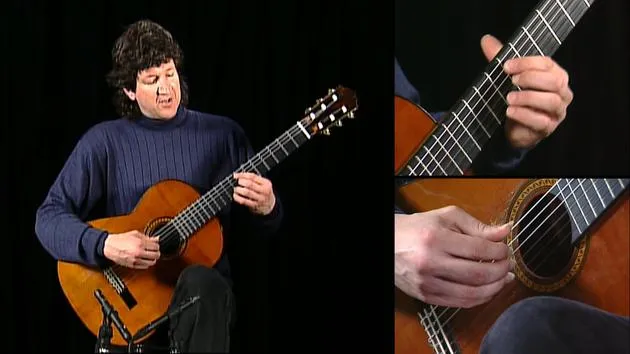
06. Groove Etude (Lektion)
Du bist hier9:20
07. Midari (Performance)
4:50
08. Midari (Lektion)
10:09
09. Bahama Beach (Aufführung)
5:14
10. Bahama Beach (Lektion)
9:47
11. Go Ahead And Play (Interpretation)
4:22
12. Go Ahead And Play (Lektion)
10:10
13. BONUS: Coming Home (Performance)
4:14
14. BONUS: Ebb And Flow (Interpretation)
5:44
Transkript der Lektion
Groove Etude Lesson
Introduction
The next tune up is a fun tune to play. It's called the Groove Etude.
You know, being a classical guitarist, I've played many etudes. I played the Villalobos etudes and a lot of different ones, but I never played a groove etude. So, I thought I'd go ahead and write one to work on my groove. This piece is kind of in that hip hop, jazzy vein, so keep that in mind.
Key Concepts:
- Swinging Eighth Notes: Think about counting like this:
- 1 and 2 and 3 and 4 and
- 1 and 2 and 3 and 4 of
- 1 and 2 and 3.
Let's bring in the introduction:
- One and two and three.
- Two and three.
- Two and three.
- One and two and three.
Once again, that sets up the groove. Let's hear that more at the real performance tempo:
Count-In:
- A 1, 2, 1, 2, 3.
Playing Without the Click
Now that we've done it with the click, let's try it without. I want to hear you really have that groove inside of you.
Count-In:
- A one, a two, a one, two, three, two.
There you go! It's kind of fun to do. Just keep that groove going.
The Verse
Alright, that leads us to our verse. The verse is kind of an old blues lick that we've all heard, paired with some chords. Let's hear that now, grooving at a slower tempo and then a bit faster.
Note on Expression: You must be thinking, "Wow, he's doing that on a classical guitar." All that slipping and sliding around, and shaking the notes, it's just expression.
Make sure you give it a nice slide out there. It's okay to put a little bit of that in, definitely a little blues on the classical guitar.
Chord Progression
That leads us to a succession of chords that we're going to play:
- A minor 11
- D7
- F13
- E7
We're going to keep it really grooving, let's hear that.
Descending Chords
Next, we'll explore a section I call the descending chords. This will take a little time to explain, but it's worth it to see what a little movement on the guitar can create.
- Play a D and an A at the 10th fret.
- At the 9th fret on the G string, play an E.
- With your first finger on the 9th fret, play an F sharp.
This gives us a D add9 chord with F sharp in the bass. It sounds complicated, but you can check out the book and the video, it's all right there.
Descending Movement:
- Move down 1, 2, and 3: This creates an F minor 13th chord from the D with F sharp to an F minor 13th.
Then we're going to move down and do the same thing on C:
- C with E in the bass
- to an E flat minor 13th chord.
Then we'll take it down to A:
- A with C sharp in the bass
- down to a C minor 13th chord,
- down to G with B in the bass,
- and then up to an E7 sharp nine chord.
Let's hear that whole succession of chords nice and slow with the click so you can hear where I'm placing some of those off beats.
Slow Version:
- Ready, go.
-
Now, let's speed it up a bit.
The Tricky Riff
Now, there's a tricky riff I should talk about in this tune. It's a fun thing to play once you get it under your fingers.
While I'm jamming out on this A minor 6 chord, check out this little riff:
- Low E, hammer to a C,
- up to an A, slide that down to F sharp,
- play a D, pull that off,
- go down to low F sharp and then come back up to A.
I'll do it fast one time so you can hear what I'm talking about.
Fast Performance:
- Yeah.
Now, let's do it slow again so you can really see what's going on:
- E, C.
Now, let's hear it in time:
- Yeah.
So, work on that riff. It's a lot of fun to play!
Final Tips
Also, I want to say this tune is the Groove Etude, and we want to groove. If you feel like adding your own improvisation at the end, please do!
As long as you're grooving and playing an A minor 6 chord, you can play anything in G major over that, and it will sound good. When you take the tune out, take it out nice and strong with the chords.
14 Lektionen
1 Std. 37 Min. strukturierte Videolektionen
Erweiterte Videofunktionen
Verlangsamen, Passagen loopen, mitlesen
Handy, Tablet & Desktop
Üben, wo du willst
100 % Zufriedenheitsgarantie
30 Tage Geld-zurück-Garantie
Lern deinen Guru kennen
Lern deinen Guru kennen
David Cullen ist Gewinner eines Grammy Awards für die beste instrumentale Pop-Aufnahme. Er ist mit Will Ackerman, Samite, Michael Manring, Victor Wooten und dem Philly Pops Orchestra aufgetreten und erwarb seinen Bachelor of Music in klassischer Gitarre an der Hartt School of Music.
Als Meister der akustischen Solo-Fingerstyle-Gitarre bewegt sich David mühelos zwischen klassischer Technik, Jazzharmonik und Improvisation sowie eigenen Originalkompositionen. Er ist in ganz Nordamerika für Klassikgitarren-Gesellschaften, Jazzfestivals und Kulturreihen aufgetreten, hat 10 CDs beim Akustikgitarren-Label Solid Air Records veröffentlicht, und seine Aufnahmen liefen auf NPR-Sendern in ganz Amerika.
Zu seiner Studioarbeit zählen der Windham Hill Guitar Sampler und weitere Windham-Hill-Kompilationen. David hat außerdem zwei Bücher bei Warner Brothers Publications veröffentlicht: "Jazz, Classical, and Beyond" und "Grateful Guitar".







