



Artikulation
Mit
Mike Lovatt
Das steckt im Kurs
29 Lektionen (1h 2m) · 1 gratis
01. Slinky - Einführung und Aufführung
1:38
02. Artikulation
Du bist hier5:21
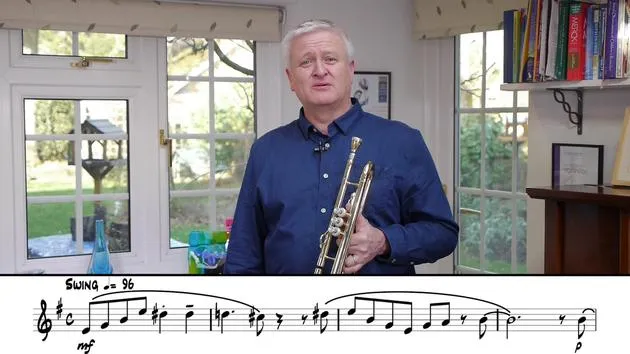
03. Lange und kurze Noten
1:44
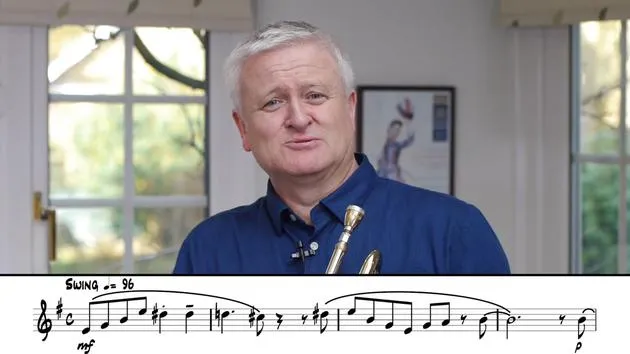
04. Die Zungentechnik
3:12
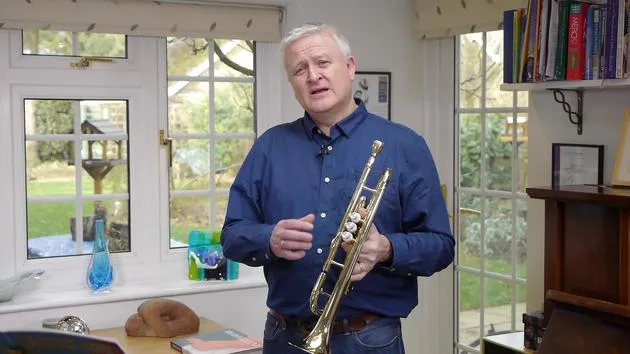
05. Ventiltechnik
1:13
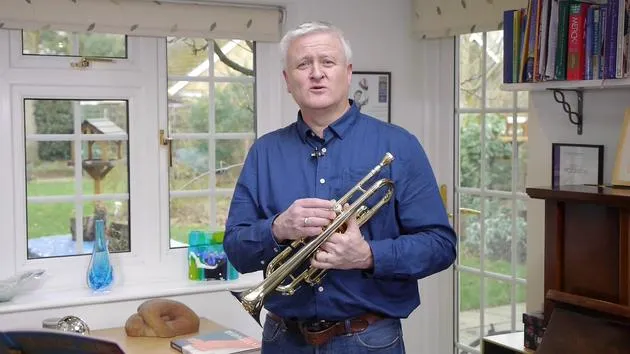
06. Vibrato
4:19
07. Zusammenfassung
0:53
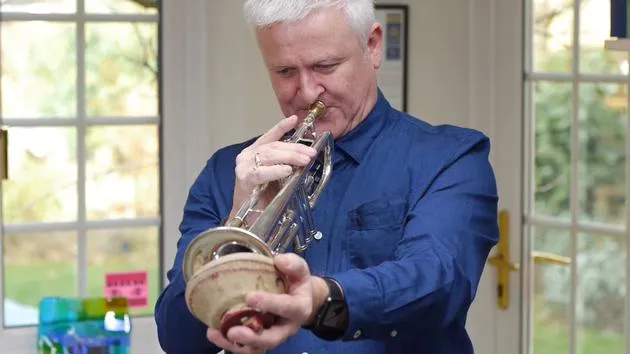
08. Performance mit Dämpfer
1:05
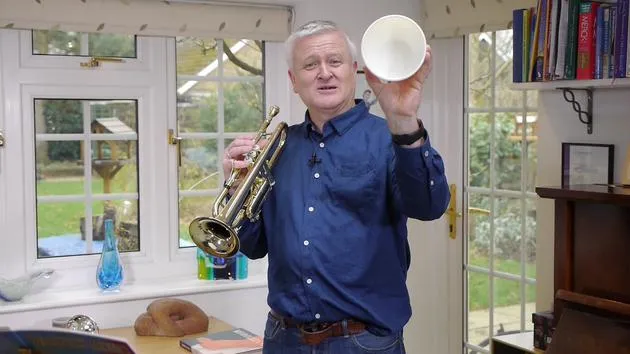
09. Wie man einen Plunger-Dämpfer benutzt
2:39
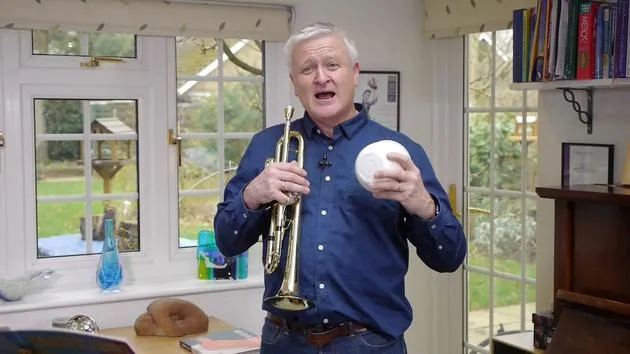
10. Challenge (mit Plunger-Dämpfer)
0:49
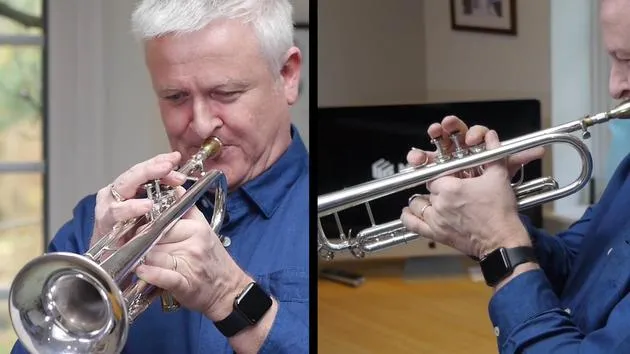
01. Transposition Blues - Einführung und Vortrag
2:05
02. Struktur
1:51
03. Sich reinknien
2:22
04. Note-Bending
2:40
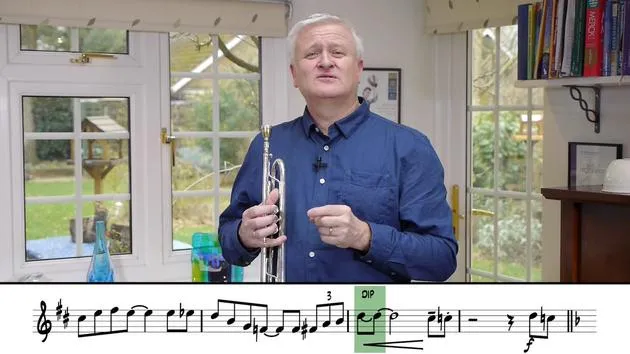
05. Dynamik
3:00
06. Zweiter Abschnitt, im Stil von Louis Armstrong
2:01
07. Shakes
5:03
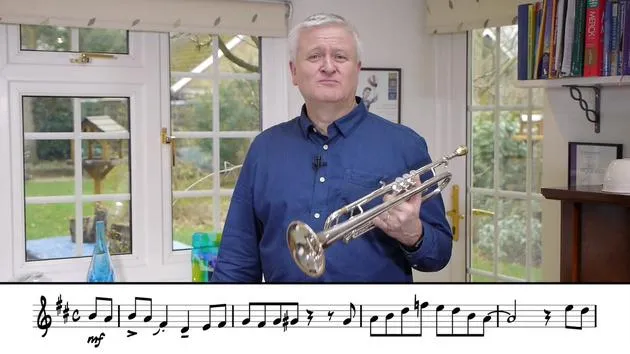
08. Scoops
2:35
09. Klang, Stil und Vibrato
3:00
10. Zusammenfassung
1:16
11. Challenge (Louis-Armstrong-Stil)
0:39
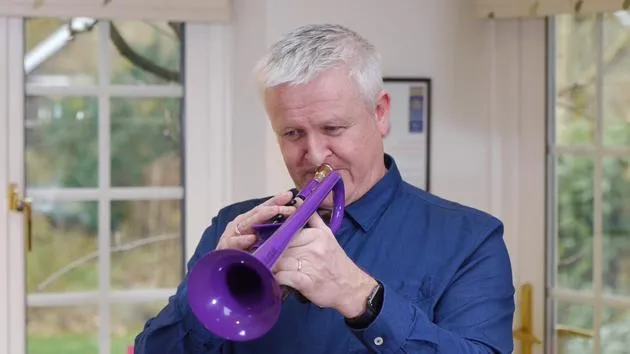
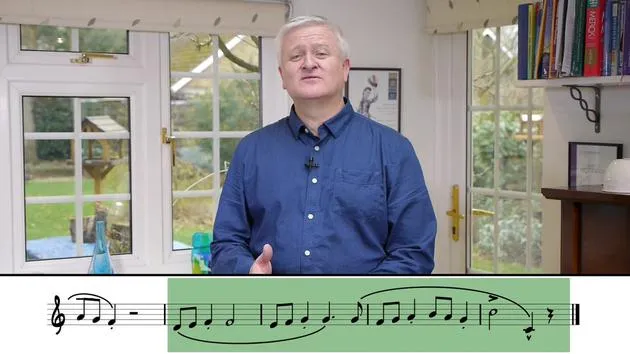
Transkript der Lektion
Music Lesson: Developing Swing Quavers
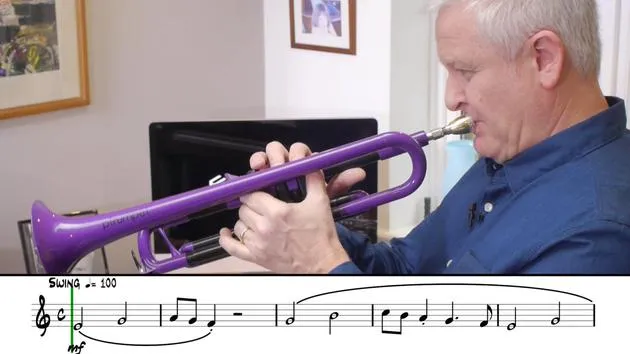
In our lesson on a small step, we learned how quavers, when swung, need to be played in a triplet fashion. So in this piece, we're going to try and develop that further and use articulation to help the swing quavers.
Listening Exercise
Listen to me play swing quavers halfway through this piece:
De de de de de de de de de de de de de de de.
Listen to the last phrase in the piece.
Can you hear me there?
I'm accenting notes:
Be dee da badida badooda.
You'll notice that the second quaver is not marked short, but I made the decision to make it short to help create that swing feel.
Accenting Notes
I'll play the section at the end now and see if you can hear me using accents there.
On the running quavers:
You can hear me using the accents there to keep time and make it swing:
Badabo do bo deedee.
See if you can copy me.
Using the Tongue for Articulation
Great! We need to use the tongue as well in order to create those accents. See if you can hear me using that.
I'm not just playing legato.
I'm accenting using my tongue. Use a D sound:
Di dee doo doo doo doo doo doo doo.
That kind of technique will make it swing more. It will provide more articulation and help the music "talk" more. This will assist us on our journey.
So, I'm rearticulating the notes, even though they sound as though they're joined together.
Accenting the First Phrase
I'm now going to play the first phrase in the piece, and I want you to see if you can hear which notes I'm accenting.
Can you hear when I reach the top of the phrase?
Booba doo bada.
Again, I'm using the D sound to help get that accent. I accent that last quaver to enhance the swing feel, as it's the last note of the triplet.
Triplets help to keep an ongoing feel in rock and roll music.
Music is very much on the beat, a static beat, whereas in swing music, it's an ongoing thing. When we hear swing, we perceive the ride on the cymbal. You hear the drummer, and we get an ongoing feeling. It makes us want to dance, it's swing music!
Copying the Phrase
I'll play that phrase again, and you can copy it.
Exploring the Second Phrase
I'm now going to play the second phrase in the piece to show you further the accents that I apply on different beats and placements.
I'm over-accenting the notes.
Hopefully, you can hear the strong beats that I'm trying to emphasize:
- The first beat of one bar
- The third beat of one bar
At the end of that phrase, there's what we call a push into that long note. A push there is on a quaver triplet, which is the last quaver of the triplet.
So we go:
da, da, da, da, da, da, da, da, da, da, da, da, da, da, triplets.
And that's how we get that feel. It helps the music swing and travel.
Final Thoughts
Now that we've accented notes, does this sound better? Does it make it sound more swingy?
You have a go accenting different notes and see if it starts to sound really swingy.
Listen back to yourself.
29 Lektionen
1 Std. 2 Min. strukturierte Videolektionen
Erweiterte Videofunktionen
Verlangsamen, Passagen loopen, mitlesen
Handy, Tablet & Desktop
Üben, wo du willst
100 % Zufriedenheitsgarantie
30 Tage Geld-zurück-Garantie
Lern deinen Guru kennen
Lern deinen Guru kennen
Mike Lovatt studierte am Trinity College of Music, wo ihm die Jon Kelly Jazz Scholarship verliehen wurde. Er ist in einer enormen Bandbreite von Stilen mit Künstlern wie Quincy Jones, Robbie Williams, Eric Clapton, dem Orchestra of the Royal Opera House Covent Garden, dem Royal Philharmonic Orchestra, Michael Buble, Oasis, Michel Legrand, Tony Bennett, Shirley Bassey und Danny Elfman und vielen anderen aufgetreten und hat mit ihnen aufgenommen.
Als Solotrompeter im Londoner West End hat Mike unter anderem in Jesus Christ Superstar, Evita, The Producers, Billy Elliot, Guys and Dolls, Saturday Night Fever, My Fair Lady und Spamalot mitgewirkt. Er hat auf Filmmusiken gespielt, darunter die James-Bond-Filme, Harry Potter mit dem London Symphony Orchestra, das preisgekrönte Chicago, Kevin Spaceys Beyond the Sea, Charlie and the Chocolate Factory, Madagascar und The Corpse Bride. In George Fentons Mrs Henderson Presents ist er an Trompete und Kornett und in Looking for Eric an der Trompete zu hören.
Mike ist Solotrompeter des Grammy-nominierten John Wilson Orchestra und war in dessen gefeierten BBC-Promenade-Konzerten und -Aufnahmen zu erleben.
Mike ist als Lehrer und Clinician sehr gefragt und Professor für Trompete an der Royal Academy of Music und am Royal College of Music. Im April 2013 wurde ihm mit Stolz der renommierte Derek Watkins' Chair of Trumpet an der Royal Academy of Music in London verliehen.
In seinen MusicGurus-Kursen teilt Mike die Geheimnisse seiner Vielseitigkeit und zeigt dir, wie du authentische Trompetenstile in Swing, Rock und Latin triffst, sodass du jeden von ihnen mit Selbstvertrauen und dem richtigen Feel spielen kannst.







