



Die-Zauberflöte-Analyse

Lesson time: (20min 58sec)
Course preview
This lesson is part of the course Mozart singen: Arien aus Figaro, Così und Die Zauberflöte
Watch a preview of the full course below.
Lesson transcript:
Music Lesson with Tamino
Tamino: Yes. Singing about love for a change.
Instructor: Okay, start. All your consonants have to be supported and not coming from under. You are a master of bringing them from under. So now we're going to change it and you're going to bring them to the right place.
Starting Notes
- This is a long note. Use it.
- This is long. B on the high note.
- Okay, so let's start. We have to correct it again.
Consonant Clarity
- You're doing a little bit D.
- You're a bit in the nose.
- I need you to open up; do not be in the nose, be in the ribs.
- I have to say this.
Instructor: Okay? Yeah, you can start. Yeah, that's it.
Improvements Noted
- Much better. B.
- Don't close your mouth for the L.
- The no-closed diphthong, but sound.
- So you have to be aware the OO comes very late.
Instructor: Okay, again. But the B was much better.
Practice Recommendations
- You have to practice at home.
- That's your practice.
Instructor: Okay, this business is that Sal. Wie No Beautiful. Almost wie noch. Versailut was very good.
Technical Adjustments
-
Unfortunately, you have a K.
-
This is German. We have to hear every consonant.
-
But you don't stop the air on the consonant; you sing through the consonants.
-
Yeah, but the bilabial was wonderful and the intonation was very good.
Vocal Techniques
- So, when I help you, it's fantastic, but not if it comes from under.
- Why is the V very good? Because it makes the sound very concentrated.
Instructor: So feel me. I can sing or I can sing. Did you feel the ribs?
- You do the V on the ribs. You can do it better.
- More sound, not more sound here.
- More sound here.
- Less air. If you can.
Instructor: Okay, a little bit more. Okay. Minor. It's much better.
Breath Support
-
You are now on the breath because of the V.
-
Every time you have V, R, they help you to be on the breath.
-
You had a little bit of shadow vowel. It's a diphthong.
Note Timing
Instructor: Mine again. So the E very late. Sing on the A.
- Minor. Minor.
- Okay, Minor.
- Even later. The E even later.
- Trust it. You will not be late.
Instructor: Okay. Mine house is my ring over here. Minor has his.
Practicing Phonetics
Instructor: Okay, let's do it again. It's much better.
-
But the second mein also, don't close.
-
For the T and the N, don't close your mouth.
-
Mit noen regun. There is no reason to close the mouth at all in this sentence.
-
Because N, T, and M you can do with the space open.
Instructor: Yeah. Okay.
Emotional Expression
- So all of again, mine held mine.
- The long note, you're parking.
- You are in parking position.
Instructor: You're singing about your heart, and your heart, I hope, doesn't park.
Discussing Note Thoughts
Instructor: What do you want to think in these notes?
- Because we need to talk about it.
- It's difficult. They're long notes.
- What are you thinking? What are you thinking of doing? Or are you not thinking?
Student: Well, in terms of the technically...
Technical Discussions
- Pushing as much air through as possible, keeping it spinning and moving towards the next bar.
- Basically. Great. But not pushing.
Instructor: Not pushing, but you're getting.
Encouragement and Corrections
Instructor: Super. This was much better.
-
Okay, I help you filt.
-
You have t at the end.
-
T is wonderful because it releases your diaphragm.
-
So do it bew. Do it with consciously.
-
It was much better because your heart suddenly we heard something.
High Notes Technique
Instructor: And that can be on the tone because you're a little bit... yeah, on the tone.
- Very nice, very nice.
- Okay. These high notes.
Instructor: Just don't push on it. Allow it to travel.
- Just trust it.
- Because you are really in a great position for the heads.
- And then suddenly I feel you pushing it up.
Releasing Tension
Instructor: No reason. Just release the diaphragm in between.
- Let's see.
- Release the tone.
- When I say "release the tone," I mean sometimes singers just... they get the note, and they're so happy, so they hold the air on it.
Sharing the Music
Instructor: No, share it with us. Don't hold anything for yourself.
- You can buy some meat.
- And don't think forte there. Not at all forte.
- Not at all. If anything, less.
Addressing Issues
Instructor: Super. Sorry, what was wrong?
- It was... it came from below.
- Yes, it came from below, you know?
Insight on the Sound
Instructor: Yeah.
- No, you're in. You're in the throat.
- You're not on the breast.
- Do here. Okay. And release the air you're holding a little bit.
Breathing Technique
Instructor: Yes. Okay. Have the space open before.
- Have the space open. Great.
- But now don't push the sound.
- The space is there.
- Your space is there.
Encouraging Focus
Instructor: Don't push the sound. Trust it.
- Do the quite forward near the T. Okay.
- The K is not quite. It's hard.
- You have to be like a violin, and the ribs have to be open.
- So you don't start on the note; you start really before.
Breathing and Reading
Instructor: Give us like two bars or something like this.
-
Breathe.
-
And no finish.
-
Okay. Not bad.
-
And then you read it to me.
Instructor: Okay, or whatever.
Reflecting on Lyrics
Instructor: I don't know where I am, but...
Student: Okay, you're asking a question.
- Sol die empfindung liebe sein. Is this love?
- Can it be love?
- I want to feel it.
Ending with Air
Instructor: At the end, you need to send it to the air.
- Leave your mouth open.
Instructor: Can I insist a little longer on these two?
- Yeah, please do it again because you are pushing the sound a little bit.
- And you're not quite on the breath.
- Do it again.
Final Adjustments
Instructor: You have to support your consonants.
- They have to be here.
- Not support them in the mouth.
- Support them with the breath.
Instructor: Okay, try again. Space first. Space. Great, great.
- So you're just lazy. You can do it.
- It was really great.
- Wasn't it better?
- I think it was much better.
Emphasizing Tone Quality
- It's such a beautiful sound coming out without nothing in the nose.
- Everything is in the body.
Instructor: Okay. Support your consonants.
- Here, the Z up, not from below.
- You want to start from there or you want to start...
- But please, you sing about love.
Emotion and Technique
Instructor: Yeah. Be a bit more in love.
- Okay. It's too forward and it's not in the breath.
- No pushing.
Instructor: Okay. Be on the breath.
Merging Resonance
Instructor: You tend to push a little bit the sound forward in the face because it gives you a good feeling, because you have a lot of resonance.
- But it doesn't sound so nice out here.
- So, and it's so amazing when it's in your body.
Instructor: When it's in the body, when it's here, then we hear the whole color of your voice, not just the front but also...
Balance and Diction
Instructor: I need a mix of the front and the back.
- Don't open your mouth too much.
- Can you sing? It's German. We have to hear that.
Final Thoughts
-
It's not so high in the register.
-
You can do.
-
Start from there.
-
It's a bit. It's a closed O in German.
-
On the breath, it's much better because you see the consonants, they give color to your singing.
-
If you sing...
-
No, the V, the... this is the color of the German language.
Instructor: We have to hear it. It was really much better.
- Okay, and caress it with the breath.
- Caress it with the breath.
Crescendo Guidance
Instructor: Okay. It was not bad before, but the high notes...
- I know that it's here written crescendo.
- Don't think about crescendo because you're going up.
- It's going to crescendo by itself.
Musical Interpretation
Instructor: So on the contrary, because you're singing two lines, musically the same, but the words are different.
- I want to hear a difference in the way you say it.
Instructor: Okay, so we're going back to that.
- And your I.
- It's a bit too close with I.
- And it's not. I.
Feeling the Doubt
Instructor: Okay, so you can start.
-
And you're asking a question.
-
I need to feel a little bit.
-
You're a little bit in doubt and you're asking the world, what am I going to do when I find her?
-
You sound very secure to me.
Instructor: Okay, so war und rein.
- Again, the V was really not up there.
- Because why? Because you don't have the space.
Final Breathing Exercises
Instructor: Okay. You sing.
- Open. Open your ribs before.
- Okay. Breath.
- My warm breast.
Instructor: Breast. Okay. And not in heissen boozen.
Performance Confidence
Instructor: Fallen sicken.
- Undies and eyes and vision.
- Yes. One day.
- One day. I want at least a little bit of T.
Instructor: Okay. Super. This was so nice.
- And then you pushed it.
- Don't push. It was so nice.
- Start from there.
Instructor: I know he wrote forte. Ignore it.
- Because I don't know even if this is the right addition.
- Okay, and believe me, the G. We will hear you.
- Tenors, we hear them.
- Okay, you are parking.
- Yeah, I know. Sorry.
Encouragement to Reflect
Instructor: Okay, think, think.
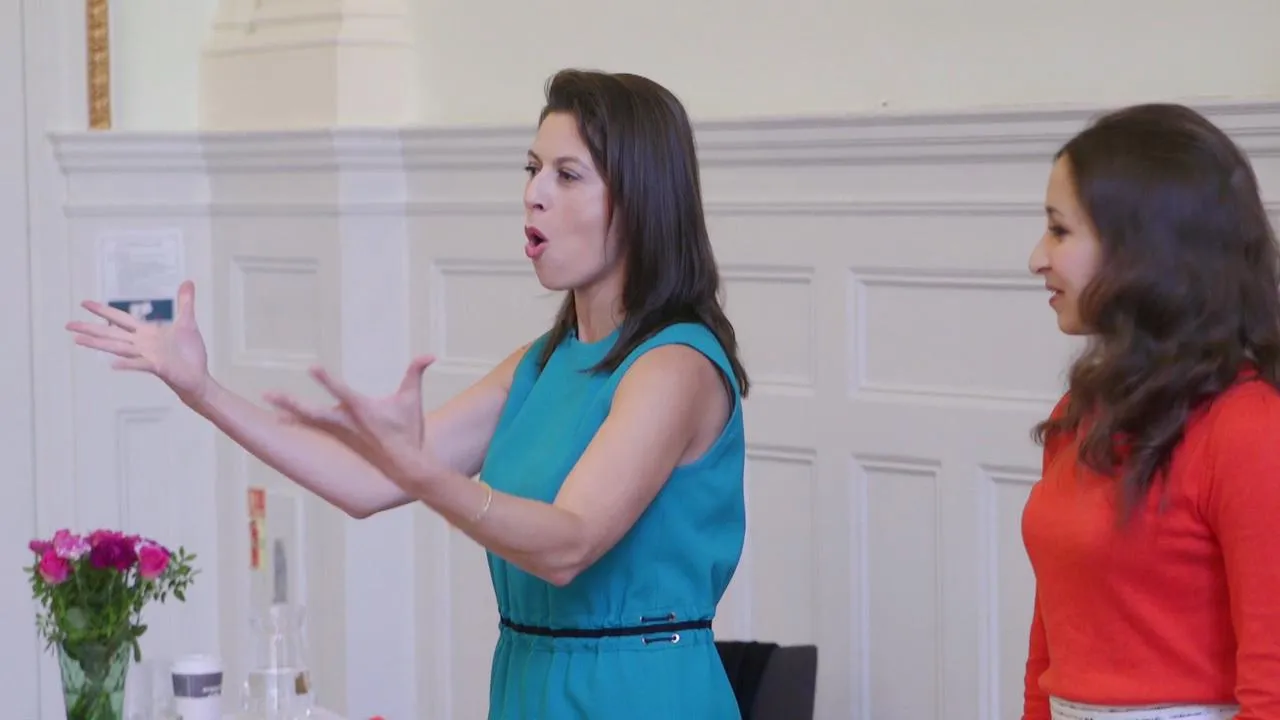
About the instructor
Die israelische Sopranistin Chen Reiss hat Hauptrollen auf vielen der großen Opernbühnen der Welt gesungen, darunter: Wiener Staatsoper Bayerische Staatsoper Théâtre des Champs-Élysées Teatro alla Scala Semperoper Dresden Deutsche Oper Berlin Hamburgische Staatsoper Wiener Festwochen Maggio Musicale Fiorentino Opera Company of Philadelphia The Israeli Opera Zu ihrem Opernrepertoire gehören unter anderem Pamina, Adina, Gilda, Nannetta, Oscar, Rosina, Servilia, Blonde, Susanna, Zerlina, Despina, Euridice, Marie (La Fille du régiment), Sophie (Der Rosenkavalier) und Adele. Auf ihrem jüngsten Album "Die Nachtigall und die Rose" präsentiert sie gemeinsam mit dem renommierten Pianisten Charles Spencer ein romantisches Programm. Im Konzert war sie in Salzburg, Luzern, im Wiener Musikverein, in Berlin, Leipzig und München zu erleben. Ihr Debüt an der Wiener Staatsoper gab sie 2009 als Sophie und sang dort seither Rollen wie Pamina, Elvira, Waldvogel, Adina, Servilia, Ilia, Xenia und Füchslein Schlaukopf. read more