



Idomeneo-Analyse

Lesson time: (26min 49sec)
Course preview
This lesson is part of the course Mozart singen: Arien aus Figaro, Così und Die Zauberflöte
Watch a preview of the full course below.
Lesson transcript:
Music Lesson
Instructor: Great, great. So you are Ilya. And what are you? Where are you? What happened to you?
Student: So I have been shipwrecked and rescued by the enemy, by Prince Idamante, who is the son of the king who's just defeated my father, who is now dead. So my people have been taken. They're taken prisoner. I'm taken prisoner. My father's dead and I'm now on the soil of the country that's taken my country.
Instructor: So she's, against her better judgment, fallen sort of instantly for Idamante and his kindness and how he rescued her. She owes him her life, but he's the enemy. So she's got a lot of conflicting emotions.
Student: Yes, definitely a lot of guilt feelings.
Instructor: Yeah, yeah. Because Idomeneo, the king of Greece, not only defeated your father, he actually murdered your father and your brothers. You saw it with your own eyes.
The Recitativo
In the recitativo, before this there is a recit, which is very, very important, but it's very long, so we cannot perform it today. But it's actually: she tells the story of her life. She is a Trojan princess and saw almost all her people die in front of her eyes. She really describes the blood.
So she is tormented. She obviously hates Idomeneo, who killed her father in front of her eyes. But you are very much in love with Idamante. It was love at first sight the minute he saved you from the storm.
The Emotional Conflict
Okay, so there is not a calm moment in this area. The orchestra, when you sing it with the orchestra, is easier. It's not easy to perform with piano because the orchestra actually gives you a lot of energy.
Instructor: So let's start. It's really great. I can give you a few tips. The beginning of sentences, especially to help you set the sound.
- You're going to sail. Okay? You can help her.
- I need you more in the drama.
- In German, you need to have the space before.
Questions to Consider:
- What is the D?
- It's not "think D," but "J D G."
You don't open on the sound, you open before the sound. Breathe and let everything open.
Instructor: Yeah. Padre. Germany. And Padre. Germany. Addio is one sentence, you know?
- Padre. Relax.
- Germany. No. Father's Day. Jesus.
The Haunting Imagery
Instructor: Okay. Think to yourself. They are ghosts. They haunt you. They are there. You are the only one who can see them. You see your father, you see your brother, but they are not alive. You know, they are dead. But what's going on? How can I see them? You are completely crazy. Insane.
Instructor: Okay, breathe. Very important. Much better.
- Use the V; it has to be on the note.
- It will send your sound out again for the D.
- Don't close your mouth; it's only the tongue.
- Double D with the tongue. Use the tip of the tongue.
Vocal Techniques
Instructor: Okay. Because it's too heavy.
- Long E at the end.
- It's a diphthong, two vowels that have a different sound on the same note.
- The second one has to happen late.
Okay? D in German, full of them.
Instructor: So English has some words like this, okay? But EOV, not eo, E O V per de O at the end.
Instructor: You can start wherever. Breathe. You are not ready.
Instructor: Okay. When you drive, you have to enter the car, put the key in, turn it on, push, then start driving.
- You start driving and the engine is not on.
- So the engine is the breath.
This has to be.
Instructor: And see them. He is playing. You see the ghost.
- He makes you, super.
- Yes. Long. Sorry.
Instructor: Okay, no problem. Sing for me: "Recha," not "grecha."
- "Recha" on the top note.
- Now, "grecha."
- Don't let the G stop the sound. Fast, very fast. G. Go to the R.
Instructor: Okay? Graco again, don't get stuck on the G. And also, the orchestra is doing this for Sano. We don't do it with a voice.
Instructor: Do it with a breath. Not on the vocal cords.
- You are not a violin.
- You cannot do that.
You have a whole opera to sing. It's the first aria; it's a long opera. The first aria will help you, but not on the voice.
Final Feedback
Instructor: Okay, help yourselves. Up to now, great. There were all six teams, right? This one is an eight.
- Take the time because it will help you set the top note.
- Help yourself; it's beautiful.
All the D's, D and R, don't close them up. The tone before the high note, release it.
Instructor: Okay? And it's, a very expressive interval.
- This interval has to be very expressive.
- It doesn't come very often.
Instructor: Enjoy it. Yes. Let me help you. It starts with D.
- Okay. Space first.
- Yeah. You have to be there.
- It's not an easy tone; it's an F.
You're in your passaggio.
Instructor: Okay? You have to be so much on the breath, and then you'll sail.
- Space between the teeth.
- Okay? Breathe.
- Yes.
Instructor: Do you have space between your teeth? And now just.
- That's it. That's what I want.
- Without space between the teeth, only the tongue moves for the D.
Instructor: Okay? Not bad. It's really good.
- "Avrae," get out of it.
- You are holding it a little bit.
This 'ma' is very important, okay? This is the turning point of the aria because suddenly you start talking about Idamante.
- Up to now, it was about the blood, about seeing your father.
- But this is, oh, my God.
It's like you saw the ghost and suddenly you see Idamante, so it's a completely different sound.
Building to the High Note
Instructor: Now you have a big jump here; you have an octave.
- So this 'ma' cannot be too low, okay?
- Basically, think already of the high note.
So you're singing the high note before the low note.
Instructor: In your head, you're going to eat and get away. It's a big surprise.
- I need your breath.
- It's good, but it can be better because your breath can be even more exciting.
Okay?
- Yeah. It goes even higher.
Allow the sound to turn for the high note and it's going to repeat.
Conclusion
Instructor: I'm going to fast forward because this repeats 10 times.
- The first time, try molto legato.
- Very much legato.
- And the second time you will do the articulation.
The second time that you do it, you can do, you see the difference?
Instructor: Okay, but the first time it's better to do legato because it's the beginning of the aria and we want you on the breath.
Final Performance
Instructor: Okay? So let's start from the "ingrata."
- Okay, give her, beautiful.
- Okay, great. Really beautiful.
And you know what it did for you that you didn't sing? You sang beautifully.
- Okay?
- You can enjoy this.
To hate.
Instructor: Yeah, but you're so helpless. You cannot hate him.
Adjustments and Interpretations
Instructor: Okay, really exaggerate the second note.
- Really away.
- Okay, support it, but less sound.
Instructor: So where do you mark where you want to start?
There. Okay, sorry, sorry, the end.
- D, not aspirated.
- Day. Italian, not day.
Polish Your Performance
Instructor: It's a little bit English or American. And it's,
Student: Day.
Instructor: It's Italian, okay?
Instructor: Really great.
- "O Dior." Another D, not "O, dear." Oh dear.
Instructor: Okay, sorry, right?
- It's a little bit long.
- Okay. Do you want to play for us once?
Student: Yes.
Instructor: You know, you are too good. I have to correct you. You are too fast.
- Yeah, you have to wait until he finishes.
- Yum. Pam, pam. Three.
Okay?
Instructor: Yeah, sorry, we have to correct it. Sorry. Play for us.
Call to Action
Instructor: Okay, look.
- Okay, let's try.
- Super.
Because you are so helpless, you don't have to repeat.
Instructor: If you want, you can repeat. If not, you can start forever.
Let's start from the beginning.
- It's fine.
- Brave girl. Super.
Instructor: Okay, good.
- You are in the emotion, but your breath is not,
- It's not so.
Instructor: Because you drop it before.
Whatever. How is it?
Instructor: Can you give me the toll?
You have to stay. You have to keep the energy up.
Instructor: Okay, let's go from non-stop.
- That's okay.
- Tone.
It wasn't open enough.
Clarity and Emotion
Instructor: Okay.
- You can tell "Padre, Germany" or "the sea."
- You can do better.
Instructor: Really, I want to hear sound on this R.
- Not "yes," okay, dummy.
- Sorry. Yes.
Instructor: And what do you feel when you sing "Grecha?"
Student: I think,
Instructor: I feel, are you accusing someone?
Student: I think the first one I am. And the second one I'm more kind of unsure that I come. I'm in this strange place.
Instructor: I want to hear. Because she says, "Grecha Cajon," to say you are the reason, Greeks Greece. You are the reason. So I want to hear it.
It's not "Grecia Gretcha."
Instructor: No. It's so loaded with meaning.
Instructor: Always. The C sharp is a bit under. So do it again.
Can you play for us?
The Emotional Connection
Student: Yeah.
Instructor: Okay.
- So painful, I am ungrateful to my own people, to my own blood.
- This is the guilt feelings.
I want to hear how it's really digging into you.
Instructor: Okay. It's a bit too thick.
- Yeah, and you're coming down.
- It's a bit too thick.
Okay.
- And start with the space open.
- Don't open on the D.
Your ribs have to be open.
Instructor: Yeah. It's a bit too fast, this tone.
Instructor: Okay? It's better, but it's not completely there. The C sharp, especially when you sing "Sangui."
- Put the S on the C sharp.
- Okay, "Grata."
You don't have to close your mouth.
The High Notes
Instructor: And a lot of emotion being, being here.
Instructor: It's gonna work to be in your guts.
Okay?
- You can double D, but not no air.
- You can do it piano pianissimo if you want.
Instructor: Okay, first one. Don't worry; everybody makes this mistake. I made it on stage, so don't worry.
Okay, we go on.
- No aspirated D.
- And the intonation is not perfect.
It's the same tone.
- Okay?
- It's the same tone, but the harmony underneath is different.
Can you play for us the harmonies?
Understanding Intonation
Instructor: Sometimes you have the same tone but the harmony changes, so you need to tune it in a different way.
Instructor: Okay.
- So it has to be a bit higher.
- Yeah.
And your "sangue culpa est" still.
Instructor: The C sharp is still not 100%.
Check it.
Okay? Because it repeats 10,000 times, so.
Instructor: But you can say, "Okay, let's do it again," so you know where you are.
Instructor: Okay? It's very confusing because it repeats 10,000 times.
Expressing Guilt and Emotion
Instructor: I need a lot of emotion.
- It has to be really uncornal.
- So I don't know what to do with all those guilt feelings that I have.
Alright, so what do you say?
- No air in the D. In Italian.
- No air.
Instructor: D is in English.
Yes.
- I don't know what word you have in "Daisy Day," but in Italian, "Dio odiare."
The Importance of Trills
Instructor: The trills, give me this zone again. You have to move the air; it's really, really going to help you.
Instructor: Where is the trill? I need a B flat. I need a B flat.
- Oh, it really has to move.
- Release this tone.
The tone before the trill, release it up.
Instructor: Give her a B flat.
Okay?
Instructor: Intonation, very, very difficult. But if you feel the "odiare," the hate, believe me, it's going to work.
So where do you want to start? Which is comfortable for you at the end?
- Same place here, before the turn.
- You can do better.
Yeah.
Instructor: This "dia" is very important here.
- The high note, no, no.
- Always hear the high note.
Instructor: Okay? Brava. Very n.
About the instructor
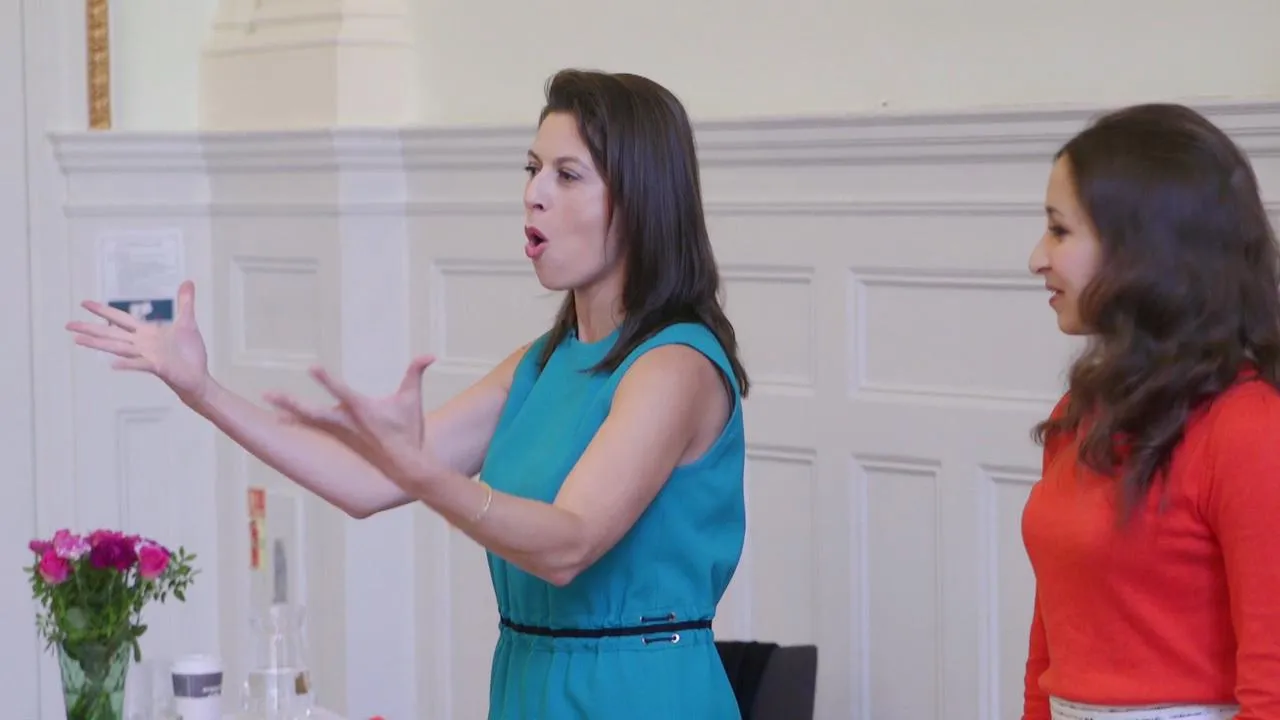
Die israelische Sopranistin Chen Reiss hat Hauptrollen auf vielen der großen Opernbühnen der Welt gesungen, darunter: Wiener Staatsoper Bayerische Staatsoper Théâtre des Champs-Élysées Teatro alla Scala Semperoper Dresden Deutsche Oper Berlin Hamburgische Staatsoper Wiener Festwochen Maggio Musicale Fiorentino Opera Company of Philadelphia The Israeli Opera Zu ihrem Opernrepertoire gehören unter anderem Pamina, Adina, Gilda, Nannetta, Oscar, Rosina, Servilia, Blonde, Susanna, Zerlina, Despina, Euridice, Marie (La Fille du régiment), Sophie (Der Rosenkavalier) und Adele. Auf ihrem jüngsten Album "Die Nachtigall und die Rose" präsentiert sie gemeinsam mit dem renommierten Pianisten Charles Spencer ein romantisches Programm. Im Konzert war sie in Salzburg, Luzern, im Wiener Musikverein, in Berlin, Leipzig und München zu erleben. Ihr Debüt an der Wiener Staatsoper gab sie 2009 als Sophie und sang dort seither Rollen wie Pamina, Elvira, Waldvogel, Adina, Servilia, Ilia, Xenia und Füchslein Schlaukopf. read more