



Den einfachen Backbeat aufpeppen
Mit
Max Sedgley
Das steckt im Kurs
7 Lektionen (1h 6m) · 1 gratis
Transkript der Lektion
Lesson Two: Spicing Up the Basic Beat
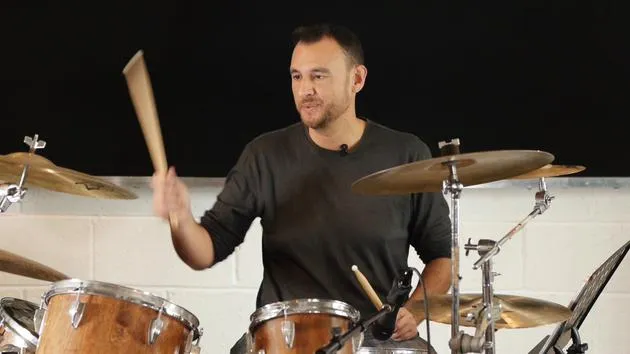
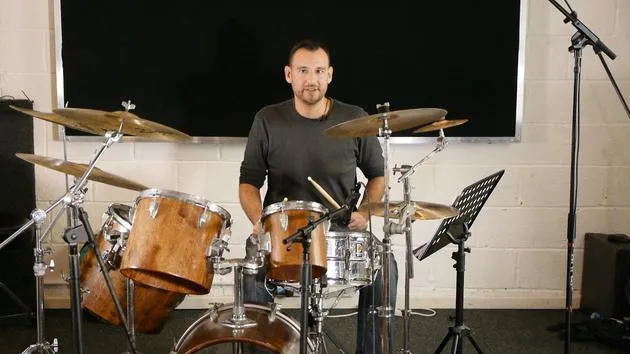
Hi there! Max Sedgley here, as part of the MusicGurus.com Back to Basics drumming course. Today is lesson two, and in this lesson, we're going to deal with the beat that we learned in lesson one, which is the most basic beat in popular music.
But we're going to spice things up a little bit and make things more interesting by moving various bits of it around within the bar or groove.
Overview
Today, we'll mainly focus on moving the kick drum around at different points and creating various variations of what we learned last time.
Recap of Lesson One
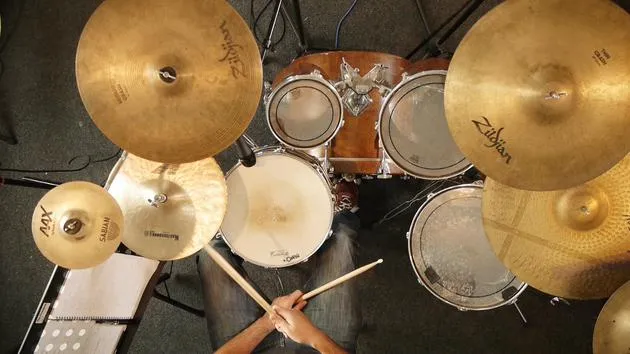
So what we learned last time, which I hope you've all been practicing, was this:
- The kick drum is on the 1 and 3.
If I count along, it's:
1, 2, 3, 4.
New Variations
Keeping the Kick Drum
To start with, the first thing we'll try is to keep the kick drum where it is, but also put it underneath when we hit the snare drum.
This means the kick drum will effectively be on every beat of the four:
1, 2, 3, 4. 2, 3, 4.
House Beat Type
This kind of sounds like a house beat.
Important Tip:
When you're hitting the drums, as you did in lesson one, make sure you're hitting them at exactly the right time to avoid creating what we call a flam.
- Ensure that all three (kick, snare, and hi-hat) are corresponding with each other.
- It might sound simple, but it's crucial to master this.
Note:
Don't feel pressured to play things too fast. Play at a speed you're comfortable with, where you can ensure everything is evenly spaced and hits at precisely the right time.
Slowing Down to Practice
If you want to slow it down, remember: the slower it is, the easier it is to hear everything happening together.
Alternate Beats
Next, you can go back to the beat that we learned in lesson one and alternate between those two beats for practice.
For example, do one bar of one and one bar of the other, like this:
1, 2, 3, 4, 1, 2, 3, 4.
Adding a Double Kick
Next, we'll add a double kick on beat three, referred to as "beat add".
When counting, you would count:
1, 2, 3, 4. 1, 2, 3, 4.
But if you want to count the eight beats in the same amount of time, count it like this:
1 and 2 and 3 and 4 and.
So, we will keep the kick drum on the 1 and 3 as in lesson one, but also add an extra beat on 3:
1 and 2 and 3 and 4.
Practice Slowly
Let's slow that down a bit:
1 and 2 and 3 and 4 and.
And then put your snare back on 2 and 4.
Another Variation
You can mix this up with the other beats you've learned.
One more variation to try is to remove the kick drum on 3, using the same pattern as before.
So you have:
1, 2, 3 and 4. 1, 2, 3 and 4.
This creates a popular variation found in many modern dance music genres, including breakbeats and drum and bass.
Final Tips
- When you hit the snare and the hi-hat on the 3, practice keeping everything even.
Key Reminder:
There's a natural inclination to accent or hit harder on that third beat where you're not hitting the kick drum.
To start with, get all the beats on the hi-hat as even as possible. If part of your body is missing out on what it's used to doing, another part might compensate by hitting harder.
Once you have a good grasp of this, you can later introduce accents as you become more comfortable.
And that's basically it for today! Keep practicing!
7 Lektionen
1 Std. 6 Min. strukturierte Videolektionen
Erweiterte Videofunktionen
Verlangsamen, Passagen loopen, mitlesen
Handy, Tablet & Desktop
Üben, wo du willst
100 % Zufriedenheitsgarantie
30 Tage Geld-zurück-Garantie
Lern deinen Guru kennen
Lern deinen Guru kennen
Max Sedgley ist ein britischer Produzent, Schlagzeuger und DJ mit einem Abschluss in klassischer Musik. Seine Kompositionen waren in zahlreichen TV-Sendungen und Werbespots zu hören, darunter die Serie Six Feet Under, und er war der Schlagzeuger des Drum-&-Bass-Produzenten Roni Size. Außerdem nimmt er unter dem Namen Cadien auf.
In seinen Kursen bringt er das Schlagzeugspiel von Grund auf bei – Schlagtechnik, grundlegende Grooves und das Achtel-Rockpattern – sowie die legendären Drum-Breaks der 60er- und 70er-Jahre, die in unzählige moderne Tracks gesampelt wurden.







