



Along The Way - Lektion
Lesson time: (11min 11sec)
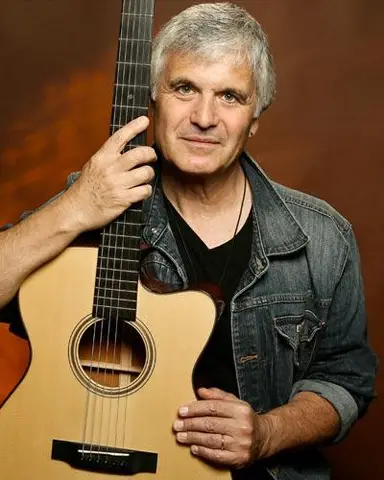
Laurence Juber unterrichtet sein Fingerstyle-Stück 'Along The Way', beginnend mit einer Wechselbass-Übung über einem C-Akkord.
Course preview
This lesson is part of the course Grundlagen der Akustikgitarre: Vol.1
Watch a preview of the full course below.
Lesson transcript:
C Chord Exercise Pattern
We're going to start this segment with an exercise pattern based on a C chord.
Alternate Bass
-
Getting Started
What I'm going to have you do is get an alternate bass happening- between the fifth string
- the fourth
- the sixth
- and then the fourth.
-
Left Hand Movement
You'll notice with my left hand that my third finger is moving from the fifth to the sixth string. -
Right Hand Technique
Now on beat one, with my middle finger of my right hand, I'm adding the second string.
Then on the "and" of beat two:- 1, 2 and
- 1, 2 and 3, 4.
- 1, 2 and 3, 4,
I'm adding the G string, the third string open.
-
Further Movement
Now I'm adding, on the "and" of three, the first string open, and then on the "and" of four, the third string open again, slowing it down.
Moving Up the Neck
Once you've got comfortable with this pattern, this is kind of like a basic fingerpicking pattern, I'm going to have you move it now to the sixth fret using the same C shape and same picking pattern.
You'll notice immediately that the melodic information is changing. What we're hearing is the relationship between:
- This F here and the open E,
- and then the relationship between this A here and the open G.
So you have two adjacent scale tones between two adjacent strings, creating a nice resonant melodic texture.
C Chord to F Chord
- Let's go back to the C.
- Go back up to the F at the sixth fret.
Transitioning to D Shape
Now we're going to the second fret, I'm sorry, the third fret, where we have a D shape or D chord still in the C shape. Here we have:
- The D and the E on adjacent strings,
- The F sharp and the G on adjacent strings.
This effect has almost a suspension quality, and underneath, you still have this bass line.
Creating Musical Layers
So now we're creating the illusion that there are three parts going on:
- this melody,
- a little bit of accompaniment in the middle,
- and a bass line too.
Out of this simple picking pattern, we're adding all kinds of information simply by moving the C chord up the neck to the third fret.
Progressing to the Eighth Fret
Now this time we're going to go to the eighth fret. We're basically on a G because that's a G tonality. If I wanted to take that same pattern and move it up to the tenth fret, now I'm on an A7 chord.
Simply by taking a shape and moving it up the neck, I'm adding all kinds of information. Here I have:
- an F chord with an E (which is A major seventh),
- and a G (which is the second or the ninth).
Understanding Major Ninths
If you take a major seventh and you put a ninth on it, that becomes a major ninth. So there's a C shape moved up here, it's an F major ninth.
Various Chord Extensions
- Here, it's almost like a D chord with the E as a ninth and then the G as the sus four.
- So you've got the feeling of an 11th chord.
- If I added the seventh to it, it could be interesting.
Cycles of Fifths
But the fact is that here is an A7, here is a variety of D, here is a variety of G, and here's a variety of C. If I go around the cycle of fifths: A, D, same pattern, G, C, I'll do that again.
The Illusion of Complexity
Sounds like there's a lot more going on than is really happening, and this is part of the trick.
Quote:
If you like fingerstyle guitar, on a piano you have two hands. You can isolate individual voices; on the guitar, we do a certain amount of faking it.
Part of the way we fake it is by taking advantage of open strings and the relationships between strings to create a texture that creates the illusion of significant musical activity.
Speeding Up
If I speed this up, it sounds pretty tricky, but really it's just a simple pattern. If I start with the E...
Now, if I do it on the E on the fifth fret, that gets a little dissonant. I mean, you can get away with that kind of effect. But what I'll do for harmony's sake is add the seventh to it and make it like a C7 chord.
Here it's an E7.
Strong Progressions
Now I'm doing a cycle of fifths progression going from:
- E to A
- to D
- to G
- to C.
This creates a very strong progression.
Musical Exercise
With this picking pattern, it becomes a very nice exercise because:
- You're exercising the right hand,
- You're exercising the left hand because you're holding a familiar shape but in different positions,
- And it has some musical value to it as well.
Transitioning to the Piece
The piece that I'm going to transition to is a tune of mine called "Along the Way." This tune evolved out of this particular exercise.
Adding Melodic Information
What I intended to do was add information to that basic pattern.
-
Starting Off:
For example, I'm adding a little melodic information. -
Note Sequences:
Here, I'm playing a sequence of notes in thirds, thickening the line a little bit. It's not a full chord, but it again adds more information to a small motif of a scale.
Progressing Through Chords
You'll notice how, like on that G chord, here on the F minor, I'm moving up, walking up in the bass line up to a first inversion G to add more information to that progression.
Then I move back up to the F, adding more information in the treble. And here I've got a very cool chord, a C6 with a major 7. It's not a complex chord to play, but again, I'm just using a basic picking pattern.
Building Tension
Now I move down to that D, walking up intense and just filling in a little bit of picking in the middle, and then I'm back to the head.
The Flat Side Progression
In the next section, I'm moving on to the flat side to a B flat.
You'll notice, in keeping with my desire to keep open strings ringing melodically, I'm playing this B flat. But instead of doing a straight bar, I'm keeping the top string open and just maintaining a simple pattern.
Maintaining the Bass Line
Now, I have on adjacent strings:
- a D
- and E
- and an F.
And I'm keeping an alternate bass happening.
Moving to A Minor
Here again, I've got an A minor but with an open B string. So it's like an A minor with an add 2. If I played it in another position, I wouldn't have the third in there, but here I have a nice progression of an A, B, and C, all on adjacent strings.
Then, I'm going to have some movement on the G there.
The Middle Section
When I get to the middle section, I'm going to have a progression where it goes:
Now here's an interesting thing: I'm basically walking up a scale, but I'm not walking up the scale in a linear fashion. I'm keeping it harmonic and letting everything ring and cascade together, then moving to an F minor.
You'll see as I go through the progression how that all works.
Closing Remarks
So, let me play the tune for you, and then I'll just pick up a few thoughts afterwards.

About the instructor
Laurence Juber wurde zunächst als Leadgitarrist in Paul McCartneys Band Wings bekannt. Seither hat er sich eine Karriere als Fingerstyle-Gitarrist, Komponist und Arrangeur aufgebaut und arbeitet vorwiegend in der DADGAD-Stimmung, die ihm den Beinamen 'the Duke of DADGAD' einbrachte.Von den Lesern des Fingerstyle Guitar Magazine wurde er zum Gitarristen des Jahres gewählt und vom Magazin Acoustic Guitar zu den besten Gitarristen gezählt – dazu kommen eine lange Liste von Soloalben und Welttourneen.In seinen Kursen vermittelt er seine Fingerstyle-Technik und die DADGAD-Stimmung, für die er bekannt ist, wie man Melodie, Harmonie und Bass für die Solo-Gitarre zusammenführt, und die Stücke – wie sein charakteristisches 'Wooden Horses' –, die all das vereinen. read more