



Creating drama

What's in the course
18 lessons (1h 33m) · 1 free






Lesson transcript
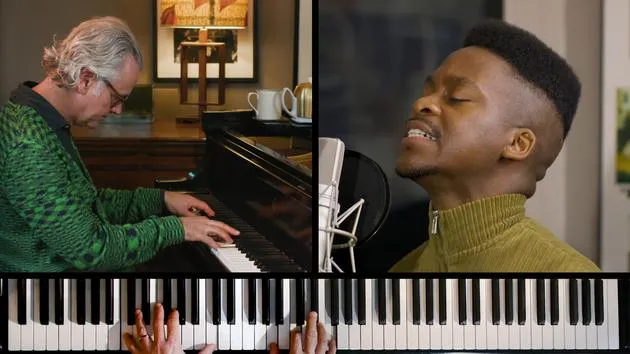
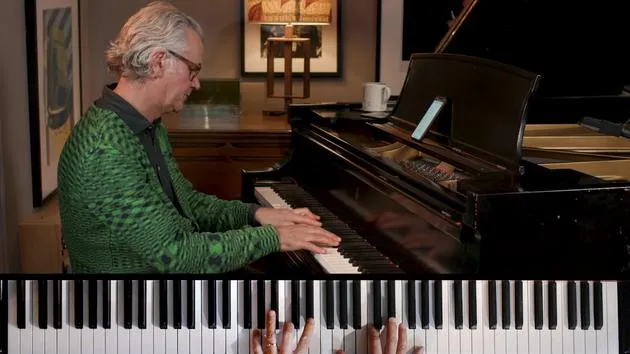
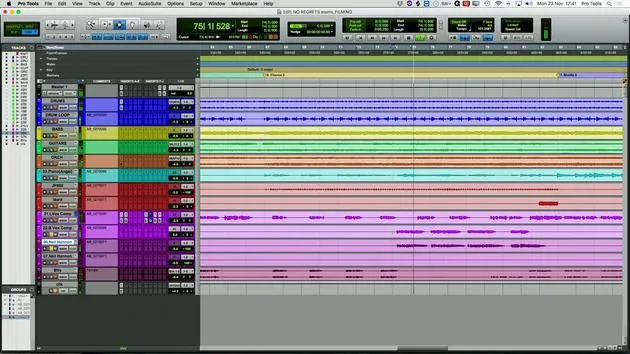
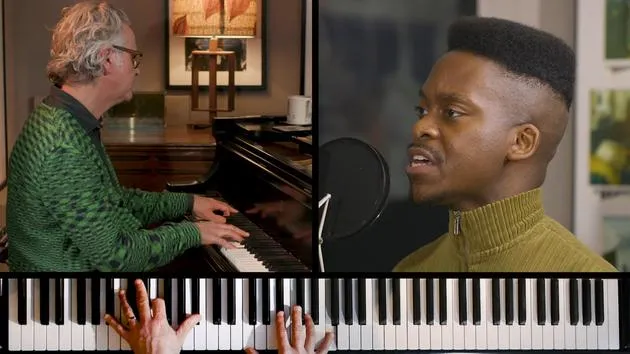
Music Lesson: Chord Progressions and Melodic Structure
Introduction to the Verse
The verse of the song fluctuates between D minor and A minor.
- Important Note: The A minor chord used here is not the usual A minor.
- This is a regular A minor with the bass on C, creating a very different sound.
- The difference, for me, is that this A minor is traveling somewhere.
Chord Progression
- D minor
- Traveling A minor (as I call it)
- A major:
- Instead of returning straight back to the root of A major, it feels static.
To create a sense of movement and uncertainty, I often shift to a chord with C# on the bass. When you put the three chords together, there's an element of unpredictability.
- Challenge: The two A chords share the same bass note, which can feel boring.
- Approach: When considering harmony, I aim to avoid repetition and think about how to move the song forward creatively.
The Next Part of the Verse
The next section features a progression of chords:
- G minor
- D minor
- A minor
Variation in Bass Notes
- The bass for the G minor to D minor progression is on F, not D. This change alters the sound significantly.
- Transitioning directly to the D might not be horrible, but I believe it's not as effective as the previous approach.
Reflecting Chord Structures
- These chords mirror the first two chords but are positioned differently on the piano.
- This mirroring symmetry is pleasing, and I am a strong proponent of symmetry in music.
Melody Overview
Consider the melody with the following lyrics:
"Come and hold my head, I wanna contact the living. Not sure I understand this role I've been given."
Range of the Song
This song is incredibly rangy. The lowest note is an A, while the highest note climbs substantially higher.
- Chorus Attempt:
- "I just want to feel real love, feel the home that I live in. Cause I got too much life running through my veins, going to waste."
- This spans over three octaves, quite a gap!
Interestingly, I believe this is the only song Rob and I have written together that features such a massive range, and perhaps he's never quite forgiven me for it.
Emotional Contrast
- The verse is moody and introspective, whereas the chorus delivers a hopeful, uplifting feel.
- The verse is in a minor key, using sombre chords, while the chorus shifts to a major key: B flat, F, C.
Satisfaction from Chord Progressions
These major chords may not be particularly original, but they work effectively in the context of the verse.
Memorable Melody
When we arrived at the chorus, I felt pleased not only with the chords but also with the melody:
"I just want to feel real love, you're the home that I live in."
I appreciated the symmetry and pattern of that melody, as there's beauty in shape. A great example is "Hey Jude," which features a captivating melodic path.
Conclusion
In choruses, it's essential to have a melody that possesses an interesting shape to resonate with listeners.
18 lessons
1h 33m of structured video lessons
Advanced video features
Slow down, loop a passage, follow along
Mobile, tablet & desktop
Practise wherever you are
100% satisfaction guarantee
30-day money-back guarantee
Meet your guru

Meet your guru
Guy Chambers is one of the UK's most successful living songwriters.
He is the writer behind songs we know from the radio, from the movies, and from the dance floor. Songs we know from our parties and our weddings. Songs that half the world can sing along to note for note. Songs that take us back in time to where we used to be. Songs that carry us forward beyond the everyday to where we wish we were; 'Angels'; 'Let Me Entertain You'; 'Strong'; 'No Regrets'; 'Millennium'; 'Rock DJ'; 'Feel' - to name but a few.
"Guy was the first person in the business who ever took me seriously" says long-standing writing partner Robbie Williams. "The first person who could see the artist that I knew I could become".
The list of other collaborators reads like pop music royalty. Over the years Guy has written and produced for Diana Ross, Tom Jones, Tina Turner (whose scorching take on 'Feel' really has to be heard to be believed), Kylie Minogue, James Blunt, Scissor Sisters, Rufus Wainwright and Mark Ronson, among many others.
He is consistently pushing himself, seeking new, creative endeavours, one of which was creating a children's folk opera based on the Oscar Wilde short story 'The Selfish Giant' - which he dedicated to his late mother, Pat. The show premiered at The Vaudeville Theatre in London's West End in 2018.
In 2019 Guy released his debut solo piano album, 'Go Gentle Into the Light' - a collection of some of the best-loved songs that he and Robbie Williams have written together, with the single 'The Road To Mandalay' reaching over 6 million streams.
He produced the BBC Children in Need official album 'Got it Covered', featuring stars such as Olivia Colman, Jodie Whittaker and Helena Bonham Carter, which reached Number 1 in the UK Charts.
Guy and Robbie Williams teamed up with Chris Heath to compose the music and lyrics for the RSC musical adaptation of David Walliams' best-selling book 'The Boy in the Dress', which opened to five-star reviews (The Independent, What's On Stage) at the Royal Shakespeare Theatre, Stratford-Upon-Avon.
Guy has produced Robbie Williams' most recent UK Number 1 album 'The Christmas Present' and co-wrote the single 'Time for Change'.
He lives with his wife Emma and their four children in Camden and in Sussex, where he enjoys "good wine, good food, cinema and pretty much everything French".
"And writing songs, of course".







