



Hardware and maintenance: Basses, EQ'ing, effects
With
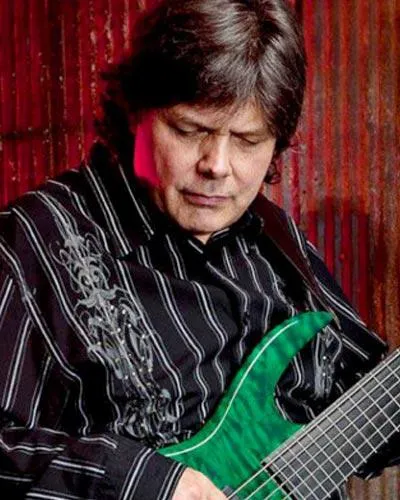
Roy VogtIn this final lesson Roy Vogt covers the gear side of bass - 4-, 5-, 6- and 7-string basses, EQ, effects like envelope filters and flangers, and basic maintenance.
What's in the course
5 lessons (2h 17m) · 1 free
Lesson transcript
Lesson 20: Exploring Musical Options
Introduction
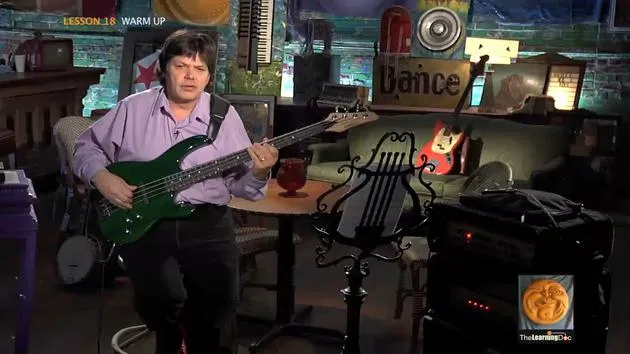
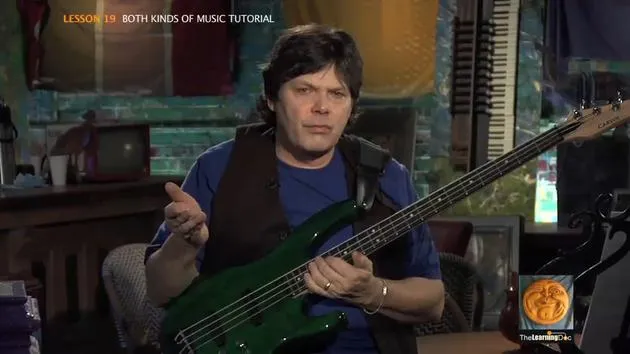
Alright, here we are at lesson 20, the final lesson of your course. Hopefully, you've learned a lot from Teach Me Bass Guitar. I certainly enjoyed teaching it. For right now, I want to explore some of the other options you have musically. We'll start with effects, then move on to different bass guitars, the sounds they create, and how they can be used.
Effects Overview
Envelope Filter
Right now, I'm using an effect called an envelope filter. This effect causes a sweep of the tone quite quickly, giving it that "wow" sound, almost like I'm talking.
Flanger
Next, let's look at a couple of other effects, starting with a flanger.
- It makes everything a little deeper.
- It adds a filter sweep effect, which sounds great with a very bright sound.
- This effect is commonly used in funk and rhythm and blues.
There's a famous bass line that uses this.
Phase Shifter
Now, we'll move to the granddaddy of all effects: the phase shifter.
- You can hear some of these sounds on old Beatles records, created back in the '60s with tape machines.
- The phase shifter behaves like a little brother to the flanger, lacking its extremity but still producing a notable "whoosh" around the note.
This might be a good one for our little two-handed tapping exercise from earlier.
Octave Divider
For those of you interested in heavier sounds, we have the octave divider, sometimes called a suboctaver.
- What it does is double the bass note down an octave.
- There are several companies that manufacture these effects.
Distortion Pedals
There are also other devices, such as distortion pedals. While I don't have one here, I can overdrive a preamp section to get a very close approximation of this type of sound. Here's what a distortion pedal might sound like:
- Hear that clipping? That's the "dirty" sound.
- It's particularly useful if you're playing in metal bands.
Different Types of Bass Guitars
Fretless Basses
Now, let's look at some different basses.
- As you notice, there's something missing from this bass: it's fretless, meaning it has no frets on the neck.
- My tone is created by pressing my hand into the fingerboard, giving it a different sound compared to a fretted bass.
The challenge is playing it in tune.
Many fretless instruments have little notch markers, helping you sight in. This particular bass has fret markers on the top of the neck, allowing for some guidance.
- If I play higher up, over the fingerboard, I get a raspier sound often referred to as the "mwa" sound.
- You'll hear this sound on recordings by Don Henley with Pino Palladino and in Joni Mitchell's work with Jaco Pastorius.
It has a very characteristic vibe.
Playing in Tune Exercise
Here's a quick exercise for playing in tune with a fretless bass. I'll walk a G scale up the neck while checking against open strings:
- G - No problem; we're on an open string.
- A - Check it against the fifth, giving a perfect fifth interval.
- B - Check it against the open E.
- C - Check it against the A; a minor sound.
- D - Can check it against the string below, the E.
- E - Can check it against the open A or E (two octaves up).
- F# - Check it with chords from what we did in "Stanley's Secret."
- G - Finish the scale.
Advantages of Fretless Basses
Why Choose Fretless?
- The main advantage of a fretless bass is the expression you can achieve by sliding from note to note, approaching the sound of an upright bass.
"It has its own little vibe."
Among other things, you can hit bell tones, which are harmonics that you can also play on fretted bass guitars.
Closing on Fretless vs. Fretted
Although you can do some bending and sliding on a fretted bass, it doesn't quite have the same feel. I usually opt for fretless when I'm going for a broader tone, especially effective in ballads.
Five and Six-String Basses
Moving to Five-String Basses
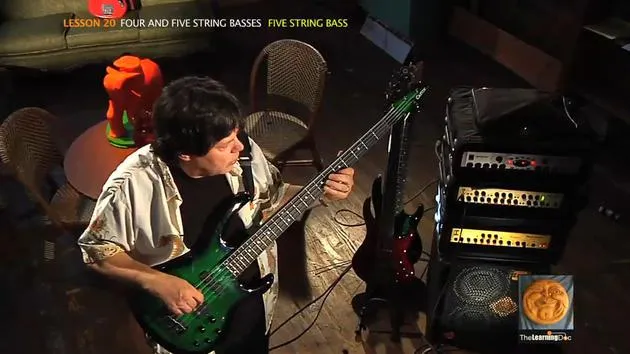
Next, we explore five-string basses.
- If E, A, D, and G aren't enough, a low B string allows for a wider range.
- This can help emulate a keyboard bass.
One appealing aspect of a five-string bass is using the L-shape to cover two octaves easily with one shift.
Fretless Cousin
Now, let's take a look at the fretless cousin of the five-string bass.
- It has fret lines, which help you play in tune by pressing right behind the frets.
- Different playing positions, like near the back pickup or over the fingerboard, yield different tones.
Adding a String: Six-String Basses
What about six-string basses?
- This model typically has a low B, E, A, D, G, and a high C.
- Using the L shapes aids in achieving three-octave coverage.
Remember those three-note voicings? They sound cleaner when played higher up the neck.
The Seven-String Bass
Introducing the Seven-String
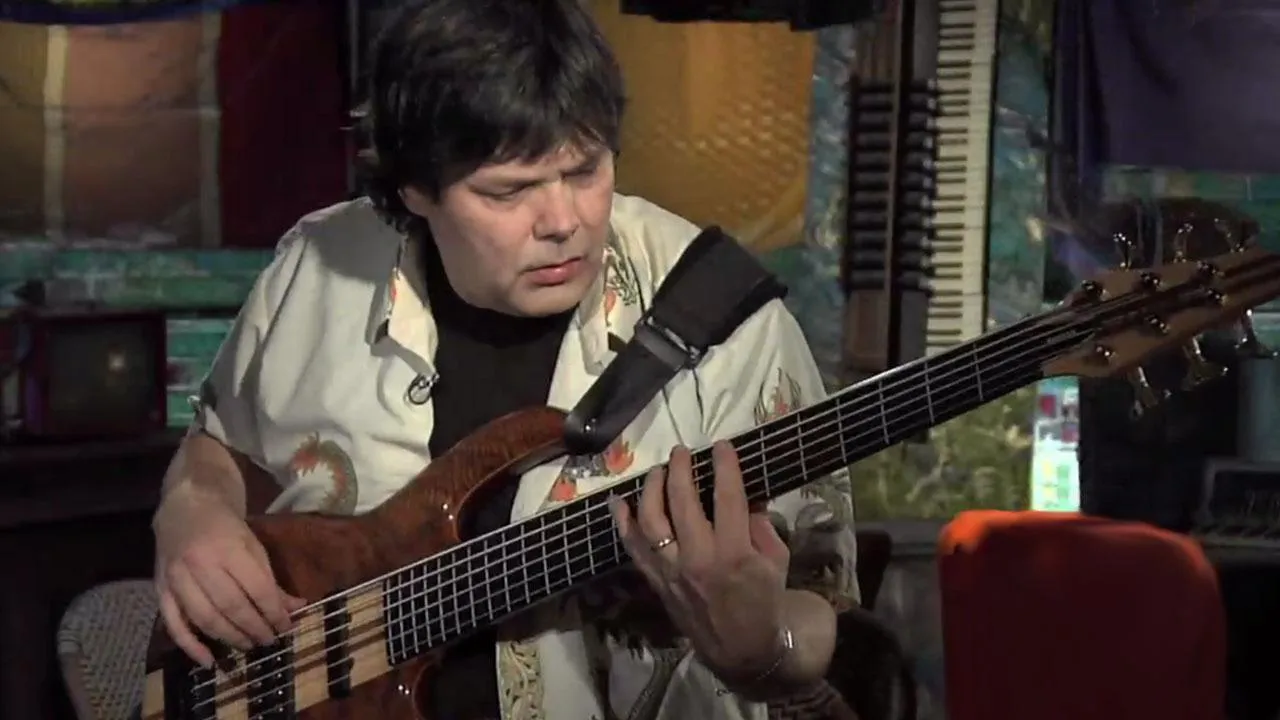
Now, this is a seven-string bass guitar.
- It starts with the low B of a five-string and adds a high C and a high F.
- This can produce a wide array of pitches without much movement on the neck.
Closing Thoughts on Instruments
While we've explored this "toy store" of bass guitars, remember:
"It's not the tools, it's you as a musician..."
Care and Feeding of Your Bass Guitar
Instrument Setup
At the Groove Chateau, I want to share a few tips on keeping your bass in tune and comfortable.
- Most instruments come un-set up, often with a bridge that has hex nuts allowing you to adjust the action.
- Remember: "Righty tighty, lefty loosey."
Adjusting Action
To adjust the action:
- Lowering a string too much can cause it to fret out, producing unwanted clattering.
Truss Rod Adjustment
One thing to note: a bass guitar neck has a certain degree of relief.
- You can adjust the neck tension using a truss rod adjuster. But, take care not to adjust it more than a quarter turn at a time.
Conclusion
Your strings should be changed when they feel too dead. Depending on your playing style and how much you sweat, this can range from a month to six months.
Remember:
- This course is just the beginning.
- Explore and learn about music and this wonderful instrument.
"Always feed the music within you, and it will come back out."
In closing, I wish you in-tune strings, good travels, and God bless!
5 lessons
2h 17m of structured video lessons
Advanced video features
Slow down, loop a passage, follow along
Mobile, tablet & desktop
Practise wherever you are
100% satisfaction guarantee
30-day money-back guarantee
Meet your guru
Meet your guru
Roy Vogt's career spans an extraordinary range of stages, from MTV's Headbanger's Ball, the Montreux Jazz Festival and the Montreal Jazz Festival to the London Palladium, the Grand Ole Opry and the Kremlin. From punk to funk, the simplicity of country and blues to the complexity of HyperJazz and World Beat, he has played it all.
Roy was the first person to receive a Master's degree in Electric Bass Performance, from the University of Miami's prestigious music school, and has been pursuing the art of bass for more than forty years. He has mentored dozens of successful professionals, including the legendary Willie Weeks. Electric, fretless, upright - you name it: if it plays low notes and has strings, Roy is a master at playing it, and at teaching others to do the same.
Over his four-decade career, Roy has recorded or performed with an amazing list of top stars, including Larry Coryell, Victor Wooten, Dave Weckl, Tom Scott and the LA Express, Chester Thompson, Miroslav Vitous, Glen Campbell, BJ Thomas, Chet Atkins, Engelbert Humperdinck, Dickey Betts, Tony Joe White, Charlie Daniels, Jerry Reed, and dozens more.
Roy has been teaching at university level for thirty years. Since 1983 he has held the Bass Professor chair at prestigious Belmont University (Nashville, TN), one of the very few schools to offer a commercial music degree program designed to turn students into professional musicians working at the top of the industry. Roy's students have toured and recorded with notable stars such as Trisha Yearwood, Faith Hill, Little Texas, Michael W. Smith, Lady Antebellum, Chick Corea, Sir Tom Jones, Blood Sweat and Tears, Yanni, and countless other music icons.
His Teach Me Bass Guitar series brings that same university-level approach to you, taking you from a complete beginner's quick start (vol. 1), through rhythm fundamentals (vol. 2), finding your own style (vol. 3) and serious musicianship (vol. 4), all the way to a pro-player toolkit (vol. 5), so you build real skills step by step.







