



Guided tour of World Music
With
Roy VogtRoy Vogt tours the bass grooves of world music, from Bossa Nova, Samba and Salsa to reggae, ska and various African styles.
What's in the course
5 lessons (2h 17m) · 1 free
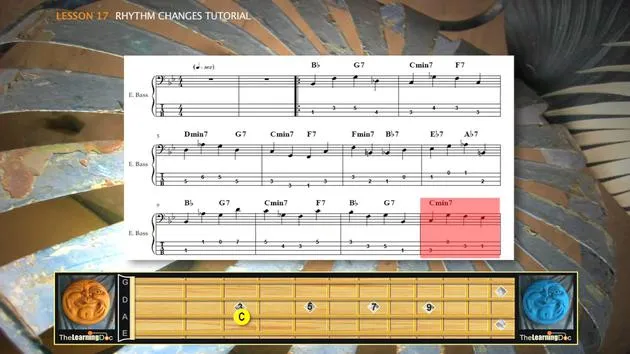
Lesson transcript
Exploring World Music Styles
All right, so here we are! We're going to discuss and study three different styles of world music that you will likely have an opportunity to play at some point or another:
- Caribbean Music
- Afro Cuban Music
- South American Music (Samba)
Samba
The samba is from Brazil and is played in the Brazilian equivalent of Mardi Gras, which is called Carnival.
Cultural Context
- Carnival is a cultural event in predominantly Catholic Brazil.
- After Ash Wednesday, everyone gives up something for Lent.
- Samba schools made up of street bands perform during Carnival.
Key Elements
- Surto: A large bass drum resembling a kettle drum, provides the typical rhythm.
- Basic Surto Rhythm:
- "1, 3, 1, 3" with a slide accent on three.
- Samba Bass Line:
- Translates to "Boom ba boom. 1 and 3. 1 and 3. 1 and three."
Important Notes
- See if you're emphasizing the eighth note, it may sound like a rock line, rather than a samba.
- Minimize the accent on the eighth note; this gives the samba its characteristic feel.
- Practice at 60 beats per minute.
Example:
- "Hiccup for the pickup."
Playing the Changes
- We'll perform a tune called "Samba These Days" at 60 beats per minute.
- Felt good going to quarter notes.
- You can let the rest of the band handle upbeat accents.
Now, let's try it a little brighter at 80 beats per minute!
Afro Cuban (Salsa)
Now let's move to Cuba and Puerto Rico to study a style called Afro Cuban or Salsa.
Rhythmic Foundations
- Clave: This rhythm is crucial in Afro Cuban music and comes from Ghana.
- 3, 2 Clave: "1, 2, 3, 1, 2, 1, 2, 3, 1, 2."
- 2, 3 Clave: "1, 2, 1, 2, 3, 1, 2."
Orchestral Dynamics
- Traditional Afro Cuban ensembles do not typically have drummers.
- Congueros (conga players), timbalero (timbale players), and a person keeping time on the clave keep the rhythm.
The Bass Line
- Play a line called Tumbal.
- Accented notes on and of 2 and 4.
Using palm mute: This helps create a dead sound resembling the Ampeg baby bass used in many Afro Cuban orchestras.
Playing Hola Bajo
"Hola Bajo" (Hello Bass) is a salsa groove.
Cut time at 80 BPM:
- 1, 2, 3, 4: "1, 2, 1, 2, 3, 4."
Let's head over to the club and jam with the band! Remember to listen to Brian's foot and phrase with it.
Reggae
Now, let's shift focus to Jamaica and explore Reggae.
Key Groove Components
- The guitar plays an upbeat called the bubble.
- Reggae guitarists typically play the off beats:
- "And 2 and 3 and 4 and 1 and 2 and 3 and 4."
Bass Characteristics
- Reggae bassists often use older basses with very old strings.
- Prominent bassists include Aston "Family Man" Barrett and Robbie Shakespeare, known for their unique tonal qualities.
Creating the Reggae Sound
- Palm mute to simulate dead strings.
- Use primary notes (roots and fifths, roots and thirds).
- Explore the one drop: No playing on the downbeat.
Performance Name
We'll play a tune called "Riddim Riddle" at 78 BPM.
- Count-in: "1, 2, 1, 2, 3, 4."
- Play root five followed by root three repetitively.
Now, let's go over to the club and jam with the band!
Conclusion
I hope you enjoyed this brief tour through some corners of the world of music. There's a whole big planet out there, go and explore styles beyond these three examples!
Stretch it Out
- Stretch and lift your arms over your head.
- Elongate your spine while reaching toward the ceiling.
- Bring the arms down and shake them out.
Next Session
The next session will explore what I do in the Nashville studios and recording sessions.
See you soon!
5 lessons
2h 17m of structured video lessons
Advanced video features
Slow down, loop a passage, follow along
Mobile, tablet & desktop
Practise wherever you are
100% satisfaction guarantee
30-day money-back guarantee
Meet your guru
Meet your guru
Roy Vogt's career spans an extraordinary range of stages, from MTV's Headbanger's Ball, the Montreux Jazz Festival and the Montreal Jazz Festival to the London Palladium, the Grand Ole Opry and the Kremlin. From punk to funk, the simplicity of country and blues to the complexity of HyperJazz and World Beat, he has played it all.
Roy was the first person to receive a Master's degree in Electric Bass Performance, from the University of Miami's prestigious music school, and has been pursuing the art of bass for more than forty years. He has mentored dozens of successful professionals, including the legendary Willie Weeks. Electric, fretless, upright - you name it: if it plays low notes and has strings, Roy is a master at playing it, and at teaching others to do the same.
Over his four-decade career, Roy has recorded or performed with an amazing list of top stars, including Larry Coryell, Victor Wooten, Dave Weckl, Tom Scott and the LA Express, Chester Thompson, Miroslav Vitous, Glen Campbell, BJ Thomas, Chet Atkins, Engelbert Humperdinck, Dickey Betts, Tony Joe White, Charlie Daniels, Jerry Reed, and dozens more.
Roy has been teaching at university level for thirty years. Since 1983 he has held the Bass Professor chair at prestigious Belmont University (Nashville, TN), one of the very few schools to offer a commercial music degree program designed to turn students into professional musicians working at the top of the industry. Roy's students have toured and recorded with notable stars such as Trisha Yearwood, Faith Hill, Little Texas, Michael W. Smith, Lady Antebellum, Chick Corea, Sir Tom Jones, Blood Sweat and Tears, Yanni, and countless other music icons.
His Teach Me Bass Guitar series brings that same university-level approach to you, taking you from a complete beginner's quick start (vol. 1), through rhythm fundamentals (vol. 2), finding your own style (vol. 3) and serious musicianship (vol. 4), all the way to a pro-player toolkit (vol. 5), so you build real skills step by step.







