



Scale, Key and Time
Lesson time: (84min 15sec)
Roy Vogt covers the building blocks of bass - time signatures, note values, major scales and key signatures - leading to your first tune, 'Keep It Simple Blues'.
Course preview
This lesson is part of the course Teach Me Bass Guitar vol.1: Quick start for beginners
Watch a preview of the full course below.
Lesson transcript:
Welcome Back to the Groove Chateau!
Alright, welcome back to the Groove Chateau. Now, let's take those notes in the first position that we learned in the last lesson and create a little warm-up exercise.
Setting the Tempo
What I'm going to do is set my drum machine at a quarter note equals 60 beats per minute. There it is! Now we have plenty of time to play from one note to the next, so I want you to think ahead.
- I'm not going to call the note names because you should have practiced enough for those to be second nature by now.
- If you find you're getting confused, go back and review the loop from the last section.
Here's our warm-up:
1, 2, 3, 4.
Notice that I played one note for every two clicks, or every two beats. That would be a half note. We'll get into the rhythms a little later in this lesson and I'll explain that a bit more.
One Note Every Click
Now let's switch to playing one note every click. This would be a quarter note, and we'll talk about these terms a little later in the lesson.
I'll give you a four count:
1, 2, 3, 4.
Importance of Warm-Up Exercises
One of the things that I want to stress with warm-up exercises is that you really don't want to play them too fast.
- Remember, a warm-up is to loosen up your muscles and stretch things out.
- Just like playing tennis or running, you would stretch your muscles out rather than going full bore and risking injury.
The same applies to playing music. Take some time to warm up those muscles before you tackle anything more challenging.
Measuring Time: Notes and Time Signatures
Understanding Note Values
I was mentioning terms like half notes and quarter notes. So let's talk about how to measure time and its function within playing bass. Remember, the bass kind of fits between rhythm and harmony, so I must have good timing and play well with the drummer.
- Additionally, I need to be aware of playing the right notes to support the chord, which we'll discuss later.
Common Time Signature: 4/4
Let's jump into time signatures. The common time signature we'll be dealing with is 4/4.
- If you look at it, it resembles a fraction, four over a four.
- The top number (4) indicates there are four beats per measure.
- The bottom number (4) signifies that a quarter note gets one beat.
Now, let's break down the rhythms:
-
A whole note lasts for four clicks:
1, 2, 3, 4
1, 2, 3, 4 -
A half note divides a whole note into two, lasting for two clicks:
1, 2, 3, 4
1, 2, 3, 4 -
A quarter note matches the tempo of the click, so each time the click occurs, I play a note.
1, 2, 3, 4
1, 2, 3, 4
Using Open Strings for Timing Exercises
Now, let's put our knowledge of whole notes, half notes, and quarter notes to use with a simple exercise using just the open strings of the bass: E, A, D, and G.
- First, we'll play across the neck in whole notes.
- Then, we'll do two half notes on each pitch.
- Finally, we'll do four quarter notes on each pitch.
So I'll count you in at 60 beats per minute:
1, 2, 3, 4.
Practice that until you feel comfortable with the changes in tempo. You might want to use the loops to get comfortable with this before moving on to the next section.
Review of Notes and Key Signatures
Understanding Key Signatures
So far, we've learned all the notes up to the 12th fret in sharps and flats. Some of you were asking, "Why do we have more than one name for some of these notes?"
This all pertains to the key signature, which is generated by what's called a major scale.
Here's a C major scale for you:
C, D, E, F, G, A, B, C.
This scale has no sharps or flats, just natural tones, no accidentals.
Looking at how it's constructed:
- C to D is a whole step,
- D to E is a whole step,
- E to F is a half step,
- F to G is a whole step,
- G to A is a whole step,
- A to B is a whole step,
- B to C is a half step.
Moving to Different Keys
Now that we've looked at this pattern, let's move it around to some different places on the bass neck.
Key of F
Starting on the low F (first fret on the E string):
- F, G (whole step),
- A, B flat (half step),
- C (whole step),
- D (whole step),
- E (whole step),
- F (half step).
Key of B flat
Starting on B flat (first fret on the A string):
- B flat, C, D,
- E flat (half step),
- F, G, A, B flat.
Key of E flat
Starting on E flat:
- E flat, F, G,
- A flat (half step),
- B flat, C, D, E flat.
Practicing Scales
Let's practice these scales with half notes, at quarter note equals 60.
I'll count you in:
1, 2, 3, 4.
E flat, F, G, A flat, B flat, C, D, E flat.
Back down: E flat, D, C, B flat, A flat, G, F, E flat.
Adding to the Progression: The 1-4-5 Chord Progression
We are now going to look at a common chord progression: the 1-4-5 progression.
- This progression appears in blues and rock and roll music, featuring artists from Chuck Berry to Jimi Hendrix, U2, and Dave Matthews Band.
Defining 1, 4, and 5 Chords
Returning to the F major scale:
- F is number 1,
- G is 2,
- A is 3,
- B flat is 4,
- C is 5,
- D is 6,
- E is 7,
- finishing off with 1 again (F).
For this progression in the key of F:
- The 1 chord is F,
- The 4 chord is B flat,
- The 5 chord is C.
Playing Triads
Now we'll play triads for these chords.
- A triad involves taking the first note (F), the third note (A), and the fifth note (C) to form a broken chord.
For F: F, A, C.
For B flat: B flat, D, F.
For C: C, E, G.
Playing Through the Progression
Let's play through a 1-4-5 progression in F first, followed by G.
Finding Your Tempo
I'll put the click on quarter equals 60. We'll be using a new time signature, 3/4, for a waltz feel.
I'll count you in:
1, 2, 3.
F, A, C, B flat, D, F, C, E, G, F, A, C.
Moving to the Key of G
Now, let's switch to the key of G. Using the movable shape:
- G is the 1 chord,
- C is the 4 chord,
- D is the 5 chord.
Let's play that progression in G:
1, 2, 3.
G, B, D, C, E, G, D, F sharp, A.
Try repeating that progression twice.
Working with the Band
Now it's time to jam with the band! We'll transition into a song called Keep It Simple Blues using the 1, 4, and 5 in the key of F.
Creating a Walking Bass Line
Using a very simple walking line:
- Root, 3, 5, 3
For F: play F, A, C, A.
For B flat: play B flat, D, F, D.
For C: play C, E, G, E.
Staying In Rhythm
Let's run through the blues progression, first just playing the root and then the walking line at a slower tempo of around 40 beats.
I'll count you in for the root notes:
1, 2, 3, 4.
Playing with Variation
Now let's switch to using the walking line:
1, 2, 3, 4.
F, A, C, A, F.
Change to B flat.
Now back to F.
Up to C.
Back to B flat, then back to F.
Feel free to keep practicing, play around with different tempos, and see what works best for you.
Closing Remarks
Remember, you can reference the accompanying book to look at different 12-bar blues progressions.
Practice and Patience
Be patient with yourself and use the practice loops to solidify your understanding of these progressions.
In upcoming sessions, we'll explore playing with a pick, adding eighth notes, and rocking it up a notch.
See you soon in lesson three!
About the instructor
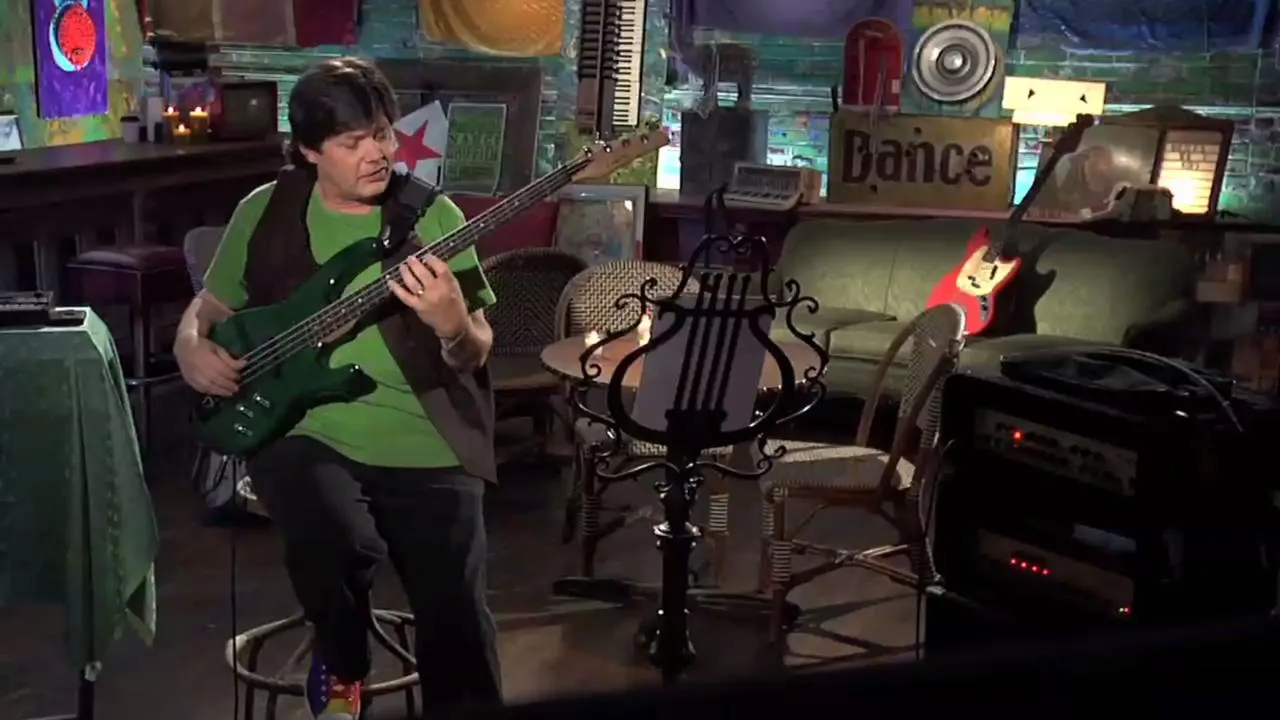
Roy Vogt's career spans an extraordinary range of stages, from MTV's Headbanger's Ball, the Montreux Jazz Festival and the Montreal Jazz Festival to the London Palladium, the Grand Ole Opry and the Kremlin. From punk to funk, the simplicity of country and blues to the complexity of HyperJazz and World Beat, he has played it all. Roy was the first person to receive a Master's degree in Electric Bass Performance, from the University of Miami's prestigious music school, and has been pursuing the art of bass for more than forty years. He has mentored dozens of successful professionals, including the legendary Willie Weeks. Electric, fretless, upright - you name it: if it plays low notes and has strings, Roy is a master at playing it, and at teaching others to do the same. Over his four-decade career, Roy has recorded or performed with an amazing list of top stars, including Larry Coryell, Victor Wooten, Dave Weckl, Tom Scott and the LA Express, Chester Thompson, Miroslav Vitous, Glen Campbell, BJ Thomas, Chet Atkins, Engelbert Humperdinck, Dickey Betts, Tony Joe White, Charlie Daniels, Jerry Reed, and dozens more. Roy has been teaching at university level for thirty years. Since 1983 he has held the Bass Professor chair at prestigious Belmont University (Nashville, TN), one of the very few schools to offer a commercial music degree program designed to turn students into professional musicians working at the top of the industry. Roy's students have toured and recorded with notable stars such as Trisha Yearwood, Faith Hill, Little Texas, Michael W. Smith, Lady Antebellum, Chick Corea, Sir Tom Jones, Blood Sweat and Tears, Yanni, and countless other music icons. His Teach Me Bass Guitar series brings that same university-level approach to you, taking you from a complete beginner's quick start (vol. 1), through rhythm fundamentals (vol. 2), finding your own style (vol. 3) and serious musicianship (vol. 4), all the way to a pro-player toolkit (vol. 5), so you build real skills step by step. read more