



Intro to the bass, right hand technique
With
Roy VogtRoy Vogt tours the bass guitar - strings, bridge and basics - then gets you started with simple 4x4 exercises to settle your picking hand.
What's in the course
5 lessons (3h 59m) · 1 free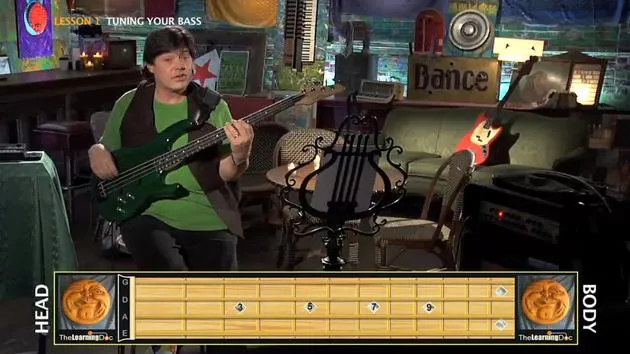
Lesson transcript
Welcome to Chateau Groove
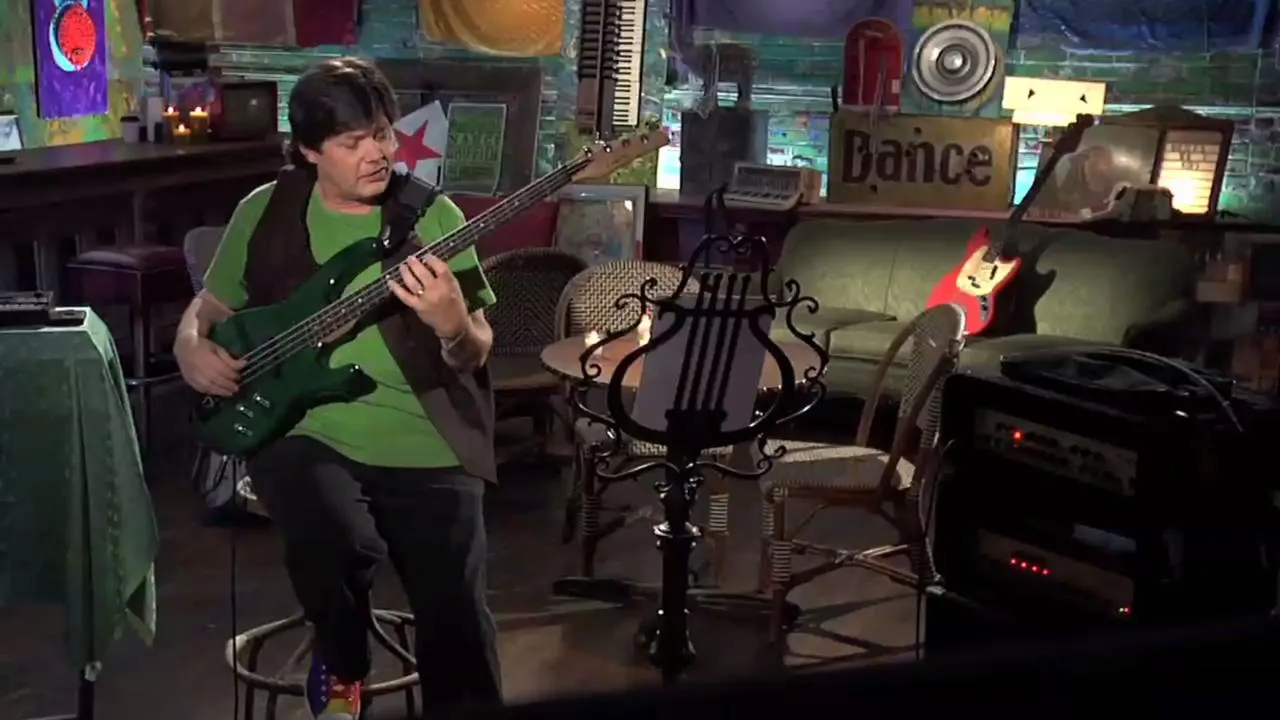
Well, here we are. Welcome to Chateau Groove! We'll be hanging out here over the next 20 lessons of the Teach Me Bass Guitar course. This will be our teaching studio. I'll be explaining a lot of musical points here, and then we're going to adjourn to play with the band. You'll meet them in the next session.
Introduction to the Bass Guitar
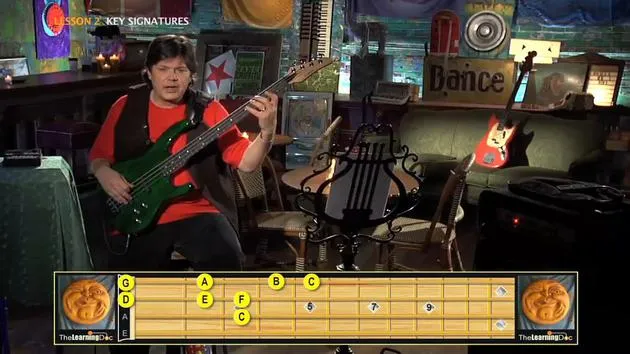
First, let's talk about the bass. Bass guitars come in a mind-boggling array of string numbers, shapes, sizes, and colors. This is a pretty basic one, a four-string guitar.
- Strings:
- E string
- A string
- D string
- G string
These strings are connected at one end and pass into what's called a bridge (this piece of metal down here). On the other end, they're passing over what's called a nutrition, and they're connected to these four tuning pegs.
Now, this is a typical left-hand tuning bass guitar since the tuning pegs are up here on the headstock. Some basses have the tuning pegs down on the body. Those are called right-hand tuning instruments.
Most of the time, a four-string bass is going to be tuned to these pitches: E, A, D, and G. If these sound familiar, they're the same four pitches that are the bottom four strings of a conventional guitar, just down an octave.
We'll explain what an octave is in a later session.
Tuning Your Bass
For right now, if you've got your bass with you, let's check your tuning. I'll play each string, and you go ahead and match your pitch to my pitch. So adjust those tuners until this sounds right.
-
Here's the low string (the one closest to me):
- E string
-
Now we're going to move up to the:
- A string
-
Now the D string
-
And then finally the string closest to the floor (the one highest in pitch):
- G string
If you're just starting out, you might want to get one of these electronic tuners. This will be very helpful until you develop your ear to hear those pitches a little bit easier.
Understanding the Bass Works
Now, how the bass works really depends on these two little objects right here: the pickups. These pickups contain magnets that respond to the vibrations of the metal strings.
When I pluck a string, the little magnets pick up the vibration and send it through these controls. In this case, these are two volume controls and a tone control. The tone control can make the sound very sharp or very soft, passing through the cable and all the way into this amplifier over here.
Importance of an Amplifier
An amplifier is crucial for an electric bass guitar because they're very quiet without one. Here's no amp; as you can see, that wouldn't be too useful in a band.
Now here's where the amplifier comes in. So that's a vital part of your system. Hopefully, you've got one. If not, then I guess it's time for a trip to the music store to get an amplifier.
Right-Hand Techniques
Now, with the right hand (I'm a righty, so I'll refer to the picking hand as the right hand). If you're a lefty, go ahead and just swap my explanation, if I say right, think left and so forth.
There are three different ways that a bass player can produce sound:
- Fingerstyle
- Slap
- Using a Pick
Using a Pick
This pick is similar to a guitar pick but is a bit heavier gauge. A lot of rock players will use these. We will come back to the pick in a later lesson. For now, let's focus on the most common technique that I and many other professional players use, which is called fingerstyle.
Fingerstyle Technique
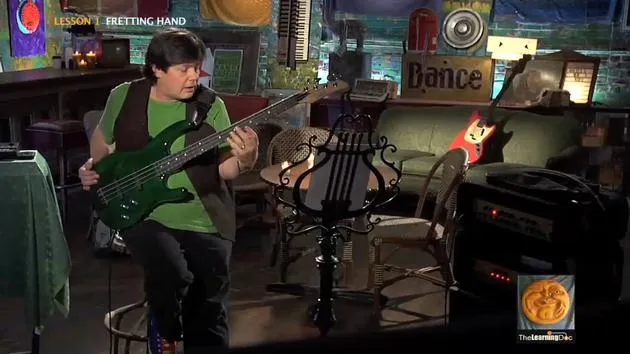
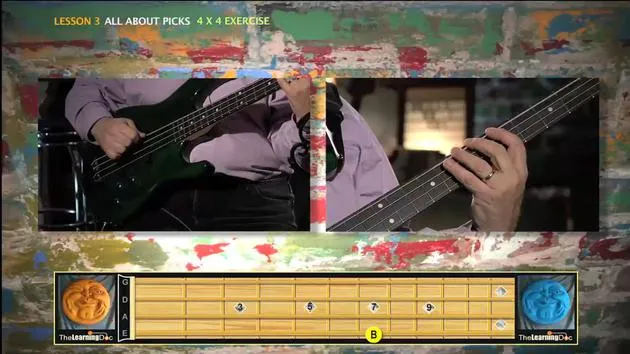
What I'm going to do is take my thumb of my picking hand and rest it right on top of the pickup. This provides a nice anchor and creates a backstop for my fingers. I will pick with my index and middle finger, this is a two-finger technique.
Notice something: as I'm picking the note on the low E, my fingers come to rest on the thumb, which serves as a backstop.
- As I move down to the A string, my thumb drops. This mutes the E string.
- As I go to the D string, my thumb drops again, covering the E and A strings.
- I can keep my thumb here because as I go to the G string, my fingers are going to rest on the D string.
Why Use This Technique?
Here's an interesting thing about this technique. If I accidentally hit a note I don't want to play, no note will ring unless I want it to. If my thumb is at the top of the pickup, I'm getting every string.
This technique can be very handy for beginners, especially when playing five, six, and seven string basses, as we'll look at later, and during recording studio work. Because you only want to play the notes that you intend to play.
5 lessons
3h 59m of structured video lessons
Advanced video features
Slow down, loop a passage, follow along
Mobile, tablet & desktop
Practise wherever you are
100% satisfaction guarantee
30-day money-back guarantee
Meet your guru
Meet your guru
Roy Vogt's career spans an extraordinary range of stages, from MTV's Headbanger's Ball, the Montreux Jazz Festival and the Montreal Jazz Festival to the London Palladium, the Grand Ole Opry and the Kremlin. From punk to funk, the simplicity of country and blues to the complexity of HyperJazz and World Beat, he has played it all.
Roy was the first person to receive a Master's degree in Electric Bass Performance, from the University of Miami's prestigious music school, and has been pursuing the art of bass for more than forty years. He has mentored dozens of successful professionals, including the legendary Willie Weeks. Electric, fretless, upright - you name it: if it plays low notes and has strings, Roy is a master at playing it, and at teaching others to do the same.
Over his four-decade career, Roy has recorded or performed with an amazing list of top stars, including Larry Coryell, Victor Wooten, Dave Weckl, Tom Scott and the LA Express, Chester Thompson, Miroslav Vitous, Glen Campbell, BJ Thomas, Chet Atkins, Engelbert Humperdinck, Dickey Betts, Tony Joe White, Charlie Daniels, Jerry Reed, and dozens more.
Roy has been teaching at university level for thirty years. Since 1983 he has held the Bass Professor chair at prestigious Belmont University (Nashville, TN), one of the very few schools to offer a commercial music degree program designed to turn students into professional musicians working at the top of the industry. Roy's students have toured and recorded with notable stars such as Trisha Yearwood, Faith Hill, Little Texas, Michael W. Smith, Lady Antebellum, Chick Corea, Sir Tom Jones, Blood Sweat and Tears, Yanni, and countless other music icons.
His Teach Me Bass Guitar series brings that same university-level approach to you, taking you from a complete beginner's quick start (vol. 1), through rhythm fundamentals (vol. 2), finding your own style (vol. 3) and serious musicianship (vol. 4), all the way to a pro-player toolkit (vol. 5), so you build real skills step by step.







