



The Note Top Eb - Fingering and Exercises
With
James RaeJames Rae introduces top E flat, the highest note in the course so far, with the palm-key fingering and exercises to play it cleanly.
Copyright © 2023 Universal Edition (London) Ltd., All compositions by James Rae except where otherwise indicated.
What's in the course
22 lessons (0h 58m) · 1 free
Lesson transcript
Introduction to Top E Flat
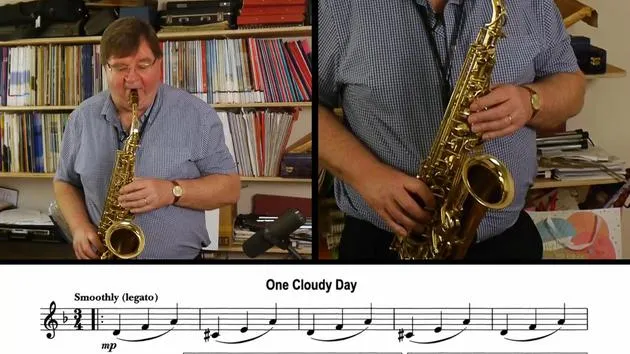
The next note we'd like to introduce is top E flat, the highest note so far in the course.
Playing Technique
- It's a palm keynote played in a similar manner to high D plus the next key up.
- You play it with the inside of the index finger of the left hand.
As a reference:
- Your D is E flat.
- By touching just a semitone higher, it's E flat (or D sharp), which are fingered the same.
Enharmonic Notes
- Enharmonic notes are written differently but sound the same, exemplified by E flat and D sharp.
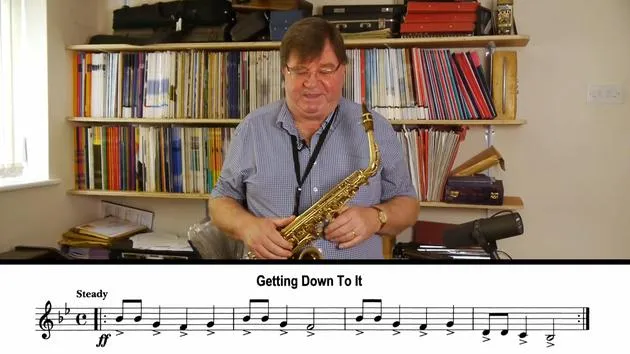
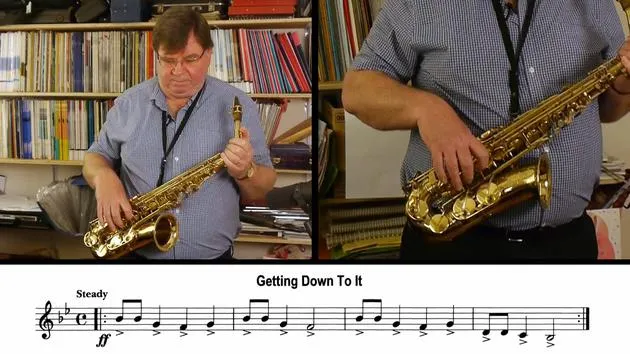
Exercise 1
Exercise 1 walks you through how to approach it:
-
First Bar:
- Practice this many times until you can achieve it without catching any other key.
- Just watch you don't catch the big one, which is the F key; we'll come back to that later.
-
Second Bar:
- Not too hard.
-
Third Bar:
- We throw in a C just to make it more interesting.
-
Final Bar:
- This one is the hardest as we have to move three fingers at once to go from C up to E flat.
- Play this really slowly at first.
As you can see, my fingers are moving as one:
- Two distinct positions: an on and an off.
- Avoid any unwanted catches; a clean interval is required.
Putting It All Together
The next challenge is the hardest of the lot, the final bar on that line, where we go from B up to E flat.
- With slow practice, you'll be able to achieve this very easily.
- Let's put that into practice in the form of the E flat major scale.
Practicing the Scale
- Have a smooth transition right to the top E flat.
- It's worth taking sections of the scale and working at them.
Let's just look at the first five notes:
- I'm using the B flat key in this case, which I find easier in this context of a scale.
- If you play those notes up and down, it forms a five finger exercise, which pianists are very familiar with.
You can work your way up the whole scale like that, moving through the next group of five notes until you reach the top.
- Focus on working each section individually.
- When you join them all together, it should come out nice and smoothly.
Technical Considerations
Just a quick technical point:
- Flat keys on the saxophone are less common than sharp keys because of transposition.
- The saxophone mechanism is designed to be more comfortable in sharp keys.
In context:
- Playing in A major is the same as C major concert pitch on piano or any concert pitch instrument.
- You always have three sharps more to negotiate than what the piano does.
When it comes to flats:
- It's the other way around; we have three flats less to negotiate.
- If we're starting with three flats, the piano will have three flats more, meaning it will play in the key of G flat major if the alto sax is playing in the key of E flat major.
Summary of Key Difficulty
This explains why extreme flat keys (of three or four flats or more) are harder than their sharp equivalents on the saxophone:
- The layout is designed to favor playing in sharp keys rather than flats.
As musicians, we have to make them sound equally smooth. E flat major parallels E major:
- E major is an easier key; although it has four sharps, E flat major can be easier to play.
- We must train our fingers to make all keys sound equally good.
E Flat Major Arpeggio
Now onto the E flat major arpeggio:
- There are lots of leaps involved here, so play very carefully.
- I favor the B flat key in this case.
Your E flat major arpeggio study in E flat is a pattern like we've had in earlier keys, just going up and down the scale, but in thirds.
Although it's quite tricky, it's worth practicing.
Final Studies
The next little study is an octave study, which is good for tuning:
- Work your way up the scale in octaves.
- Play it tongued at first, then add the slurs.
Last Challenge
The last challenge is the hard slow exercise:
- Keep the air going right through the note to achieve a nice octave.
22 lessons
0h 58m of structured video lessons
Advanced video features
Slow down, loop a passage, follow along
Mobile, tablet & desktop
Practise wherever you are
100% satisfaction guarantee
30-day money-back guarantee
Meet your guru
Meet your guru
James Rae was born on Tyneside in 1957. He studied clarinet, bass clarinet, piano and composition at the Guildhall School of Music and Drama from 1975 to 1979, under professors Yona Ettlinger, Stephen Trier, Meriel Jefferson and Patric Standford respectively. Since leaving the Guildhall, he has pursued a highly successful and varied career across three areas: performing, writing and teaching.
James Rae has worked in many West End and Royal National Theatre productions, including Sir Peter Hall's award-winning Oresteia with music by Sir Harrison Birtwistle, and has received many freelance engagements with some of the country's leading orchestras and ensembles. He is the leader of the Phoenix Saxophone Quartet, who over the years have given many recitals and BBC broadcasts, and have recorded the complete works of Carey Blyton on two albums, 'The Return of Bulgy Gogo' and 'Sherlock Holmes meets Dr Who'.
As a composer, James Rae is one of Europe's most published writers of educational wind music, with over 250 publications to his credit, mainly published by Universal Edition. His music includes instrumental study books, sonatas, tutors, baroque, classical and jazz transcriptions, plus many volumes of duets, many of which feature on all the major wind examination syllabuses worldwide. He has also written four musicals for schools with Mike Cornick, and his larger commissions include The Turn of a Wheel, a major work for concert band that premiered in November 1999 for the North Tyneside Concert Band, of which he was a founder member as a boy, and the overture Moving On in 2012.
James Rae has worked extensively as a syllabus consultant and composer for both the Associated Board and Trinity College London, and has been highly involved in developing the woodwind sight-reading requirements for both exam boards. As a teacher, he has held many posts in both the state and independent sectors, and currently works at King's College School Wimbledon, where he directs the Wind Orchestra and Concert Band, and Shrewsbury House School in Surbiton, where he coaches three large bands and a chamber group. That teaching experience runs right through his saxophone series for MusicGurus, which takes you step by step from your very first notes to a confident, stylish player: First Notes, New Keys & Low Notes, Expanding Your Range, Scales & High Notes, Extended Range & Rhythm, and Polish & Style.







