



The Note C#, Dotted Minims and Minim Rests - Fingering, Exercises and Introduction
With
James RaeAn introduction to the note C#, dotted minims and minim rests on alto saxophone, with fingering and exercises from James Rae.
Copyright © 2023 Universal Edition (London) Ltd., All compositions by James Rae except where otherwise indicated.
What's in the course
26 lessons (0h 38m) · 1 free
Lesson transcript
Music Lesson: Introduction to C Sharp, Dotted Minim, and Minim Rest
In this section, we introduce three items: C sharp, the dotted minim, and the minim rest.
C Sharp
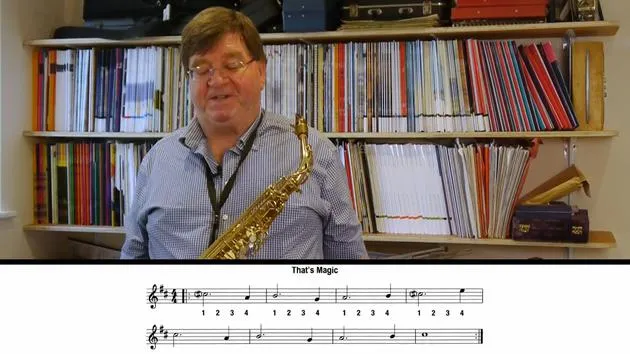
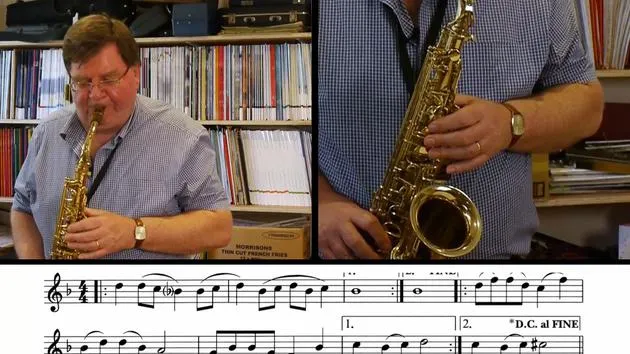
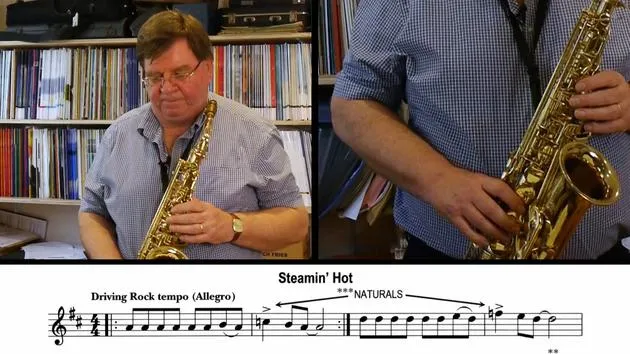
C sharp is probably the easiest note to play badly on the saxophone because it doesn't involve any fingers other than the thumbs, which you are using to hold the instrument and position it.
Important Points to Remember:
- Hold the Saxophone: Think of the sax as being held by the sling rather than by your hands. The thumbs just position the saxophone rather than actually take any weight.
- Playing C Sharp:
- When you play C sharp, you have nothing at the front, no fingers at the front. Therefore, you have to rely on this balance for the note to work.
- C sharp is a semitone higher than the standard note C, but not as high as D.
Dotted Minim
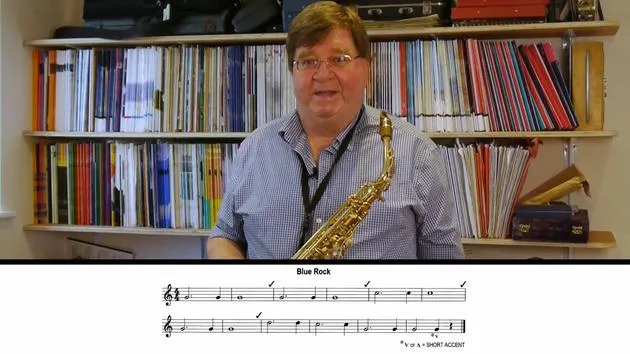
As you can see from the diagram, dotted minims are note values of three crotchet beats.
Understanding Dots on Notes:
- Dot After a Note:
- A dot placed after any note increases its length by 50%, regardless of the note's original length.
- For instance:
- A two-beat note becomes a three-beat note.
- A four-beat note becomes a six-beat note.
- A hypothetical hundred-beat note would become 150 beats.
- Clarification:
- The dot does not simply add half a beat as many people think; instead, it adds half of whatever the note is worth.
- Example: A dotted crotchet would be worth one and a half beats, while a minim, which is a two-beat note, becomes a three-beat note.
Minim Rest
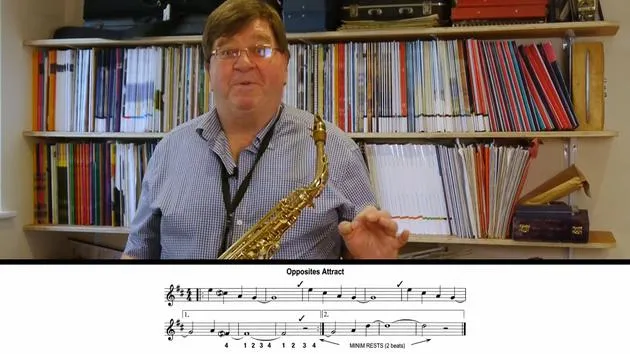
We also introduce the minim rest, which is, as it says, a rest of two beats.
Exercise Example:
- Play for two beats, then rest for two beats:
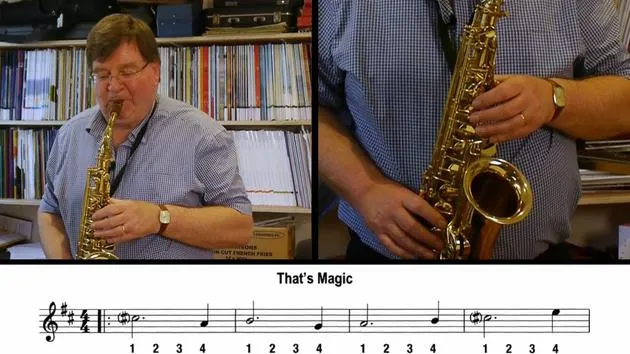
- Exercise 1: Play, rest, rest, play, rest, rest.
- This approach allows us to kill two birds with one stone: introducing C sharp and the minim rest.
Exercises Overview
-
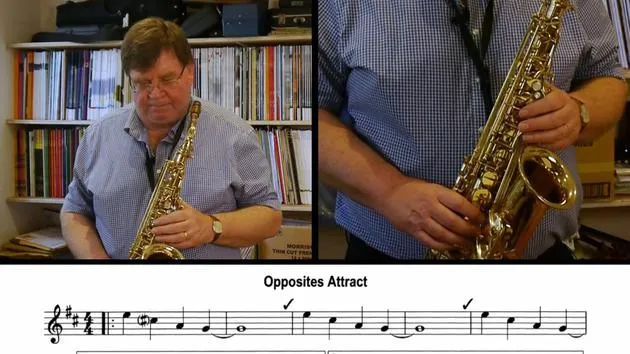
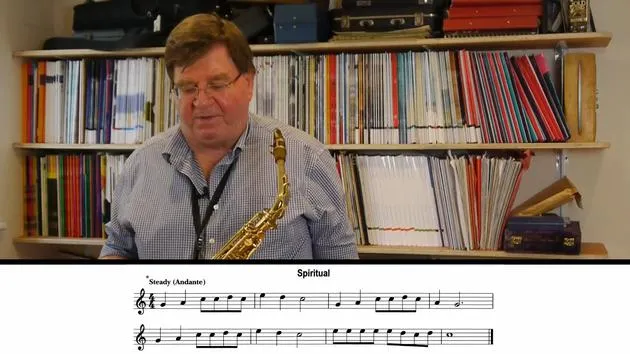
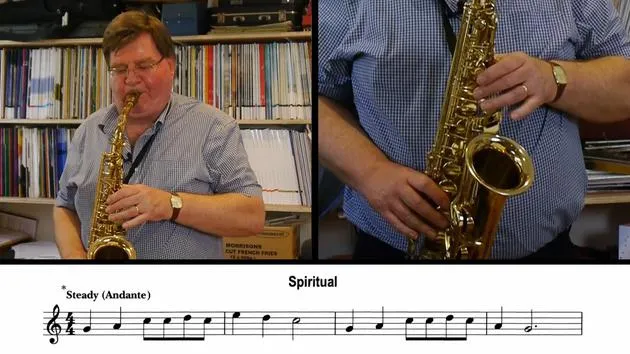
Exercise 2: Introduces the dotted minim along with C sharp "just for a bit of fun."
- Example: Bum bum bum bum bum (instead of a boring normal C).
-
Exercise 3: Similar to Exercise 2 but with the reversed rhythm: short-long.
-
Exercise 4: Revisits the time signature of 3/4.
- Here, we have one note per bar since each note is worth three beats, being all dotted minims, with a tie note at the end to round things off.
26 lessons
0h 38m of structured video lessons
Advanced video features
Slow down, loop a passage, follow along
Mobile, tablet & desktop
Practise wherever you are
100% satisfaction guarantee
30-day money-back guarantee
Meet your guru
Meet your guru
James Rae was born on Tyneside in 1957. He studied clarinet, bass clarinet, piano and composition at the Guildhall School of Music and Drama from 1975 to 1979, under professors Yona Ettlinger, Stephen Trier, Meriel Jefferson and Patric Standford respectively. Since leaving the Guildhall, he has pursued a highly successful and varied career across three areas: performing, writing and teaching.
James Rae has worked in many West End and Royal National Theatre productions, including Sir Peter Hall's award-winning Oresteia with music by Sir Harrison Birtwistle, and has received many freelance engagements with some of the country's leading orchestras and ensembles. He is the leader of the Phoenix Saxophone Quartet, who over the years have given many recitals and BBC broadcasts, and have recorded the complete works of Carey Blyton on two albums, 'The Return of Bulgy Gogo' and 'Sherlock Holmes meets Dr Who'.
As a composer, James Rae is one of Europe's most published writers of educational wind music, with over 250 publications to his credit, mainly published by Universal Edition. His music includes instrumental study books, sonatas, tutors, baroque, classical and jazz transcriptions, plus many volumes of duets, many of which feature on all the major wind examination syllabuses worldwide. He has also written four musicals for schools with Mike Cornick, and his larger commissions include The Turn of a Wheel, a major work for concert band that premiered in November 1999 for the North Tyneside Concert Band, of which he was a founder member as a boy, and the overture Moving On in 2012.
James Rae has worked extensively as a syllabus consultant and composer for both the Associated Board and Trinity College London, and has been highly involved in developing the woodwind sight-reading requirements for both exam boards. As a teacher, he has held many posts in both the state and independent sectors, and currently works at King's College School Wimbledon, where he directs the Wind Orchestra and Concert Band, and Shrewsbury House School in Surbiton, where he coaches three large bands and a chamber group. That teaching experience runs right through his saxophone series for MusicGurus, which takes you step by step from your very first notes to a confident, stylish player: First Notes, New Keys & Low Notes, Expanding Your Range, Scales & High Notes, Extended Range & Rhythm, and Polish & Style.







