



Cool A Jig - The Choice Wife (lesson)
With
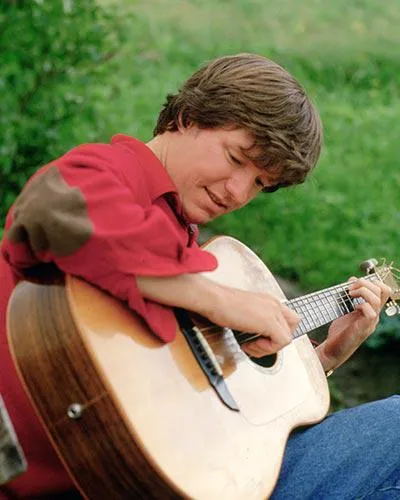
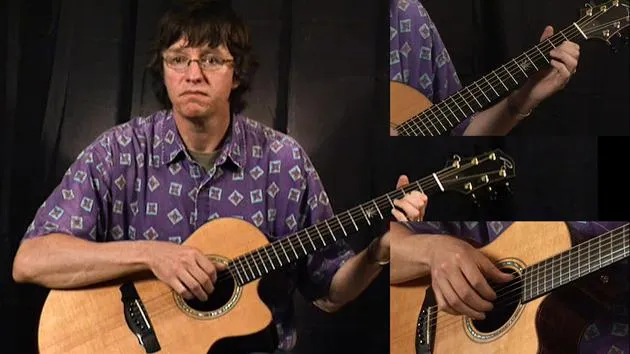
Steve BaughmanSteve Baughman teaches two jigs - 'The Cool A Jig' (6/8) and the slip jig 'The Choice Wife' (9/8) - sharing the right-hand groove he uses for both in Orkney tuning.
What's in the course
13 lessons (1h 9m) · 1 free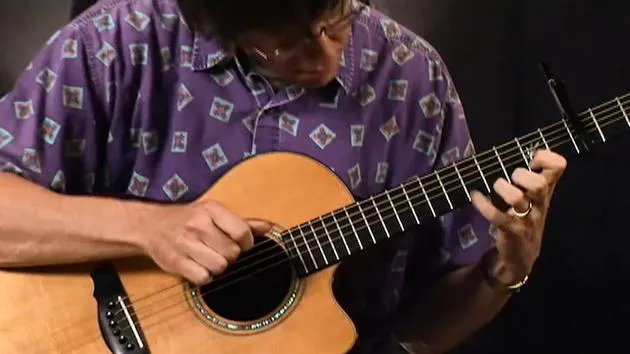
01. Dans A Sailheu - Tavarn - Danse des Deux Pommes Frites (performance)
Free lesson5:10
02. Dans A Sailheu - Tavarn - Danse des Deux Pommes Frites (lesson)
10:24
03. Little Beggar Man (performance)
1:54
04. Little Beggar Man (lesson)
8:24
05. Loch Lomond (performance)
3:20
06. Planxty John Irwin (performance)
3:33
07. Planxty John Irwin (lesson)
1:29
08. Cool A Jig - The Choice Wife (performance)
4:09
09. Cool A Jig - The Choice Wife (lesson)
You are here6:09
10. Neil Gow's Lament - Devil In The Kitchen - The Tushgar (performance)
6:24
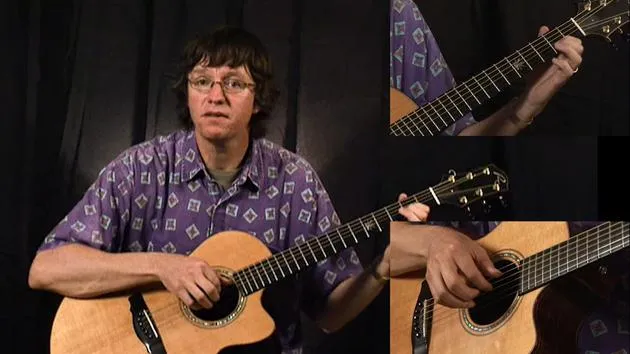
11. Neil Gow's Lament - Devil In The Kitchen - The Tushgar (lesson)
11:08
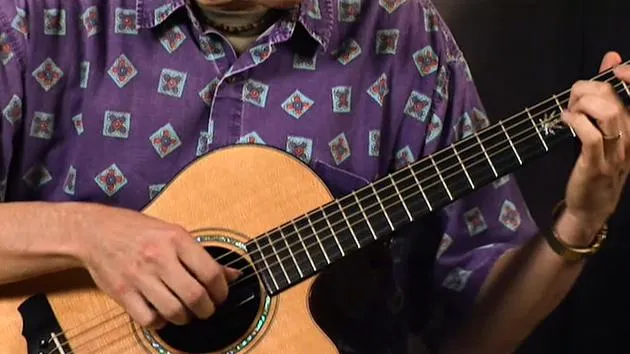
12. Paddy Fahy's Jig (performance)
2:40
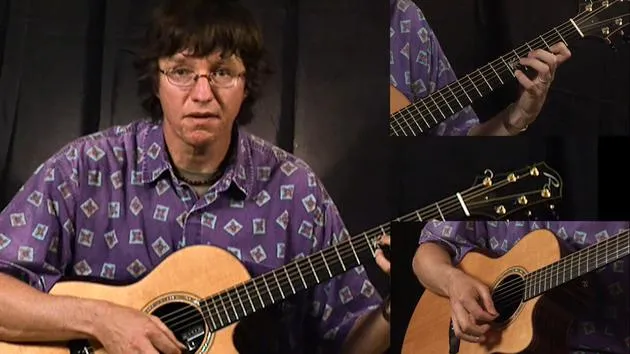
13. Orkney Tuning (lesson)
4:43
Lesson transcript
Music Lesson: Jig Patterns
I forgot to tell you the names of those two jigs that I just played.
Jigs Introduced
-
First Jig: The Cool A Jig
- A straight-up six-eight jig.
- "jiggety jiggety, jiggety jiggety."
-
Second Jig: The Choice Wife
- A slip jig, which is a nine-eight jig.
- "So it's 1, 2, 3, 4, 5, 6, 1, 2, 3, 1, 2, 3, 4th, 5, 6, 1, 2, 3."
I use the same right-hand pattern on both of them, even though one's a six-eight jig and the other's a slip jig.
Right Hand Patterns
Speaking of right-hand patterns, now I'm going to take the opportunity to show you the basic jig pattern that I use pretty much on all my jigs.
"I don't necessarily keep the pattern going the whole time through a jig. I'll employ slurs, hammer-ons, pull-offs, open spaces."
This is the basic thing that's going on. Let me show you the basic pattern, then a couple variations on it.
Tuning
Okay, I am back in Orkney tuning, where I'd like you to be if you were going to be practicing all these patterns because it just works out a lot easier here.
Tuning: cgd, gcd
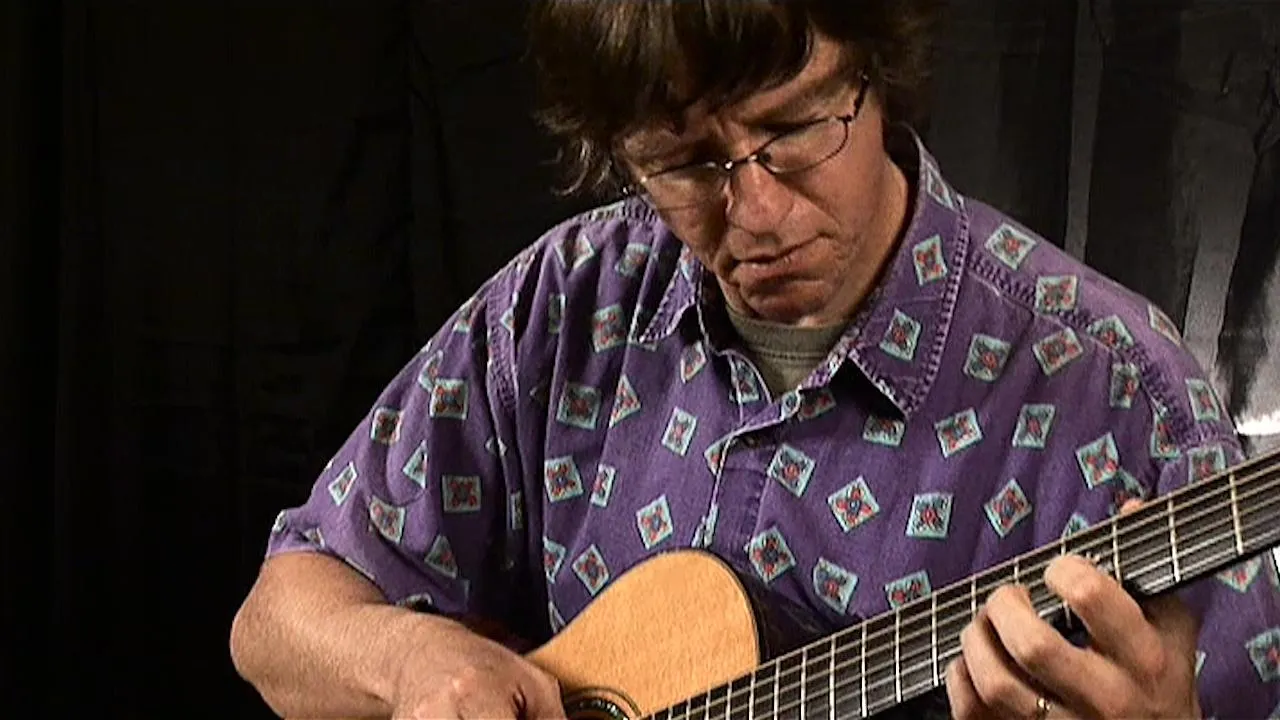
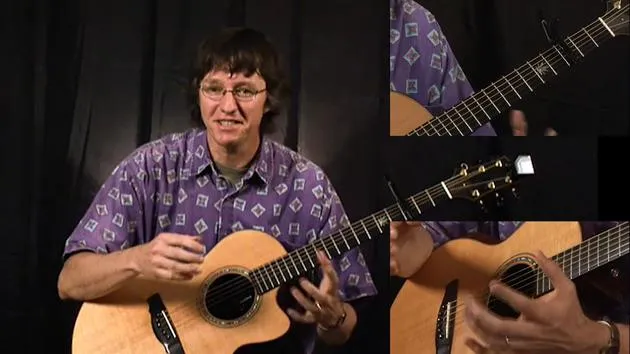
Now, I'm going to keep my index finger on the second string, second fret on the left hand. You might want to have your multi-angle focus on my right hand now because that's where the action is really going to be.
Basic Pattern
The basic pattern is on different strings.
"It doesn't really matter which strings you're doing this on. The important part is the right-hand groove."
Remember, it's not a straight six with a jig.
"It's dotted, jiggety, jiggity, jiggity jiggety."
Variations
Now, another way to play it is by bringing your thumb down to one of the treble strings as opposed to...
Okay, now since that can get pretty darn boring quickly, let me show you a riff from a really well-known Scottish fiddle tune.
- Tune: The Athol Highlanders
- (A T, H, O, L, E. Do not mispronounce that.)
- Here's how it goes, showing how that pattern would apply to that tune.
Now, just to show you that Orkney tuning can also play in a key other than G, I'll do a part of an Irish jig called the Kunla. I'll just employ this pattern to show you how it would work with a different fiddle tune.
Encouragement
Okay. I'm having way too much fun. I just can't stop.
"It really is an invigorating pattern."
"I encourage you to spend as much time as you can just doing them till you internalize them, get them in your blood, and then throw in the left hand. That's the easy part."
Once you have the patterns, you can play pretty much any jig that you would want to play.
Final Thoughts on the Athol Highlanders
Before we move on, let me just alert you to how I would play the Athol Highlanders if I were using my thumb.
Remember I just said that you can do it using these two fingers: pluck, and then middle ring or middle index.
You can also do it with a slightly different feel. I think it's actually a bit more powerful. It may not be right for all jigs, but here's how I would use it:
- With a thumb
- As opposed to without a thumb.
Recap
Okay, so that's the basic jig pattern.
13 lessons
1h 9m of structured video lessons
Advanced video features
Slow down, loop a passage, follow along
Mobile, tablet & desktop
Practise wherever you are
100% satisfaction guarantee
30-day money-back guarantee
Meet your guru
Meet your guru
Steve Baughman is one of fingerstyle guitar's true originals - a player whose open-tuned, Celtic-rooted acoustic work has earned critical acclaim on both sides of the Atlantic.
'Once in a while an album comes along that can alter your thinking about guitar music - Steve Baughman's Farewell to Orkney is one of those... A must for all lovers of guitar and especially Celtic music.'
--Acoustic Guitar Magazine
'A star of fingerstyle guitar: very deft, thoughtful, quietly adventurous, deeply lyrical and playful.'
--Radio National, Australia
'Steve's artistry and musicality are world-class, with dynamics, timing and interpretation that always bring out the emotional essence of the song.'
--Sing Out Magazine
'...technical innovation, virtuosity, and intensity.'
--Acoustic Guitar Magazine
'Incredible virtuosity ... showcases the quiet beauty of the open-tuned acoustic guitar.'
--Marin Independent Journal (Too bad it's not the Washington Post. But I'll take it.)
His album Farewell to Orkney was listed as one of the 'Best Albums of 2013' by Acoustic Guitar Magazine.
And then there's the accolade Steve can't quite take seriously. He is on the Digital Dream Door list of the 100 best fingerstyle guitar players of all time, which includes dead ones. 'I used to put this in my press materials. But then I figured it was just the lone opinion of some dude/gal somewhere in cyberspace. Anyone can make a list. Besides, how many fingerstyle guitar players can there be anyway? It must be hard not to make the top 100. I suspect the 81-100 slots are all made up names. As long as you did a guitar CD you're top 80. I think I was 77. Maybe I'll be deleted from the list now that I've said all this. But I appreciate the passion of whomever compiled it. Thanks for including me, and it impressed my mother. Maybe it won't now.'
In Celtic Guitar Solos, Tunes & Techniques, Steve shares the open tunings and fingerstyle approaches behind that sound, so you can play it for yourself.







