


Inversions and accompanying

With
Tim Richards
What's in the course
24 lessons (1h 30m) · 1 free
01. Dominant seventh arpeggios and inversions
2:49
02. DOWN THE LINE Performance
1:46
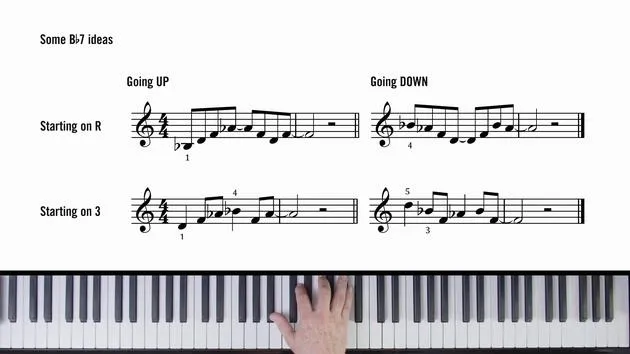
03. Improvisation tips
3:59
04. The 12-bar blues sequence, tritones and shells
5:49
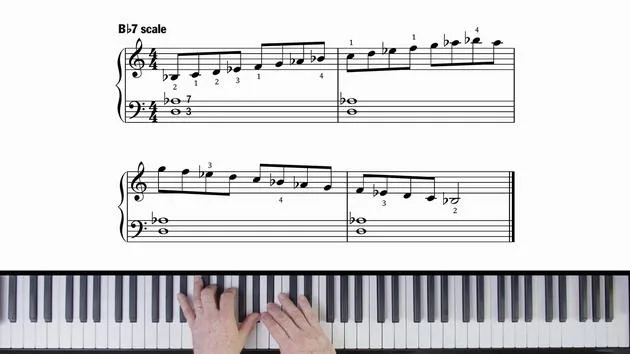
05. Mixolydian, whole-tone and chromatic scales
5:51
06. STRAIGHT NO CHASER Performance
1:34
07. The Flat Three Pentatonic scale
3:25
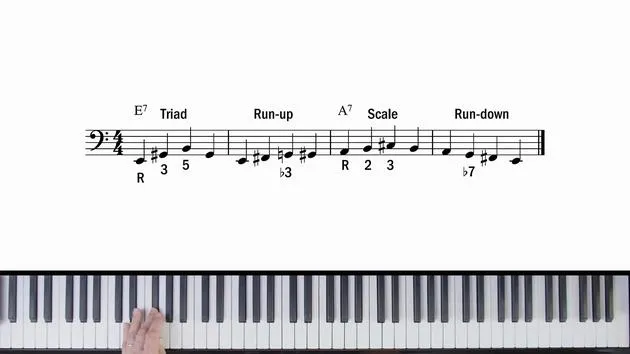
08. Learning Dominant 7ths in all keys
5:37
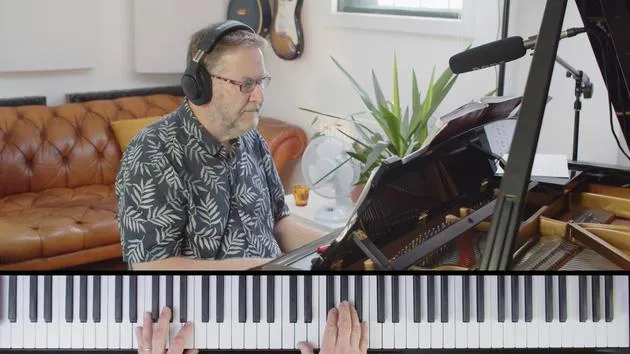
09. DOMINANT SEVENTH WORKOUT #1 Performance
1:48
10. Broken chord patterns
5:22
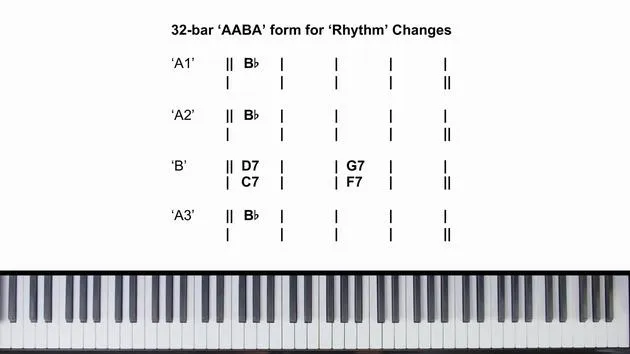
11. Rhythm changes and the dominant seventh cycle
3:50
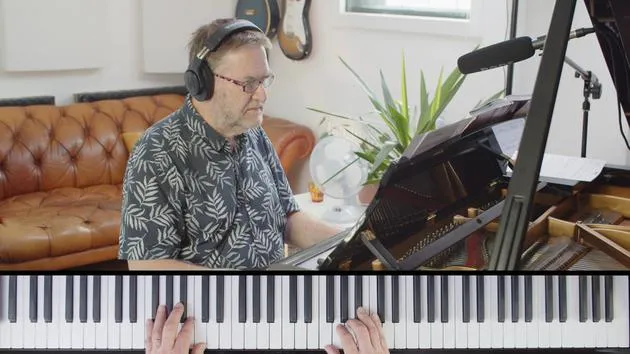
12. THE THEME Performance
2:22
13. Improvising over the tonic chord
5:42
Lesson transcript
Dream On Chords Lesson
In this lesson, we're going to look at the chords of Dream On and talk about how you might accompany someone playing the tune, such as:
- Flute
- Saxophone
- Trumpet
- Voice
Accompaniment Style
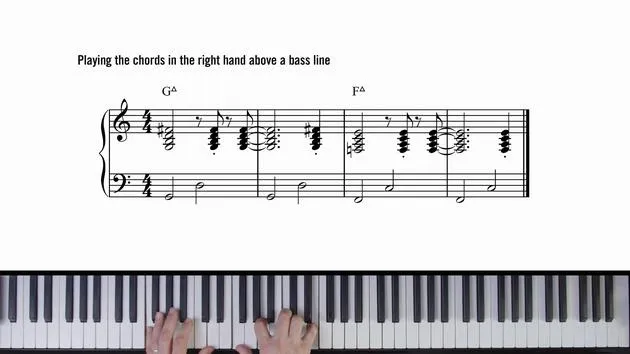
You might want to do a two-feel bassline and play some chords in the right hand.
- Tip: Don't play all the chords on the beat like we did in the left hand; try mixing up on and off the beat chords.
- This creates a kind of Latin feel.
Chord Inversions
Make sure to explore different inversions of the chords. You don't have to stick with the root positions I've given, apart from the Ab, which is a second inversion.
Inversions Routine Practice
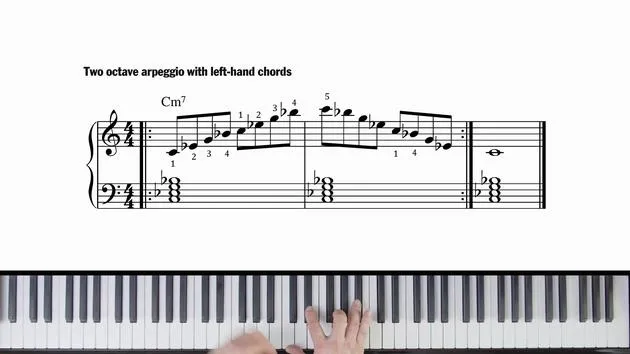
One good way to practice would be an inversions routine. For instance, if we go back to C major 7, perhaps with a metronome:
- Start with four flexor chords.
- If you find that easy, try two clicks of each chord.
This involves going through all the inversions of the chord, starting from root position up to root position on top.
Left Hand Practice
Now, we'll try the left hand:
- Count: Two, three, four.
- Then, double up.
Aim to play all those shapes cleanly.
- This chord lends itself to third inversion, which has a nice semitone on the bottom.
- The second inversion is nice as well, with the semitone in the middle.
This is a distinctive aspect of major seventh chords. Practice this for all the chords you need in Dream On.
Major Seventh Workout
In the next piece, Major Seventh Workout, we'll group the chords together in pairs, as we did with:
- Major triad workout
- Natural minor workout
Chord Pairs
The first two will be:
- A major seven and D major seven
Then we'll move on to:
- G major seven and C seven
And so on around the cycle.
Key Analysis
Notice that, because we're repeating each pair of chords several times, each key will play for 16 bars. When we keep going back to A, it sounds like those two chords are in A major.
- Play a single scale on top, A major, for both the A and D chords.
- When moving to G and C, play G major on top, and so on around the cycle.
Chord Exercises
In Major Seventh Workout:
- We'll start with the right-hand chords in second inversion, moving to root position.
- This is a nice register for these chords.
Bass and Rhythm
We'll play bass in the left hand, allowing you to explore different rhythms in the right hand against this walking bass line.
- With these two chords, there will always be two notes shared between the first and the second chord.
- In this configuration, the top two notes stay the same, while the bottom two notes move down.
- This holds true for every chord pair.
Structure of the Piece
In the first half of the piece, you'll be playing with drums.
- With the left hand on bass and chords in the right, this forms an accompaniment style.
- Notice: The drums are the missing element.
When we change to the second half:
- The bass will replace your left hand, and you'll start playing chords in the left hand.
- The configuration will be root position first, then second inversion for the D major.
Each chord pair will maintain that movement:
- This time, the bottom two notes stay the same.
Progression
- Move to G major root position.
- Keep the top two notes the same.
- For the second chord, remember the bottom two notes are shared.
Because we repeat A to D over and over, it sounds like we're in the key of A.
- We're doing one to four in A, allowing you to play one scale.
- When you move to G and C, you'll play G major, and so on.
Scale Revision and Improvisation
Now's a great opportunity to revise your scale fingering for all the scales you'll need.
- Especially check out D flat major and any other scales that you're uncertain of.
You'll also need to improvise because you'll get four bars in each key.
- Tip: Don't just play the scale up and down.
- Take the opportunity to go over the track several times.
- Each time you transition to a new key, improvise with the major scale while keeping the chords going in the left hand.
24 lessons
1h 30m of structured video lessons
Advanced video features
Slow down, loop a passage, follow along
Mobile, tablet & desktop
Practise wherever you are
100% satisfaction guarantee
30-day money-back guarantee
Meet your guru
Meet your guru
Critically acclaimed jazz pianist and composer Tim Richards is one of Britain’s most experienced jazz educators, teaching piano privately for over 30 years, as well as at Morley College, Goldsmiths College, the University of Surrey, Premises Studios and other venues in the UK and abroad. He has produced numerous titles for Schott Music, including the best-selling two-volume Exploring Jazz Piano, Blues, Boogie & Gospel Collection and the acclaimed Improvising Blues Piano. He is also co-author, with John Crawford, of Exploring Latin Piano and Brazilian Piano Collection.
More recently Schott have published Jazz, Latin & Modern Collection (15 pieces for solo piano), comprising Tim Richards originals alongside pieces by Duke Ellington and Thelonious Monk, and the two volume set Beginning Jazz Piano (now a two-part MusicGurus course).
“The real joy of Tim’s music… is that it is both hugely educational but also such great fun to play. Anyone with the slightest interest in learning to play or teach jazz piano should really acquire a set of Tim’s books.” PianoDao
As a performer Tim has been a presence on the UK jazz scene since the 1980s, also playing the blues with UK and US legends such as Otis Grand, Earl Green, Dana Gillespie, Larry Garner, Joe Louis Walker and Mojo Buford. He has released over a dozen albums as a leader (featuring many of London’s best jazz musicians including Pete King, Gilad Atzmon, Tony Kofi, Jason Yarde, Seb Rochford, Ed Jones, Dick Pearce and many others), and toured all over Europe with line-ups ranging from duo to nine-piece. His latest recording, the album ‘Telegraph Hill’ by the six-piece Hextet, was described in The Observer as "A true joy from beginning to end".
More info can be found on his website www.timrichards.ndo.co.uk