



Introducing Sharps and Flats
With
Talia Girton
What's in the course
19 lessons (0h 33m) · 1 free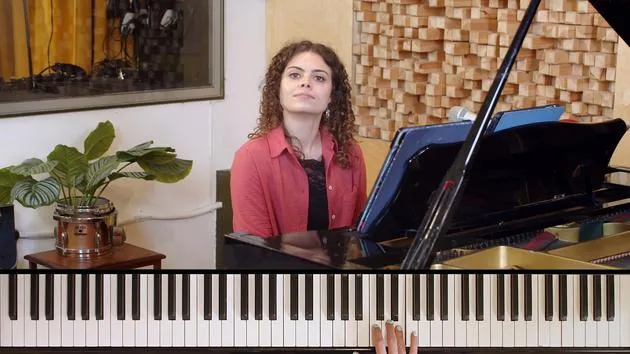
Lesson transcript
Introduction to Sharps and Flats
So far, we've been working only with the white keys on the piano, also known as naturals. Now, we're going to look at the black keys, which we refer to as sharps and flats.
Understanding Sharps and Flats
- Sharps are represented on the stave by a number sign (‚ôØ) or a little hash sign.
- Flats look like a little B (b).
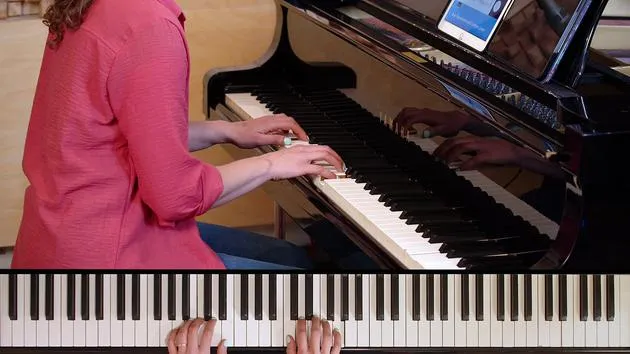
Example on the Keyboard
If we look at the keyboard, I'll give you an example of what each of those looks like:
-
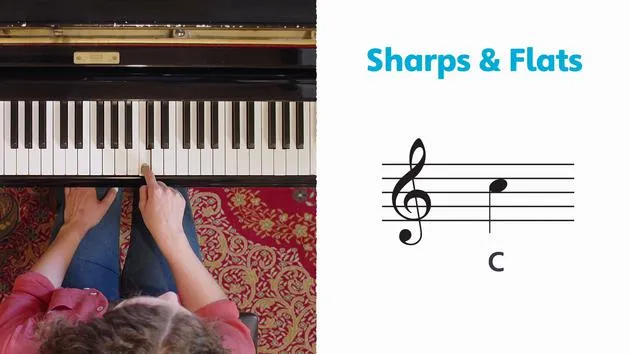
C: This note is a C.
-
C‚ôØ: If I go to the note directly to the right, this is a C sharp.
- Remember: If you step on something sharp, you jump up, and on the piano, we're moving up a semitone.
-
D: We know that this note is D.
-
Db: The note directly to the left is D flat.
- Remember: When a tire is flat, it moves down towards the ground, so we are moving down by a semitone.
Enharmonic Equivalents
I already know what you're thinking: How in the world is this note both C sharp and D flat? The answer is that they are enharmonic equivalents.
You don't need to remember that big fancy word; just remember:
- When you're moving to a black note on the right, it's going to be A sharp (from here to here).
- When you're moving to a black note on the left, it will be A flat (from here to here).
Sharps and Flats with White Keys
There are also some places where we have white keys that are named flats and sharps. This occurs when there is no black key in between two white keys:
- Between E and F
- Between B and C
Notes Related to Sharps and Flats
-
If you were to ask me what E sharp is, I would tell you that it's this note (the note above E).
- Reason: We are moving up a semitone.
-
Similarly, if you asked me about F flat, I would move down to this note (the note below F).
- Reason: We are moving down a semitone.
Conclusion
We'll have a look at using sharps and flats in a song in our performance piece a bit later on.
19 lessons
0h 33m of structured video lessons
Advanced video features
Slow down, loop a passage, follow along
Mobile, tablet & desktop
Practise wherever you are
100% satisfaction guarantee
30-day money-back guarantee
Meet your guru
Meet your guru
Talia Girton is a musician and HCPC-registered music therapist, and the founder of The Cycling Music Teachers. Her work brings together music therapy, counselling and education, and she tutors internationally on the music therapy training course at UDELAS in Panama as well as contributing to professional development with the European Piano Teachers Association (EPTA). On MusicGurus she teaches the Piano Method and Piano Foundations courses, guiding complete beginners from first steps through rhythm, both hands, theory and performance.







