



Articulation Games

With
Talia Girton
What's in the course
19 lessons (0h 33m) · 1 free
Lesson transcript
Staccato vs. Legato
Listen to this example and tell me if it's staccato or legato.
I'll play through it twice.
Here it is again.
If you said staccato, that's exactly right.
I was playing the notes detached and crisp.
Next Example
Here's the next one.
And again, if you said legato, that's exactly right.
I played the same notes as before, but I connected them rather than separating them.
Final Example
Here's the last example.
What's your guess on that one?
I tricked you. If you said the first part was legato and the second part was staccato, you're exactly right.
Key Considerations
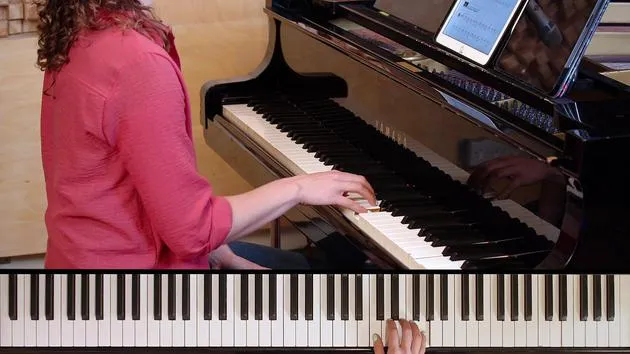
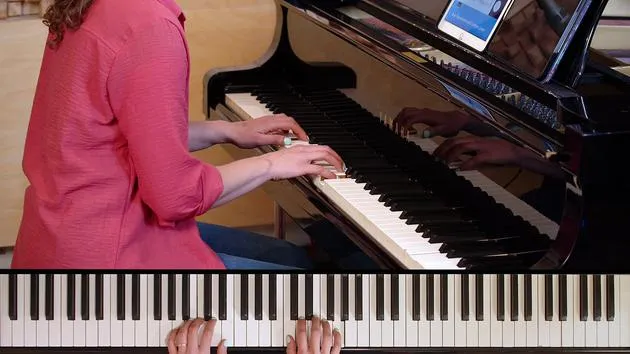
One thing to think about, especially when playing staccato, is that you really want to make sure there's no tension in your body.
- At first, it can be really tempting to keep a tense wrist in order to really separate the notes,
- but make sure that your wrist stays loose and flexible.
It's the same case when you're playing legato and when you're doing things like moving over the octave.
You might even use your elbow and your shoulder to help you move towards that direction and keep a smooth line of the melody.
19 lessons
0h 33m of structured video lessons
Advanced video features
Slow down, loop a passage, follow along
Mobile, tablet & desktop
Practise wherever you are
100% satisfaction guarantee
30-day money-back guarantee
Meet your guru
Meet your guru
Talia Girton is a musician and HCPC-registered music therapist, and the founder of The Cycling Music Teachers. Her work brings together music therapy, counselling and education, and she tutors internationally on the music therapy training course at UDELAS in Panama as well as contributing to professional development with the European Piano Teachers Association (EPTA). On MusicGurus she teaches the Piano Method and Piano Foundations courses, guiding complete beginners from first steps through rhythm, both hands, theory and performance.







