



András Schiff analysis of No 1. Moderato
With
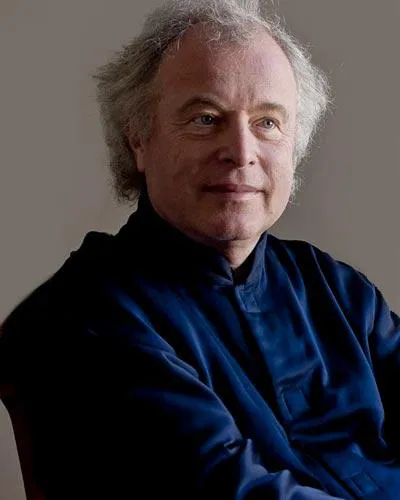
András Schiff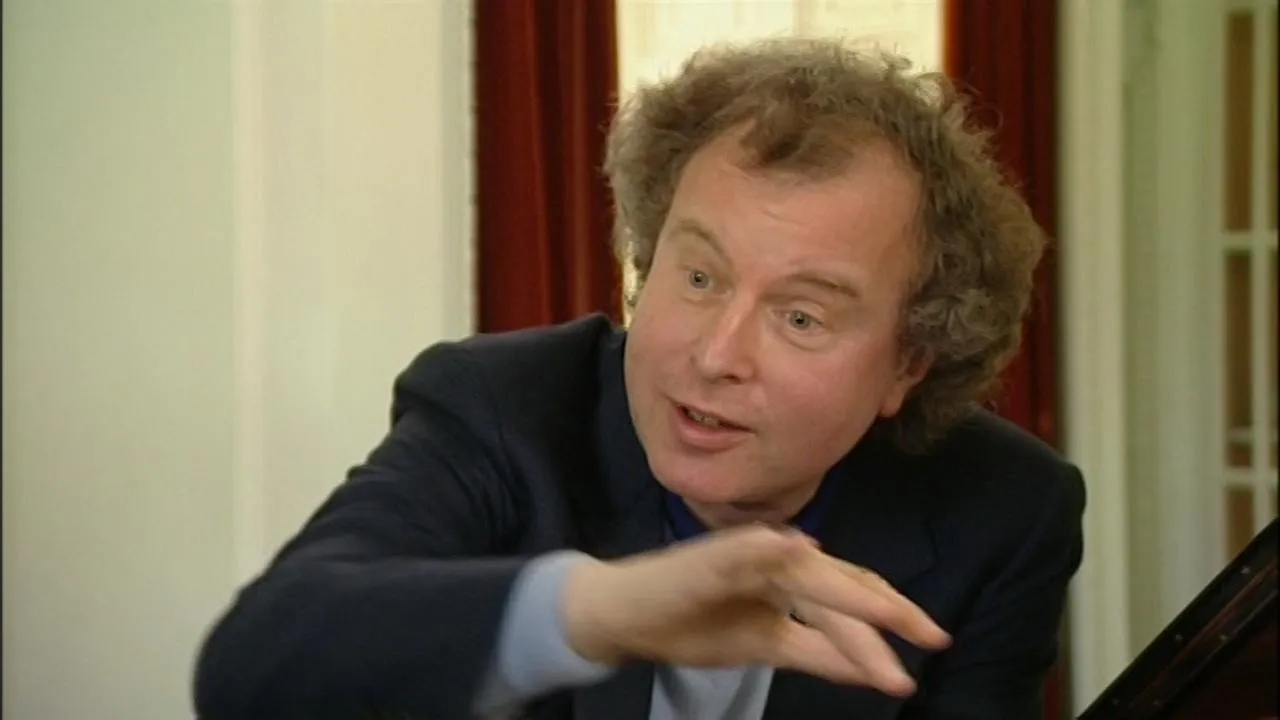
What's in the course
4 lessons (0h 57m) · 1 free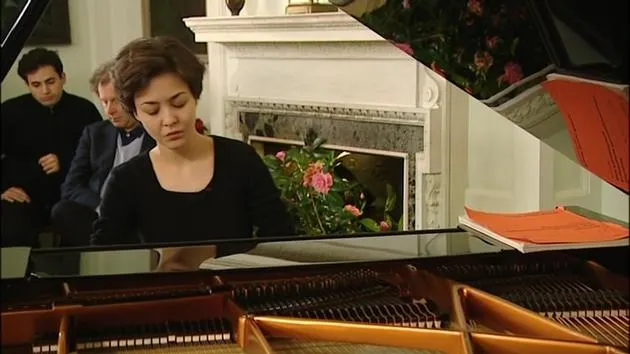
Lesson transcript
Musical Moments with Franz Schubert
Now we have here Maumam Musico, a musical moment of Franz Schubert. Wonderful music!
Intimacy in Schubert's Music
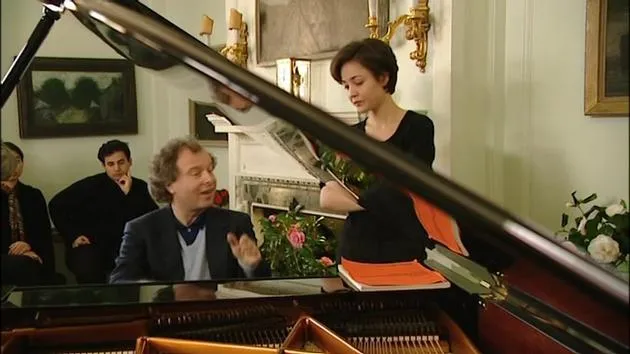
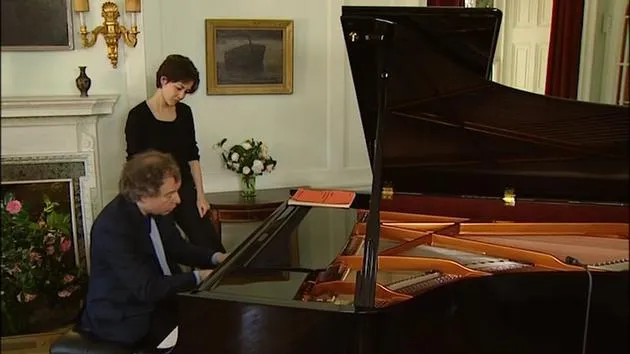
What does this title suggest? It could be called anything, but to me, it suggests intimacy. And we are in a wonderful room here.
- You don't have to play as you would in the Royal Festival Hall.
- You must scale your playing to the room, the acoustics, and the surroundings.
Of course, if you play Maumam Musico in the Royal Festival Hall, it's not a very good idea, mind you. But then you will play it differently.
To me, Schubert's music is the most touching and intimate. It's capable of great dramatic outbursts. But what makes Schubert's music unique is the soft music, how many colors you have from piano downwards:
- Pianissimo
- Triple pianissimo
- Quadruple pianissimo
- Thousands of colors
And you are not using that. It's much too loud for the room and for the music.
The Nature of the Music
Let me show you: while we are playing in a room, the music is about nature.
- We have a horn call.
- I always see pictures of nature in front of me: forests and a horn call in the forest.
These days in Britain, we talk a lot about fox hunting. I am not a fan of fox hunting myself, but in Schubert's days, there was a lot of hunting.
This Jagdorn, we know Schubert's wonderful song cycle Die schTripletne M?llerin, and it's full of these images. To me, this cycle Maumam Musico is very close to the SchTripletne M?llerin.
Schubert is the greatest song composer of all time, and these are songs without words.
Technique and Expression
So please hear accents, but small accents. You must voice your chords. The piano is a polyphonic instrument, so when you play six notes together, you shouldn't play all of them with equal strength.
Here's a cooking analogy:
- If you put a little more salt, a little more pepper, a little more nutmeg, you just taste it.
Alright, let's try from the beginning.
"Please play for me this horn call: Yum Ba Ba. Once more. That's right. Now, from the beginning."
Be careful! We have the triplets. Don't play rubato here, because Schubert composed triplets and duplets.
- 1, 2, 3, 14 , You always change.
I would be much stricter with the tempo. Romantic music is full of emotions, but it doesn't mean it's without tempo.
Balance and Tone
Let's go on. The tone quality is not beautiful. Even if you play forte, not hard, please.
In the forest, you have different birds:
- What's that ugly black bird? A crow.
- And then there are very nice birds.
Play the grace notes gracefully. There is great domestic warmth in this to me.
The SchTripletne M?llerin is in springtime and in summer; then you have Winterreise, the winter journey.
- That one has ice and snow, but this is in springtime. It's all green and flowers.
Adjusting Dynamics
Now the second half, please. Why is this hard?
You see, it's because the balance is not right. The left hand is too strong. The modern piano has much thicker bass strings than a piano from Schubert's time. So, you have to watch the left hand.
Really?
- Uh huh.
- Look good, but don't stop all the time.
Come on! 1, 2, 3. I don't hear the bird call. Where is the rest?
If you pedal through the rest, it's not good. We lost the tempo.
You have to lead the listener who doesn't have the score in front of them. They must understand rhythmically, metrically, what you are playing, doing all the details.
Major and Minor
Schubert always plays between minor and major. We often think of major as happy and minor as sad, but it's nonsense.
- I feel that with Schubert, the major is the tragic one, so the minor is more...
You have to play rhythmically. And here, this can only...
You have this move, this wonderful flowing triplet. It always means water, you know, a brook flowing.
So do the middle section, please.
- No G major.
Alright. Can this be a gentle brook? It's a very loud one.
Please play. You don't have to whisper, but I think that the palette of colors of a pianist is very important.
Technique and Imagination
Technique is not just about playing fast and loud and accurately, but the colors and the imagination.
You also have to trust your listeners. Of course, we live in a world dominated by disco music and rock music, and many people are hard of hearing.
But we have to trust that there are still people out there who can listen to fine nuances.
- Alright? Yes, beautiful! Now all the way through.
This is very typical of Schubert. The fifth of the chord, it's like a bell calling.
- Here. The simpler, the better.
Now again, all the pieces that you play, every piece by Schubert has a basic rhythm.
Just play me the left hand here. You have to have this.
- Don't move from that. Okay?
Very good. Together.
The Reality of Major and Minor
These are again, two horns, the horn quintet. Minor.
To me, the minor is reality. The major is a wish, a dream. We would all like to be somewhere else, but this is where we are.
Life is not so easy to put up with, not for Schubert. But he had his dreams.
So do this, G Minor please.
But there's breath.
Again, the opening of...
You have to think. If I was the director of Austrian Radio, I would make this the signal. A beautiful signal.
Why have they never thought of this?
Please.
But you see, what's most important is the rest. If you take away your hand, there is no tension.
This frozen time is very important, so the listener remembers this outburst.
Final Touches
Not... and the transfiguration. It's a different world. Very good.
Now, the accented notes are not with pedals.
Alright? Just a little more cozy. Gem?tlich.
You don't have to write a four-hour long opera like Mr. Wagner to achieve something great. You can do it in two minutes. That's Schubert's unique greatness.
4 lessons
0h 57m of structured video lessons
Advanced video features
Slow down, loop a passage, follow along
Mobile, tablet & desktop
Practise wherever you are
100% satisfaction guarantee
30-day money-back guarantee
Meet your guru
Meet your guru
András Schiff is one of the most prominent members of a generation of Hungarian pianists born in the years following the Second World War, along with such artists as Zoltán Kocsis, Dezso Ránki, and Jenő Jandó. Of this remarkable group, Schiff has achieved the greatest international reputation, due not only to his decision to pursue his career outside of Hungary, but also thanks to his finely shaded sense of touch and an impressive memory that allows him to present, in concerts and recordings, large portions of a composer's oeuvre.
Schiff was born in Budapest on December 21, 1953, and studied with Hungarian composer Pal Kadosa and Ferenc Rados (both of whom also taught Kocsis and Ránki), and English harpsichordist George Malcolm. He made his debut in Budapest at the age of 19, following it with concert appearances throughout Europe and the United States. His reputation grew with prizewinning performances at the 1974 Moscow competition and the 1975 Leeds Festival.
András Schiff works with most of the major international orchestras and conductors, but most of his performances of piano concertos by Bach, Beethoven and Mozart are directed by himself. In 1999 he created his own chamber orchestra, the Cappella Andrea Barca, with which he works annually as conductor and soloist, as he also does with the Philharmonia Orchestra and the Chamber Orchestra of Europe.
Schiff's style, in which an unusually sensitive touch is combined with an alertness to contrapuntal clarity, has made him one of the foremost Bach interpreters of the day. He has recorded the complete keyboard music of Bach, as well as the complete sonatas and sonata fragments of Franz Schubert, whose introspective keyboard music is well suited to Schiff's temperament. He completed a Beethoven sonata cycle on ECM in 2009, and he was awarded the 2011 Schumann Prize by the city of Zwickau for his interpretation and promotion of Schumann's music. In 2001, Schiff began revisiting and re-recording the works of Bach. In addition to the expected middle-European Romantic works, the music of Béla Bartók and Leos Janácek figures prominently in Schiff's repertoire.
In his MusicGurus courses on Schubert's Moments Musicaux Nos 1, 3 and 4, Bach's Partita No. 2 and Beethoven's Late Piano Sonatas, Schiff takes you inside that interpretive world - sharing how he thinks about voicing, touch, contrapuntal clarity and structure so you can bring real depth and understanding to these works at the keyboard.







