



When The Saints Go Marching In

With
Mat WalklatePlaying a simple melody on the harmonica, this time using the major scale instead of the blues scale
What's in the course
9 lessons (0h 54m) · 2 free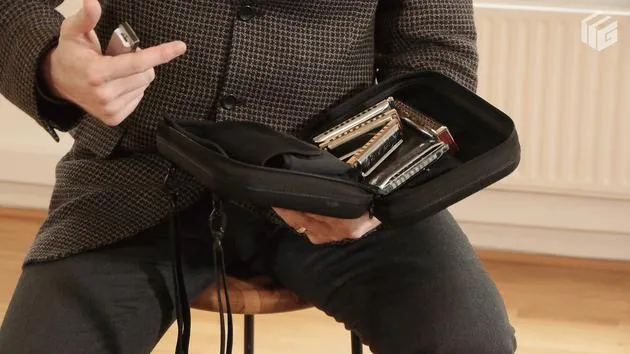
01. Getting familiar with your harmonica
Free lesson3:56
02. Simple chord rhythm, first blues solo
8:52

03. Learn a simple blues solo
7:04
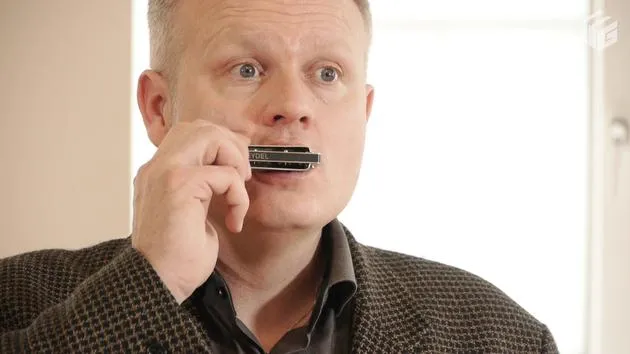
04. Embouchure (lip shape)
4:51

05. When The Saints Go Marching In
You are here12:37
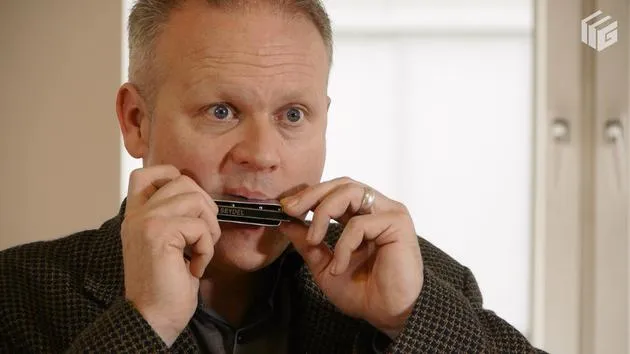
06. Toungue blocking
8:03
07. Playing scales
1:58

08. Simple boogie rhythm
5:25

09. BONUS: Learn to play The Beatles, Love Me Do
Free lesson1:48
Lesson transcript
Introduction to Playing a Simple Melody on the Harmonica
Hello, my name is Matt. And now we're going to look at playing a simple melody, a simple tune on the harmonica. This time, we're not using the blues scale; we're using the major scale on our C diatonic harmonica.
Understanding the Harmonica
The harmonica was designed back in Germany, in the 1840s, so you could play tunes in the middle bit and use chords at the bottom to accompany that melody. However, what they did was take two notes out of the first scale, so it doesn't go:
Do, Re, Mi, Fa, Sol, La, Ti, Do.
Instead, it goes:
Do, Re, Mi, so Ti, Do.
- In the middle, you've got: Do, Re, Mi, Fa, Sol, La, Ti, Do.
- At the top end, there's nearly a full scale, but the second to last note is missing.
When we play tunes, we restrict it at first to the middle chunk of the harmonica, where we have a full suite of notes. Eventually, if you learn to bend the notes, you can get the missing notes back, but that's quite difficult and for more advanced players.
Embouchure and the First Tune
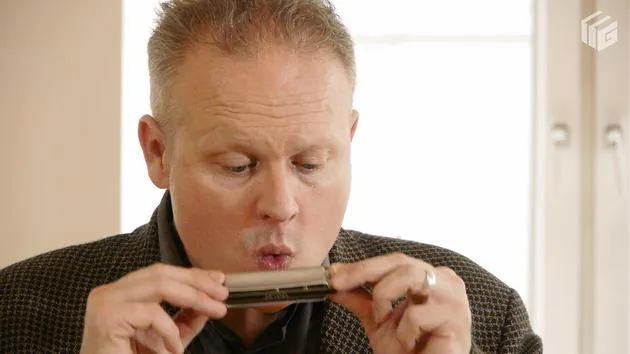
Now, looking at our first tune, we need to think about our embouchure.
-
Say "oo" in your deepest voice and freeze. What happens when you do that?
- It puts your embouchure together.
- Drops your chin.
- Puts your lips into a circle.
- Makes your tongue do that at the back.
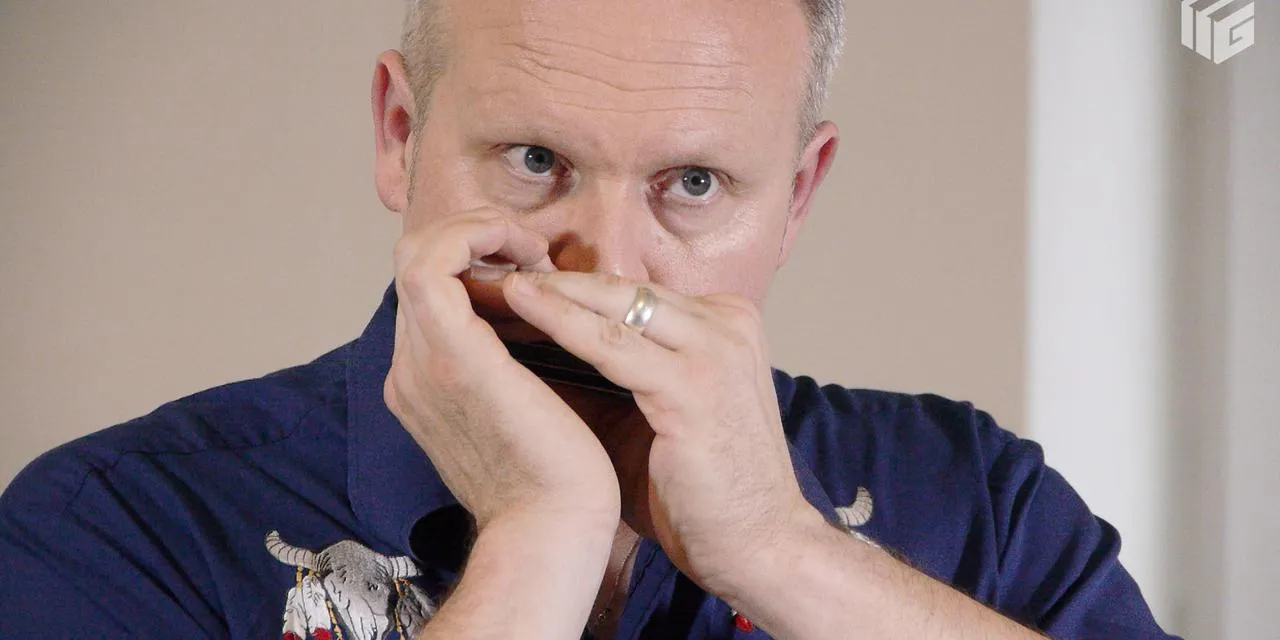
We're going to play a tune called "When the Saints Go Marching In." This only involves holes 4, 5, and 6 on your harmonica.
Tablature Instructions
The tab (tablature) for this is written out on the site in glorious Technicolor. The numbers refer to the holes on your harmonica:
- First line: 4, 5, 5, 6
- 4 and 5 (green): Blow
- Second 5 (red): Draw (or breathe in)
- 6 (green): Blow
So, the first line of "When the Saints Go Marching In" sounds like this:
- Tab: 4, 5, 5, 6
If you do each number as an individual breath, it sounds very choppy, very staccato.
Fluid Playing Technique
A better way to approach it is to slide from one note to another while still breathing, as it makes it sound much more fluid.
- For example, in the first line, you'll want to slide from:
- Four blow to five blow while still breathing out for a smoother sound.
Let's try playing "When the Saints Go Marching In" really slowly, after a count of three:
1, 2, 3...
Don't worry if you get two notes at once; it takes a while for the embouchure to develop. Even if it sounds like this, it's still recognizable as "When the Saints Go Marching In." It's all good practice!
Articulations and Final Lines
You'll notice there are some articulations in this tune. When we come to the line, "I'm gonna be in that number," there are two Ds on number 5 and two Ds on number 6 at the end. This adds a sung quality to the tune.
Whenever you see the opportunity in this or any other tune to slide from one note to another, take it as it makes everything sound much more fluid.
At the end of the last line, you have a sequence:
- 6 blow, 5 blow, 4 blow in a line.
Again, it's best to try and do those in one breath. This develops a slightly jerky movement of the head which helps separate one note from another.
Breathing Technique
Take your time with it and breathe gently as well.
- Remember, you don't need to breathe hard into your harmonica.
- Nice and slow, and steady.
- Each time you pick up the harmonica, think: "I want to get it a little bit further inside my lip shape."
Getting it inside your mouth shape each time makes all the difference!
Chord Rhythm Practice
With the chord rhythm, we can do a variety of things. As you know, it fits all the way through the 12-bar structure.
- You can drop it in any way you like and it's going to sound okay.
You can also play it at different tempos. It works well when played slowly, but with practice, you can speed it up.
Tips for Speed
- Start off nice and steady:
- Day 1: 5 miles an hour
- Next practice: Aim for 10 miles an hour
- Then: 15 miles an hour, rather than going for 90 miles an hour at first.
For a fun exercise, start slowly like a train leaving the station, then get gradually faster.
Volume Control Techniques
You can also use your chord rhythm for volume control. Here are two ways:
- Start at normal volume and drop down to very quiet, then bring it back to loud , like this.
- Gradually increase the volume as if you were turning up your stereo.
Blues Solo Practice
When practicing Blues Solo Number One, we can fill in the blanks between phrases.
- The phrase: da, da, da, da
- Rather than counting two beats, say tut, tut on the chord of 1, 2, and 3.
Here's a demonstration. Feel free to join in:
1, 2, 3...
We can also use the Blues Solo Number One to practice dynamics, going from normal volume down to quiet and back to normal.
Final Demonstration
Let's play Blues Solo Number One in the usual way, then have the guitar go quiet.
When the guitar goes quiet, the harmonicas go quiet as well. Then, when the guitar returns to normal volume, so do the harmonicas.
Let's give it a go after a count of three:
1, 2, 3...
And there you go!
9 lessons
0h 54m of structured video lessons
Advanced video features
Slow down, loop a passage, follow along
Mobile, tablet & desktop
Practise wherever you are
100% satisfaction guarantee
30-day money-back guarantee
Meet your guru
Meet your guru
Mat Walklate is a Manchester-based harmonica player and teacher working in blues and folk, who also plays flute, whistle and uilleann pipes and sings. He won the British Blues Harmonica Championship in 1992 and the All-Britain Fleadh Cheoil on harmonica in 1993, and is a Seydel-endorsed artist.
Over a thirty-year career he has toured Europe with bands including The Moochers and the Irish-music group The House Devils, recorded and mixed some fourteen albums between 2001 and 2021 - among them Sea of Blues and Traditional Harmonica - and now performs in a duo with singer-guitarist Alex Haynes and alongside blues scholar Dr Tom Attah. He teaches harmonica at Leeds Conservatoire and privately.
On MusicGurus his courses take you from your first notes on a C harmonica - embouchure, the cross-harp position, bending and your first improvisation - through to fluent blues playing, with vibrato, alternative positions and the phrasing that makes a solo sing.







