



La note fa# - Doigté et exercices
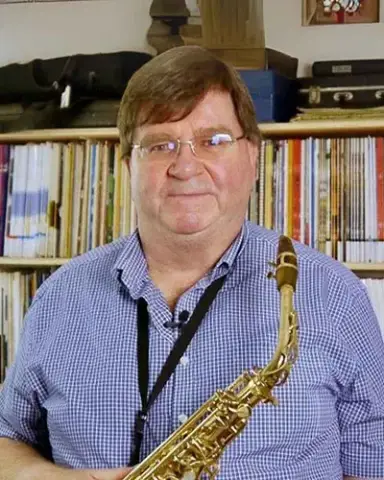
Lesson time: (4min 37sec)
Apprends à doigter le fa dièse au saxophone et comprends comment fonctionnent les dièses, les bémols et les armures.
Copyright © 2023 Universal Edition (London) Ltd., All compositions by James Rae except where otherwise indicated.
Course preview
This lesson is part of the course Saxophone : élargis ton registre
Watch a preview of the full course below.
Lesson transcript:
Music Lesson: Understanding F Sharp
In this section, we deal with the first sharp we encounter in music: F sharp.
Fingering F Sharp on Saxophone
- On the saxophone, F sharp is played by:
- Fingering G
- Adding the middle finger of the right hand on the middle key
It sounds like this: G. F sharp's a little bit lower and there's a G.
Understanding Sharps and Flats
- A sharp is pretty much a hashtag symbol.
- When placed before a note, it:
- Raises its pitch by half a step (or a semitone).
Conversely, a flat lowers the note by a semitone when placed in front of it.
Key Signature
- You often see sharps and flats at the beginnings of a line of music.
- This is called the key signature.
- For example, if you put F sharp at the beginning of the line, this means:
- All the Fs in the piece will be played as F sharps unless otherwise marked with another accidental, like a natural or a flat.
- For example, if you put F sharp at the beginning of the line, this means:
But that's something we'll look at later on.
Exercises
Exercise 1: Long Notes
- The first exercise in this section deals with all the notes we've done so far in a long note fashion.
- Play eight counts on each note to recap everything we've learned note-wise so far.
These are all the notes we have at our disposal at the moment.
Exercise 2: Up and Down the Hill
- Exercise two focuses on going up and down a hill.
- This is a little technical workout for the fingers.
Exercise 3: Leaps
- Exercise three is similar but involves leaps.
- Here we move two fingers at a time.
- Try to avoid catching the notes in between:
- In the first bar, it's the A, do not play the A.
- In the second bar, it's G, don't want to hear that.
We want to hear nice, clean intervals.
Exercise 4: Changing Patterns
- Exercise four is a pattern where the first note of every two bars changes, but the rest remain the same.
- Listen to the pattern.
Again, keep the big leaps clean, etc.
About the instructor
James Rae est né à Tyneside en 1957. Il a étudié la clarinette, la clarinette basse, le piano et la composition à la Guildhall School of Music and Drama de 1975 à 1979, respectivement auprès des professeurs Yona Ettlinger, Stephen Trier, Meriel Jefferson et Patric Standford. Depuis qu'il a quitté la Guildhall, il mène une carrière très réussie et variée dans trois domaines : l'interprétation, l'écriture et l'enseignement. James Rae a travaillé sur de nombreuses productions du West End et du Royal National Theatre, dont l'Oresteia primée de Sir Peter Hall sur une musique de Sir Harrison Birtwistle, et il a reçu de nombreux engagements en freelance auprès de certains des plus grands orchestres et ensembles du pays. Il est le leader du Phoenix Saxophone Quartet, qui, au fil des ans, a donné de nombreux récitals et diffusions à la BBC, et a enregistré l'intégrale des œuvres de Carey Blyton sur deux albums, 'The Return of Bulgy Gogo' et 'Sherlock Holmes meets Dr Who'. En tant que compositeur, James Rae est l'un des auteurs de musique pédagogique pour vents les plus publiés d'Europe, avec plus de 250 publications à son actif, principalement éditées par Universal Edition. Sa musique comprend des cahiers d'étude instrumentale, des sonates, des méthodes, des transcriptions baroques, classiques et jazz, ainsi que de nombreux recueils de duos, dont beaucoup figurent dans tous les grands programmes d'examen pour instruments à vent du monde entier. Il a également écrit quatre comédies musicales pour écoles avec Mike Cornick, et parmi ses commandes les plus importantes figurent The Turn of a Wheel, une œuvre majeure pour orchestre d'harmonie créée en novembre 1999 pour le North Tyneside Concert Band, dont il fut membre fondateur enfant, et l'ouverture Moving On en 2012. James Rae a travaillé de manière approfondie comme consultant de programmes et compositeur pour l'Associated Board comme pour le Trinity College London, et s'est fortement impliqué dans l'élaboration des épreuves de déchiffrage pour bois des deux jurys d'examen. Comme enseignant, il a occupé de nombreux postes dans les secteurs public et privé, et travaille actuellement à la King's College School Wimbledon, où il dirige le Wind Orchestra et le Concert Band, ainsi qu'à la Shrewsbury House School de Surbiton, où il encadre trois grands ensembles et un groupe de chambre. Cette expérience pédagogique traverse toute sa série de saxophone pour MusicGurus, qui te mène pas à pas de tes toutes premières notes jusqu'à un jeu assuré et plein de style : First Notes, New Keys & Low Notes, Expanding Your Range, Scales & High Notes, Extended Range & Rhythm, et Polish & Style. read more