



Clé d'octave - doigté et exercices
Lesson time: (4min 23sec)
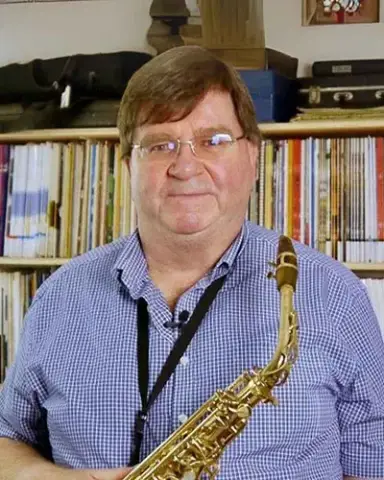
James Rae présente la clé d'octave et ta première note qui l'utilise - Ré - avec doigté et exercices pour faire travailler ton pouce.
Copyright © 2023 Universal Edition (London) Ltd. Toutes les compositions par James Rae sauf indication contraire.
Course preview
This lesson is part of the course Saxophone : élargis ton registre
Watch a preview of the full course below.
Lesson transcript:
Introduction to the Octave Key and the Note D
This section of the book introduces the use of the octave key and the note D. It's a very important section, as D is the first note we encounter that involves the octave key.
Understanding the Octave Key
- The octave key is located at the back of the saxophone.
- It's the only key we operate with our thumb.
- To use it, rest your thumb on the rest and pivot it across.
Tip: It might feel a bit strange at first, but you will get used to it.
Playing the Note D
D is played with:
- Fingers 1, 2, 3, 4, 5, 6 at the front
- Plus the thumb at the back
Sound Characteristics
- D has a slightly different sound compared to other notes on the saxophone.
- If you compare it with a B, D has a slightly veiled sound.
- It is the first note in what we call the upper register of the saxophone, which involves putting fingers down to go up, contrary to what we've done so far.
Exercises
Exercise One: Counting Exercise on D
- This exercise acts as a workout for the tongue.
- You can play it quite fast while maintaining:
- A relaxed throat position
- A curved finger position
Exercise Two: Approaching D from Below
- Starts with G moving up to D:
- A, D, B, D, etc.
- This may feel tricky at first, but with practice, it will become easier.
Exercise Three: Finger Coordination
- Each bar here is repeated to reinforce technique.
- It acts as a workout for the D and the thumb.
- This is challenging because you have to move several fingers at once to go one step. For example:
- From C to D requires moving both front fingers and your thumb.
Observation:
- Keep your fingers very close to the instrument at all times.
- Any excess movement is wasted if you take your fingers too far away; it doesn't produce any effect.
Key Technique
- The only movement that accomplishes anything is the movement of the keys.
- Try to keep your fingers just touching the keys as you move them around.
- This practice leads to a very rapid technique.
Analogy:
Think of a good typist. Their fingers hardly leave the surface of the keyboard, apply the same principle to the saxophone.
Exercise Four: Approaching D from Below
- Follow the same routine as previous exercises, focusing on approaching D from below.
About the instructor
James Rae est né à Tyneside en 1957. Il a étudié la clarinette, la clarinette basse, le piano et la composition à la Guildhall School of Music and Drama de 1975 à 1979, respectivement auprès des professeurs Yona Ettlinger, Stephen Trier, Meriel Jefferson et Patric Standford. Depuis qu'il a quitté la Guildhall, il mène une carrière très réussie et variée dans trois domaines : l'interprétation, l'écriture et l'enseignement. James Rae a travaillé sur de nombreuses productions du West End et du Royal National Theatre, dont l'Oresteia primée de Sir Peter Hall sur une musique de Sir Harrison Birtwistle, et il a reçu de nombreux engagements en freelance auprès de certains des plus grands orchestres et ensembles du pays. Il est le leader du Phoenix Saxophone Quartet, qui, au fil des ans, a donné de nombreux récitals et diffusions à la BBC, et a enregistré l'intégrale des œuvres de Carey Blyton sur deux albums, 'The Return of Bulgy Gogo' et 'Sherlock Holmes meets Dr Who'. En tant que compositeur, James Rae est l'un des auteurs de musique pédagogique pour vents les plus publiés d'Europe, avec plus de 250 publications à son actif, principalement éditées par Universal Edition. Sa musique comprend des cahiers d'étude instrumentale, des sonates, des méthodes, des transcriptions baroques, classiques et jazz, ainsi que de nombreux recueils de duos, dont beaucoup figurent dans tous les grands programmes d'examen pour instruments à vent du monde entier. Il a également écrit quatre comédies musicales pour écoles avec Mike Cornick, et parmi ses commandes les plus importantes figurent The Turn of a Wheel, une œuvre majeure pour orchestre d'harmonie créée en novembre 1999 pour le North Tyneside Concert Band, dont il fut membre fondateur enfant, et l'ouverture Moving On en 2012. James Rae a travaillé de manière approfondie comme consultant de programmes et compositeur pour l'Associated Board comme pour le Trinity College London, et s'est fortement impliqué dans l'élaboration des épreuves de déchiffrage pour bois des deux jurys d'examen. Comme enseignant, il a occupé de nombreux postes dans les secteurs public et privé, et travaille actuellement à la King's College School Wimbledon, où il dirige le Wind Orchestra et le Concert Band, ainsi qu'à la Shrewsbury House School de Surbiton, où il encadre trois grands ensembles et un groupe de chambre. Cette expérience pédagogique traverse toute sa série de saxophone pour MusicGurus, qui te mène pas à pas de tes toutes premières notes jusqu'à un jeu assuré et plein de style : First Notes, New Keys & Low Notes, Expanding Your Range, Scales & High Notes, Extended Range & Rhythm, et Polish & Style. read more