



Dora and Bootsy (Analyse)
Une analyse pro du morceau funk de Grade 2 'Dora and Bootsy', couvrant ses contretemps syncopés, le charleston ouvert à la mesure 3 et la régularité qui maintient le groupe soudé.
Le contenu du cours
28 leçons (2h 7min) · 1 gratuites
01. Georgia On My Mind – Ray Charles
2:38
02. Maggie May – Rod Stewart
1:31
03. Relegation Riddim – Bugzy Malone
1:19
04. Heard it through the Grapevine – Marvin Gaye
1:20
05. Losing my Religion – REM
1:26
06. Passionfruit – Drake
1:14
07. Bleach
1:19
08. Dora and Bootsy
Leçon gratuite1:32
09. Cuba Mama
1:21
10. For You
1:26
11. Slipstream
1:20
12. Y'all
1:29
01. Heard it through the Grapevine – Marvin Gaye (Analyse)
7:22
02. Losing my Religion – REM (Analyse)
10:19
03. Georgia On My Mind – Ray Charles (Analyse)
10:42
04. Maggie May – Rod Stewart (analyse)
10:40
05. Passionfruit – Drake (analyse)
8:18
06. Relegation Riddim – Bugzy Malone (Analyse)
11:10
07. Bleach (Analyse)
12:19
08. Dora and Bootsy (Analyse)
Tu es ici4:16
09. Cuba Mama (Analyse)
3:46
10. For You (analyse)
2:51
11. Slipstream (analyse)
7:01
12. Y'all (Analyse)
8:49
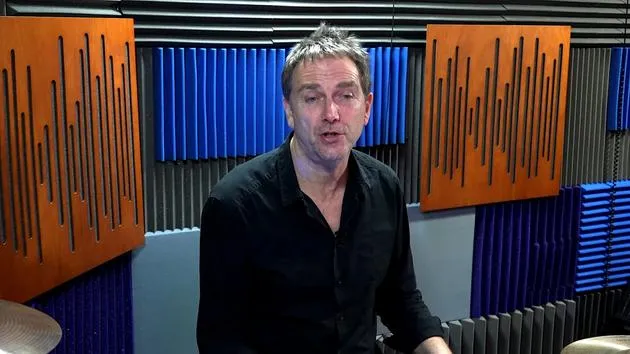
Transcription de la leçon
Music Lesson: Funk Tune with Dora and Bootsy
Okay, so Dora and Bootsy. Grade 2. It's a really, really funky tune. Bootsy is obviously a reference to Bootsy Collins, the bass player from Parliament. And we're really, really going down that route with this.
Key Points About the Tune
- Funk Style:
The term "funk" usually means you'll encounter snare and bass drum hits that are not strictly on beats 1 and 2. There's a lot of syncopation, emphasizing the off beats, which sounds great, and I really enjoy it.
Things to Watch Out For
-
Bar 3:
There's an open hi-hat lasting for a whole beat. Make sure that you finish the open hi-hat and play the snare drum at the exact same time. You want to ensure that it finishes exactly with the snare drum. -
Steadiness:
With all these pieces, it's particularly important to be steady because you're taking care of the whole band. When you play this live, there's a horn section and a big rhythm section. It's vital for you to be the anchor. -
Listen to the Track:
Sit back on it. Try not to rush, as it's tempting when you play something that may not be as technically demanding, but it's still difficult, so pay it some respect.
Tom Fills and Ride Beat
-
Tom Fills (Bars 12, 13, and 17):
Be careful with the orchestration; they're not always played in a straightforward manner around the drums. Read them carefully. -
Ride Beat:
Maintain a consistent ride beat throughout. I wouldn't recommend playing accents, let's keep them even. It's a lovely wash that serves as a bed for the kicking snare.
Important Timing Notes
-
At Section B:
You'll have the snare drum on beat 1 and then beat 2 and. This can be a surprise if you haven't seen it coming. Practice that, and remember that after playing the snare on beat 2, you still have two quavers of silence before the next snare drum. -
Counting:
Count: 1 and 2 and 3 and 4 throughout. Don't let yourself turn 2 and into 2. -
Volume Levels:
Throughout the piece, I'd like the bass drum and the snare drum to be at the same volume consistently. There's no variance in levels; this approach will tie the whole band together. Trust me, it's going to sound cool!
Inspiration from Great Drummers
In the book, there are mentions of some really cool drummers, like Clyde Stubblefield from James Brown, who is a big influence. I will play a little bit within this funk style, starting quite basic like this piece, and I'll see what happens within that funk genre.
Concluding Thoughts
- Syncopation:
Syncopation can range from simple (snare drum on 1 and 2 and) to very complicated. Keep working at your current speed and push through those grades, and you'll get there, I promise.
See you there!
28 leçons
2h 7m de leçons vidéo structurées
Fonctions vidéo avancées
Ralentissez, bouclez un passage, suivez la partition
Mobile, tablette et ordinateur
Pratiquez où vous voulez
Satisfaction garantie à 100 %
Garantie remboursement 30 jours







