



Ressentir le rythme en mesure 7/4 - avec Unsquare Dance, Seven from Heaven, Earthrise, 7/4 Etudes

Lesson time: (16min 6sec)
Darius et Mike utilisent Unsquare Dance de Dave Brubeck pour expliquer comment ressentir une mesure à 7/4, y compris les différents types de métriques et de subdivisions possibles au sein de cette mesure. Le morceau de Darius, Earthrise, et celui de Mike, Seven from Heaven, sont également explorés pour observer différents feels en sept.
Course preview
This lesson is part of the course Maîtriser les mesures impaires
Watch a preview of the full course below.
Lesson transcript:
Welcome Back to Music Gurus: Exploring Time Signatures
Introduction to 7/4
Today, we'll start unpacking 7/4. You've just listened to Unsquare Dance, a big hit from the Time Further Out album by the Dave Brubeck Quartet recorded in 1961. It may sound familiar to you because bits of it have been quoted constantly in soundtracks throughout the years.
The asymmetry of that beat suggests action and excitement, especially with the hand clapping. The title, by the way, is a bit of a joke ? a square dance versus an unsquare dance, since we're talking about 7/4.
Listening for Patterns
Let's listen to a bit more and pay attention to the hand clap pattern because we'll be discussing that.
"The hand clap in Unsquare Dance is really the main reason it was a hit."
I've very successfully had whole audiences clapping along to it at the end of concerts. They certainly weren't counting; they were simply feeling the beat.
Clap along with me:
- 1, 2, 3, 4, 5, 6, 7
- 1, 2, 3, 4, 5, 6, 7
Sometimes, I walk up to the apron of the stage and start that, and it takes a while for the audience to feel it. One exception was when I played in Riyadh; all of the Arabs in the audience seemed to relate rhythmically.
Cultural Context of Time Signatures
The idea of these "odd times" really came from the Dave Brubeck Quartet's tours across the Middle East and into Asia.
In India, they have a system for counting or feeling beats called the tala system. This makes what you're listening to in a Western jazz situation very explicit.
In jazz, you tend to snap on 2 and 4, which is not the same as:
"1, 2, 3, 4. 1, 2, 3, 4."
These things are cultural; we have different conventions for feeling the beat. In the Indian tala system, breaking it up into threes and twos or threes and fours is quite explicit.
The 7/4 Beat in Jazz
In 7/4, a very popular tala is:
- 1, 2, 3, 4, 5, 6, 7
In jazz, we often start with the 4, which would be:
- 1, 2, 3, 4, 5, 6, 7
- 1, 2, 3, 4, 5, 6, 7
Dave and the other musicians were exposed to the tala system. I have no direct evidence of this, but I infer that the idea of basing something on hand claps may have originated from that.
"For you jazz anoraks, this is good pub quiz material: Who did the hand claps on Unsquare Dance?"
If Joe Morello had his sticks in his hand, it was my father's brother, Uncle Howard, a conductor and composer, along with Teo Macero, perhaps the most famous producer Columbia Records ever had.
Practical Application
Now, I'll hand over to my colleague Mike for some practical exercises you can work on to apply this knowledge.
Clapping Exercise
Let's get back to the clapping.
Clap the basic Unsquare Dance:
- 1, 2, 3, 4, 5, 6, 7
- 1, 2, 3, 4, 5, 6, 7
Now, we switch that around, referring to what you mentioned in tala:
- 1, 2, 3, 5
- 1, 2, 3
Before you start playing, it's excellent practice to clap or sing it.
Practicing Scales
Now, let's take a scale fragment. We all love to practice our scales, right, Darius? Yes!
In the Western world, scales are generally made up of seven notes.
For example, let's practice:
- Start on C minor and go up half steps, accenting:
- 1, 2, 1, 2, 1, 2, 3
- 1, 2, 1, 2, 1, 2, 3
Now try reversing that to:
- 1, 2, 3, 1, 2, 1
- 1, 2, 1, 2, 3, 1, 2
This helps you internalize the rhythm while you play, while also looking at music and seeing the subdivisions.
Exploring 7/4
Another comment about 7/4:
Whichever way you turn it around, there are three accents in the bar. They are not equally distributed, as that would be six.
"Look for those three accents."
When listening or playing, try to articulate those accents so you won't get lost.
Vertical and Horizontal Approaches
You can also play around with adding different styles:
- Play vertically using arpeggios or extending the chord up, focusing on every other note of the scale up to the 11th.
Starting from C minor:
- 1, 2, 3, 4, 5, 6
You can also change it to three plus four, giving you many options to explore subdivisions within the bar.
Listening and Learning
We've listened to the bass pattern on Unsquare Dance, it's like a square dance, but unsquare because it's seven rather than eight.
My original tune, Earthrise, is a different way of relating to 7. I like to think of it as serene, similar to Herbie Hancock's Maiden Voyage, but of course, my tune is named N74.
Rhythmic Execution:
Mike, just count out loud while I play it:
- 2, 3, 4, 5, 6, 7
- 1, 2, 3, 4, 5, 6, 7
Additional Exercises
You can also play along with Mike's tune, which is featured in this series.
In the book, we have introduced a unique idea of having rhythmic sketches, offering rhythms without pitches to experiment with.
"These can be used as melodic ideas for improvisation."
Additionally, the etude is available on page 66 of the book. Here's the first four bars of the rhythmic sketch on page 69, which begins with the introduction to seven from heaven.
Recap:
- 1, 2, 3, 4, 5.
Feel free to take notes while playing along, experimenting with different comping patterns.
Remember, sometimes simplifying to specific rhythms might help, especially when confronted with a lot of notes on the page. Happy practicing!
About the instructor
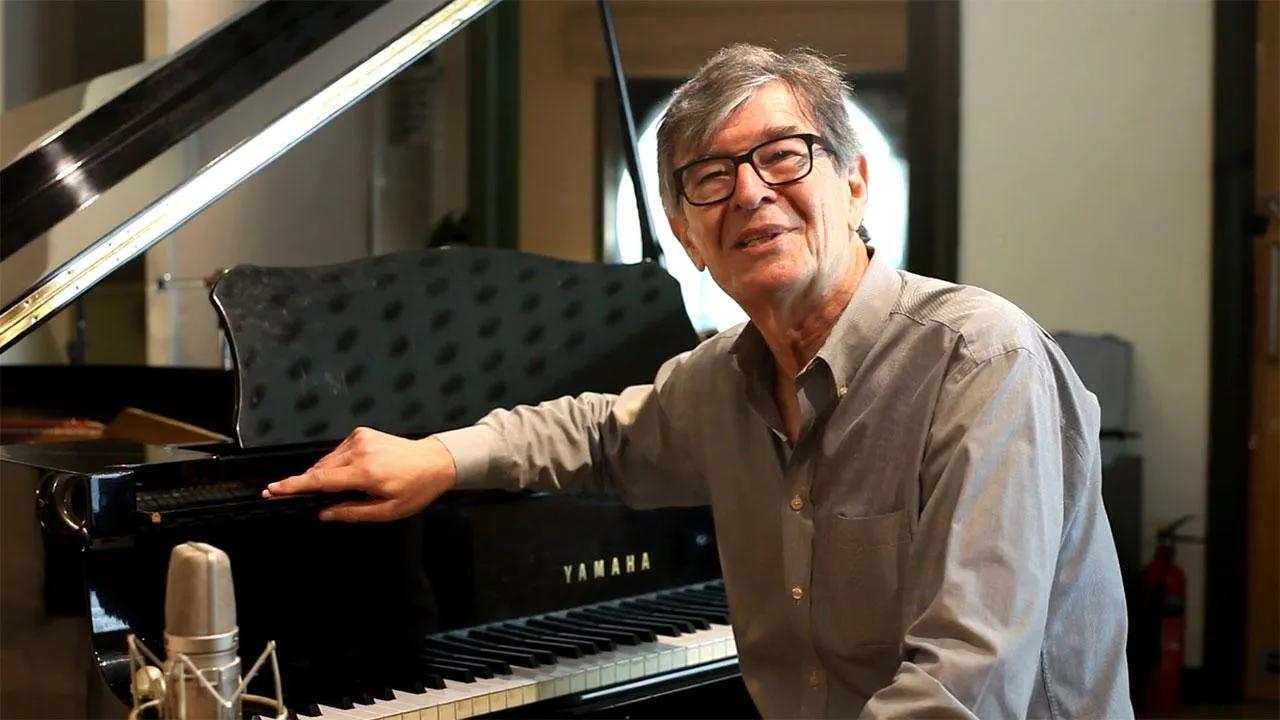
Darius Brubeck est un pianiste de jazz et pédagogue reconnu. Il a publié de nombreux albums en tant que leader, tourné à l'international avec ses propres formations et collaboré avec ses frères sur Brubecks Play Brubeck. Darius a été professeur invité Fulbright en Roumanie et en Turquie. Il a créé le premier cursus diplômant en jazz proposé par une université africaine, à la University of KwaZulu-Natal en Afrique du Sud, où il a enseigné jusqu'en 2005. Darius collabore souvent avec Mike Rossi, saxophoniste et professeur de musique à la University of Cape Town. Parmi les réalisations de Mike figurent de nombreux enregistrements et apparitions sur les scènes internationales en tant que leader, soliste et sideman aux côtés de Tony Bennett, Dave Liebman, Winston Mankunku Ngozi, George Russell, Clark Terry et Alessio Menconi, entre autres. Avec Darius pour guide, tu iras droit à l'essentiel. Dans Harmony 101, il démystifie l'harmonie du jazz pour que tu puisses te l'approprier rapidement, et dans Mastering Odd Times, il explique comment jouer et improviser avec assurance dans des mesures inhabituelles. read more