Les progressions d'accords et « faker » un morceau
Avec
Roy VogtRoy Vogt te montre comment 'faker' un morceau à l'oreille, en utilisant des progressions d'accords classiques comme le 2-5-1 pour trouver une ligne de basse sur le moment.
Le contenu du cours
5 leçons (2h 17min) · 1 gratuites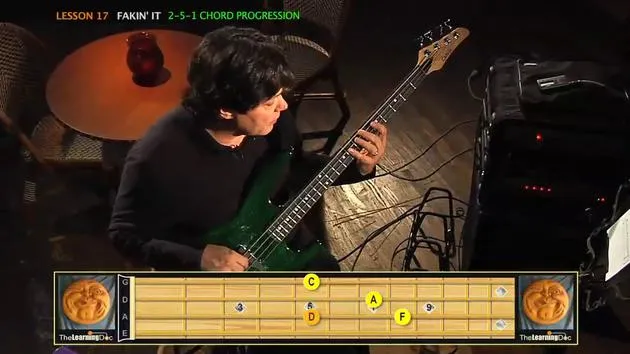
Transcription de la leçon
Music Lesson: Understanding Chord Progressions
Okay. Now, a lot of times when I'm working in a live music situation, I'll have to hear a chord progression and come up with a bass line on the spot. This is what's called faking a tune. It sounds like it's going to be a really difficult thing, but there are a few formulas that we can use to help hear the chord progressions.
These are called standard chord progressions, and they really do help you organize these tunes.
The 2-5-1 Progression
The first one is what is called a 2, 5, 1 progression.
- If we go back to our modal section, there was a two chord on the C, which was the D minor seven.
- There's your diatonic two, here's your diatonic five, and then here's your diatonic one: D minor seven, G seven, C major seven.
Common Use
A lot of standard tunes utilize this progression over and over again. For example, I just played:
- D minor 7
- G7
- C major 7
- C minor 7
- F7
- B flat major 7
- B flat minor 7
- E flat 7
- A flat major 7
- A flat minor 7
- D7
- G flat major 7
Playing Tips
When I start hearing those progressions, I don't really have to grab the third. If I can hear it, great! But one of the things I can do is just play roots and fifths.
- That's a good way to kind of get around this.
- If I have a chance to hear the third, I can put that in as well.
- Once again, just get used to hearing the two, five, ones, and so forth.
Turnaround Progressions
There are two different kinds of progressions that we call a turnaround that are used in different tunes.
1-6-4-5 Progression
One of them is called a 1, 6, 4, 5 progression.
- If you listen to a lot of 50s and 60s rock and roll, you'll hear this one.
- Essentially, a 1, 6, 4,5 progression in the key of C would be:
- C major (1)
- A minor (6)
- F major (4)
- G major (5)
Adding Sevenths
If I want to add sevenths to that:
- C major 7
- A minor 7
- F major 7
- G7
Chord Sound
Here's how the chords sound. That's how you might hear it in a 50s rock tune. A lot of times, you can hear that, and within a couple of passes, you'll be able to kind of figure out where things are.
Positioning with Piano Players
If there's a piano player, a lot of times I'll try to sit close to where his left hand is. This is particularly useful if the piano player is more familiar with the tune than I am; he can kind of feed me the roots.
- It's also a good idea to get some familiarity with the piano keyboard so that you can read the notes and then match once again.
- You can start with just the roots and you can add approach tones, particularly if you're walking.
1-6-2-5 Progression
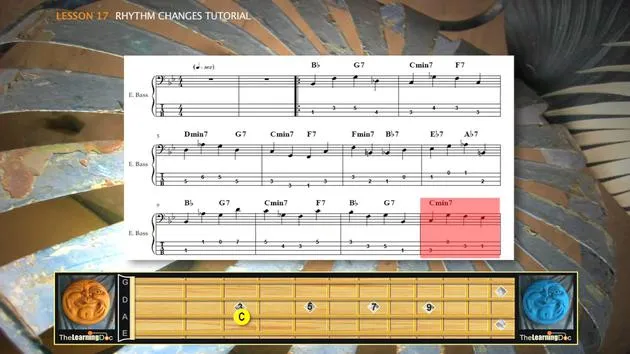
Now, there's a cousin of this that you see more of in standard tunes. This is called a 1, 6, 2, 5 progression.
- I'll play one in B flat.
- This is sometimes called a rhythm changes progression because it's based on an old Gershwin tune called "I've Got Rhythm."
- Many jazz musicians use this as a standard progression for their tunes.
Examples
You get tunes like:
- The Theme by Miles Davis
- Olio by Sonny Rollins
- A lot of the 30s and 40s pop tunes as well
Walking Through Chords
If I'm going to be walking through that, a safe choice immediately, if I can hear the 1, 6, 2, and 5, would be to either play just roots.
- You want to break up the rhythm to avoid sounding repetitious.
- With a swing line, you want to randomize that stuff.
Adding Complexity
The next step here would be to add the fifth, followed by adding an approach tone (half step, half step, half step).
The 1, 6, 2, 5 can either be:
- A major to A minor: so it's like one major (B flat major seven) to six minor (G minor seven) to a two minor (C minor seven) to an F7.
Secondary Dominants
You can also use what would be called a secondary dominant.
- A secondary dominant is just kind of a five chord that leads to another chord.
Example
If I go from a B flat major 7 to a G7, that G7 is really functioning as a V chord of the C minor 7.
Even though we're still in the key of B flat, you would have: G7, C minor 7, and F7.
5 leçons
2h 17m de leçons vidéo structurées
Fonctions vidéo avancées
Ralentissez, bouclez un passage, suivez la partition
Mobile, tablette et ordinateur
Pratiquez où vous voulez
Satisfaction garantie à 100 %
Garantie remboursement 30 jours
Rencontrez votre guru
Rencontrez votre guru
La carrière de Roy Vogt couvre un éventail extraordinaire de scènes, du Headbanger's Ball de MTV, du Montreux Jazz Festival et du Montreal Jazz Festival jusqu'au London Palladium, au Grand Ole Opry et au Kremlin. Du punk au funk, de la simplicité du country et du blues à la complexité du HyperJazz et du World Beat, il a tout joué.
Roy a été la première personne à obtenir un master en interprétation de basse électrique, à la prestigieuse école de musique de l'University of Miami, et il poursuit l'art de la basse depuis plus de quarante ans. Il a été le mentor de dizaines de professionnels reconnus, dont le légendaire Willie Weeks. Électrique, fretless, contrebasse - tu l'imagines : si ça joue des notes graves et que ça a des cordes, Roy en est un maître, et il excelle à l'enseigner aux autres.
Au cours de sa carrière de quatre décennies, Roy a enregistré ou joué avec une liste stupéfiante de grandes stars, dont Larry Coryell, Victor Wooten, Dave Weckl, Tom Scott et le LA Express, Chester Thompson, Miroslav Vitous, Glen Campbell, BJ Thomas, Chet Atkins, Engelbert Humperdinck, Dickey Betts, Tony Joe White, Charlie Daniels, Jerry Reed, et des dizaines d'autres.
Roy enseigne au niveau universitaire depuis trente ans. Depuis 1983, il occupe la chaire de professeur de basse à la prestigieuse Belmont University (Nashville, TN), l'une des très rares écoles à proposer un cursus diplômant en musique commerciale conçu pour transformer les étudiants en musiciens professionnels travaillant au sommet de l'industrie. Les élèves de Roy ont tourné et enregistré avec des stars de renom telles que Trisha Yearwood, Faith Hill, Little Texas, Michael W. Smith, Lady Antebellum, Chick Corea, Sir Tom Jones, Blood Sweat and Tears, Yanni et d'innombrables autres icônes de la musique.
Sa série Teach Me Bass Guitar t'apporte cette même approche de niveau universitaire, te menant d'un démarrage rapide pour débutant complet (vol. 1), en passant par les fondamentaux du rythme (vol. 2), la recherche de ton propre style (vol. 3) et une musicalité sérieuse (vol. 4), jusqu'à une boîte à outils de joueur pro (vol. 5), afin que tu développes de vraies compétences étape par étape.