



Les fondamentaux du rythme
Lesson time: (58min 52sec)
Roy Vogt aborde le côté rythmique de la basse : croches et silences, liaisons et rythmes pointés, syncope et jeu au médiator.
Course preview
This lesson is part of the course Teach Me Bass Guitar vol.1 : démarrage rapide pour débutants
Watch a preview of the full course below.
Lesson transcript:
Music Lesson Formatting
Warm-Up Exercise
Alright, welcome back. We're going to do something a little bit different for the warmup on this lesson. We're going to revisit our very first four by four exercise. This time, we will use a pick while playing the tune "Rocking Blues."
Playing with a Pick
Let's talk a little bit about how to play with a pick, and then we will use this for our warm-up.
-
Pick Choice: Select a fairly heavy pick to get a decent tone.
- A flabby pick can create an unwanted click unless that sound is desired, which is probably not the best choice.
-
Grip Technique:
- Use a little corner of the pick (about 1/8 exposed).
- Align your thumb parallel to the string being played.
There are many schools of thought regarding pick playing. I use the studio player's grip. Another method is to wear the bass around your knees and do downstrokes, which may feel reminiscent of an emo style. However, I find that this isn't very efficient.
Downstroke and Upstroke Pattern
- Perform a downstroke followed by an upstroke:
- Down, up, down, up...
From the perspective of the right hand:
- When playing, rotate your wrist rather than simply sawing back and forth.
- Keep your thumb parallel to the string.
Warm-Up Exercise Routine
For the warm-up, we will perform the first four by four exercise.
- Tempo: 60 BPM
- First Round: Play quarter notes.
- Second Round: Play eighth notes.
Eighth Notes Technique
Always follow a downstroke with an upstroke for a move-counter move effect.
Here we go:
- Count In: 1, 2, 3, 4.
- Eighth Notes:
- Now, let's do the eighth notes, starting with a down pick and answering with an up pick.
Key Point: Do not grip the pick too hard. Only use the corner of the pick.
Why Use a Pick?
Question and Answer
Question: Why use a pick at all? Is it just a matter of personal preference?
Answer: That is a great question! My personal opinion is that in certain styles of music, a pick works exceptionally well:
- Styles:
- Hard rock
- Punk rock
- Studio work
A pick gives a cleaner sound that can be more aggressive than using fingers, which produce a softer tone. Incorporating both techniques allows musicians to have more tonal colors at their disposal.
Eighth Notes Review
Now, we will clarify how eighth notes work:
-
Quarter Notes:
- Count: 1, 2, 3, 4.
- Played using an open E string.
-
Eighth Notes:
- Count: 1 and 2 and 3 and 4 and.
- Play twice as fast as quarter notes.
Tapping Technique
To feel the tempo, tap your foot:
- Downbeat: Foot down on the ground.
- Upbeat: Foot up in the air.
This tapping can help keep track of the rhythm.
Different Note Notations
We will look at how different notations can sound the same:
- Whole Note: 1, 2, 3, 4.
- Two Half Notes: 1, 2, 3, 4.
- Four Quarter Notes: 1, 2, 3, 4.
Comparative Playing: Let's play each of these together, with a count in.
Half Notes and Rhythmic Groupings
Half Notes
- Half notes can be perceived as:
- Two quarter notes tied together.
- Four eighth notes tied together.
Let's play all of these together with a count in.
Quarter Notes
If they are quarter notes:
- Play: 1, 2, 3, 4.
If tied together as eighth notes, they will sound the same with a count of: 1 and 2 and 3 and 4.
Dotted Notes
The rule of thumb for dotted notes:
- Placing a dot behind a note increases its length by half.
- For example, a dotted half note has the same sound as a half note tied to a quarter.
Let's explore how this sounds with a count in.
Dotted Quarter and Eighth Rhythm
In the second tune, we use a common dotted quarter eighth rhythm. This rhythm, characteristic of rock and roll, will tie together the first three eighth notes and then play the fourth eighth note.
Here's what it sounds like when played together:
- Count: 1, 2, 3, 4.
- Play: 1 and 2 and 3 and 4.
Let's transition into practice with the band.
Triads with Guest Jason
Introduction to Triads
Now, we welcome my student, Jason, to learn about triads. Remember, triads are formed from the first, third, and fifth notes of a major scale.
Triad on G:
- The G is located at the third fret on the E string.
Fingering:
- Second finger on G.
- First finger on the second fret of the A string.
- Fourth finger on the fifth fret of the A string.
A Minor Triad
Let's switch this to A Minor:
- Move the third (B) back to B flat (first fret).
Diminished Chord
For a Diminished Chord:
- Flat the third and modify the fifth.
- Start with G.
- Reach for B flat.
- Move back one fret to play D flat.
Augmented Chord
Moving to Augmented:
- Begin with the G and adjust the fifth up.
Easier Fingering:
- Use an easier shape to maintain a relaxed hand.
Playing Progressions
Major and Minor Movement:
- Take the shape and move it up the neck to find major and minor triads (A, C, D).
Final Practice and Improv
Chord Progression - Jam Session
We will now connect these triads in a 12-bar blues in G format.
- Progression:
- A minor to B minor.
- Transition to D minor and E minor.
To Play: Use pedal eighth notes for the bass line and integrate triads during play.
Conclusion
We have covered techniques with picks, triads, and various rhythmic notations. Remember to practice improvisation and jam with your friends!
Let's finish with some relaxation techniques after a lengthy playing session.
- Drop your hands to your sides and shake them out to relieve tension.
See you in the next lesson!
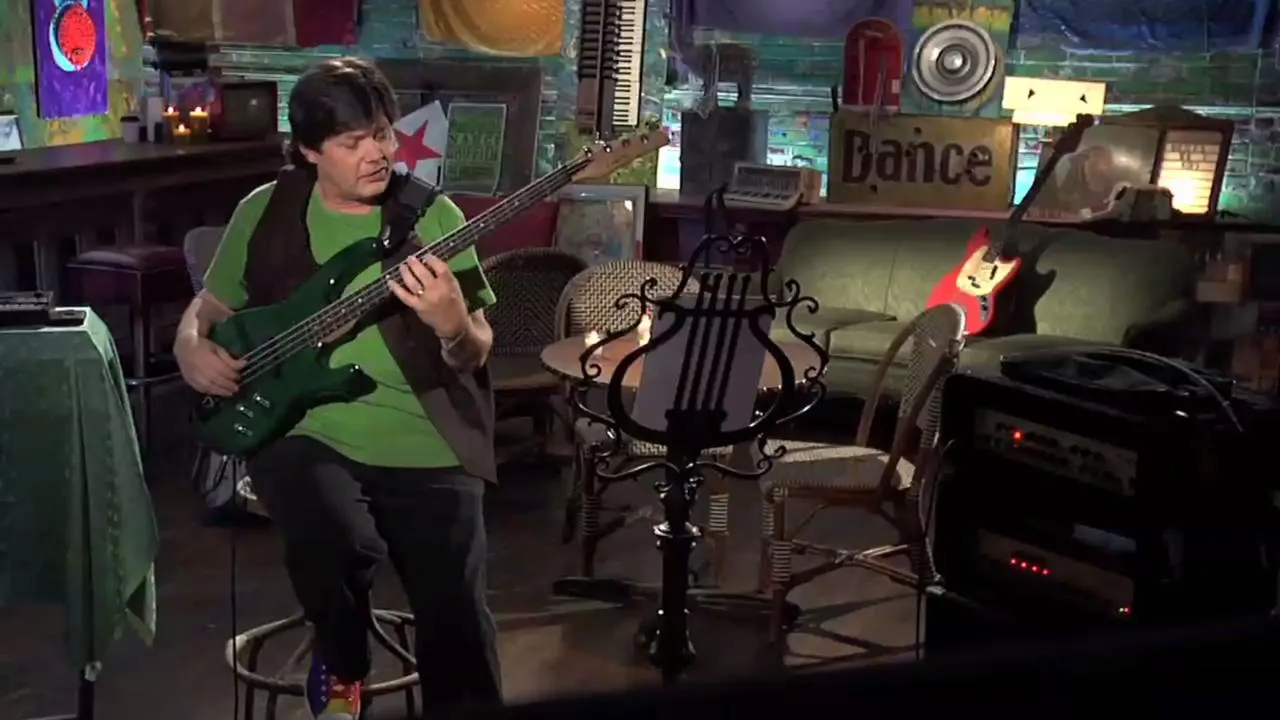
About the instructor
La carrière de Roy Vogt couvre un éventail extraordinaire de scènes, du Headbanger's Ball de MTV, du Montreux Jazz Festival et du Montreal Jazz Festival jusqu'au London Palladium, au Grand Ole Opry et au Kremlin. Du punk au funk, de la simplicité du country et du blues à la complexité du HyperJazz et du World Beat, il a tout joué. Roy a été la première personne à obtenir un master en interprétation de basse électrique, à la prestigieuse école de musique de l'University of Miami, et il poursuit l'art de la basse depuis plus de quarante ans. Il a été le mentor de dizaines de professionnels reconnus, dont le légendaire Willie Weeks. Électrique, fretless, contrebasse - tu l'imagines : si ça joue des notes graves et que ça a des cordes, Roy en est un maître, et il excelle à l'enseigner aux autres. Au cours de sa carrière de quatre décennies, Roy a enregistré ou joué avec une liste stupéfiante de grandes stars, dont Larry Coryell, Victor Wooten, Dave Weckl, Tom Scott et le LA Express, Chester Thompson, Miroslav Vitous, Glen Campbell, BJ Thomas, Chet Atkins, Engelbert Humperdinck, Dickey Betts, Tony Joe White, Charlie Daniels, Jerry Reed, et des dizaines d'autres. Roy enseigne au niveau universitaire depuis trente ans. Depuis 1983, il occupe la chaire de professeur de basse à la prestigieuse Belmont University (Nashville, TN), l'une des très rares écoles à proposer un cursus diplômant en musique commerciale conçu pour transformer les étudiants en musiciens professionnels travaillant au sommet de l'industrie. Les élèves de Roy ont tourné et enregistré avec des stars de renom telles que Trisha Yearwood, Faith Hill, Little Texas, Michael W. Smith, Lady Antebellum, Chick Corea, Sir Tom Jones, Blood Sweat and Tears, Yanni et d'innombrables autres icônes de la musique. Sa série Teach Me Bass Guitar t'apporte cette même approche de niveau universitaire, te menant d'un démarrage rapide pour débutant complet (vol. 1), en passant par les fondamentaux du rythme (vol. 2), la recherche de ton propre style (vol. 3) et une musicalité sérieuse (vol. 4), jusqu'à une boîte à outils de joueur pro (vol. 5), afin que tu développes de vraies compétences étape par étape. read more