



Dans A Sailheu - Tavarn - Danse des Deux Pommes Frites (leçon)
Avec
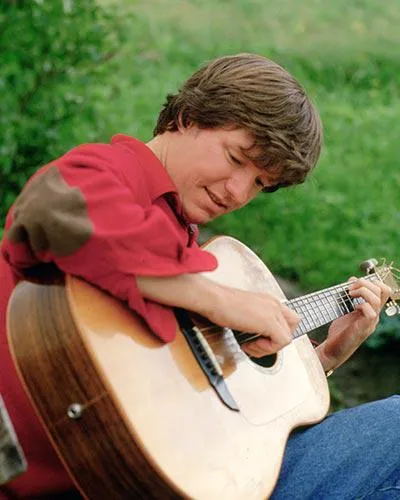
Steve BaughmanSteve Baughman enseigne trois morceaux de guitare celtique en accordage Orkney, en se concentrant sur les techniques simples de main droite qui donnent leur groove.
Le contenu du cours
13 leçons (1h 9min) · 1 gratuites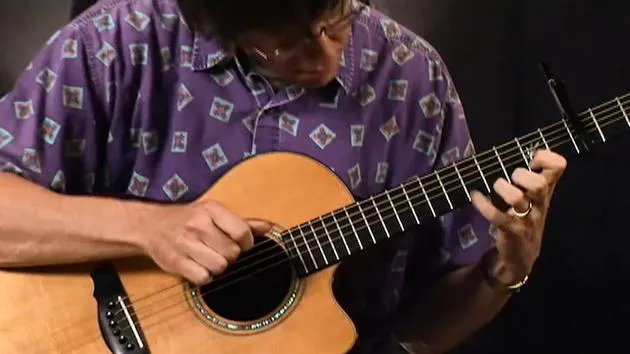
01. Dans A Sailheu - Tavarn - Danse des Deux Pommes Frites (interprétation)
Leçon gratuite5:10
02. Dans A Sailheu - Tavarn - Danse des Deux Pommes Frites (leçon)
Tu es ici10:24
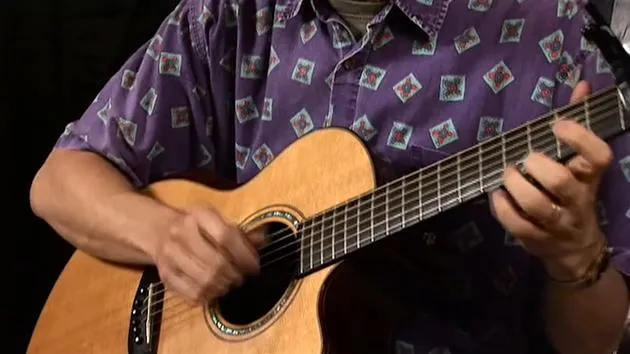
03. Little Beggar Man (performance)
1:54
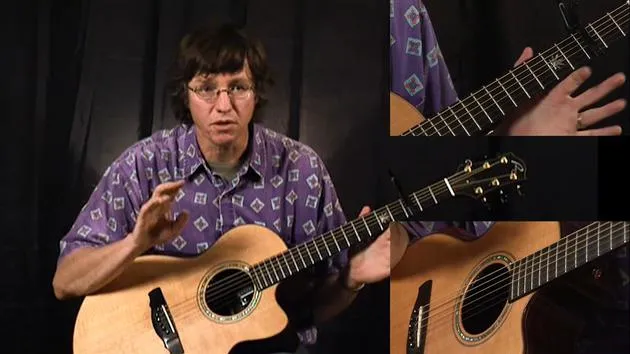
04. Little Beggar Man (leçon)
8:24
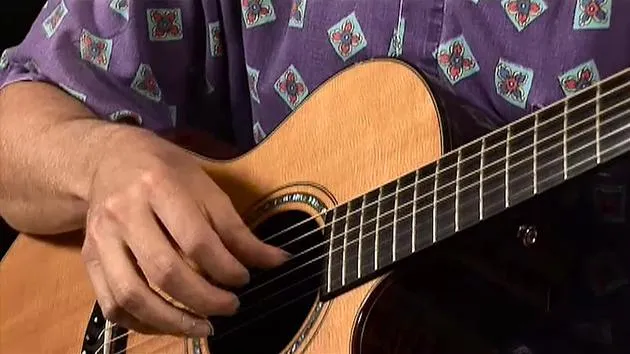
05. Loch Lomond (interprétation)
3:20
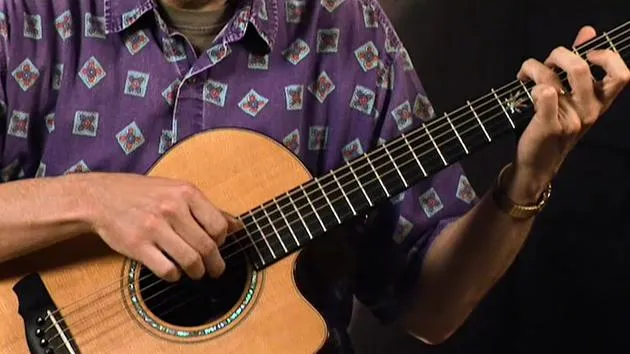
06. Planxty John Irwin (interprétation)
3:33
07. Planxty John Irwin (leçon)
1:29
08. Cool A Jig - The Choice Wife (interprétation)
4:09
09. Cool A Jig - The Choice Wife (leçon)
6:09
10. Neil Gow's Lament - Devil In The Kitchen - The Tushgar (interprétation)
6:24
11. Neil Gow's Lament - Devil In The Kitchen - The Tushgar (leçon)
11:08
12. Paddy Fahy's Jig (interprétation)
2:40
13. Accordage Orkney (leçon)
4:43
Transcription de la leçon
Right Hand Techniques in Music
There were some really fun, kind of exciting, cool right hand things happening in the second and third pieces that I just played. They involve really pretty simple techniques, but they can be quite powerful. Let me show you the most basic technique that I was using.
Basic Groove and Tuning
Keep in mind, when you go back and look at the tab, you'll see that I'm departing from these techniques frequently. However, these techniques still provide the basic groove to the pieces you heard.
Tuning
- Orkney Tuning: C, G, D, G, C, D
(Note: This tuning has nothing to do with the Orkney Islands in the north of Scotland.)
Capo
I usually don't have a capo on, but for these three pieces, I decided to use one. I'll take it off soon.
Right Hand Technique
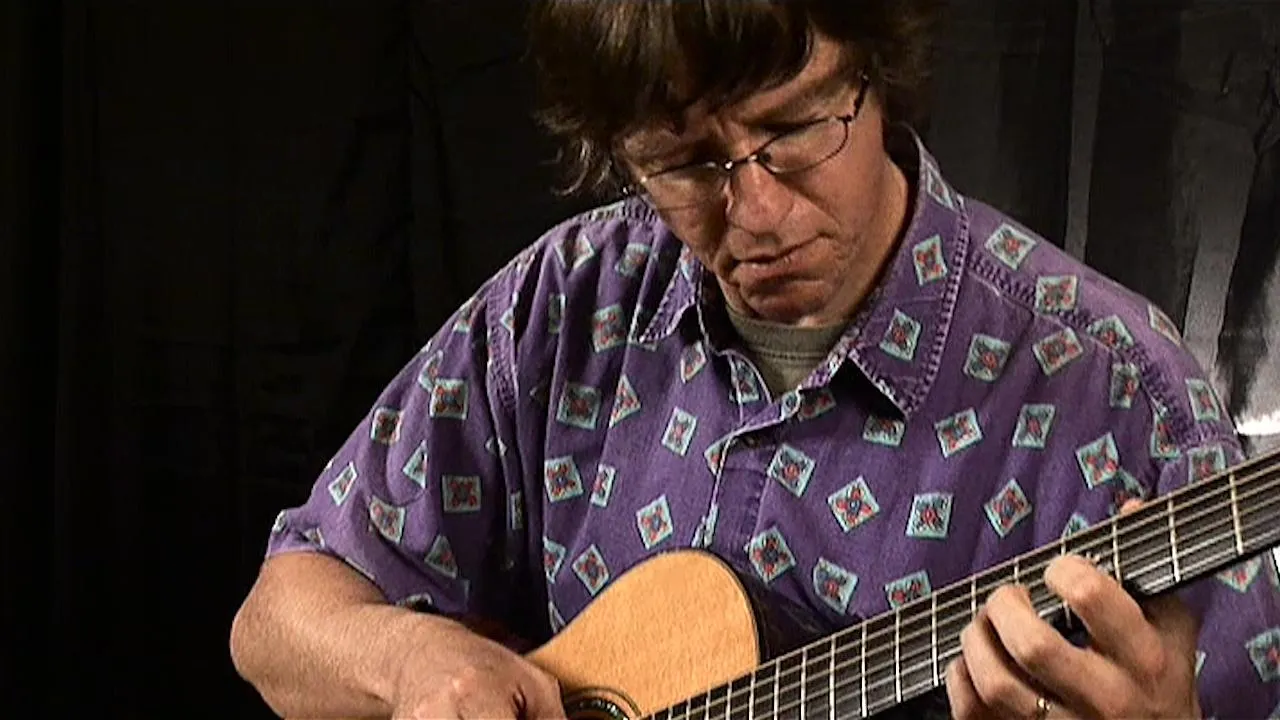
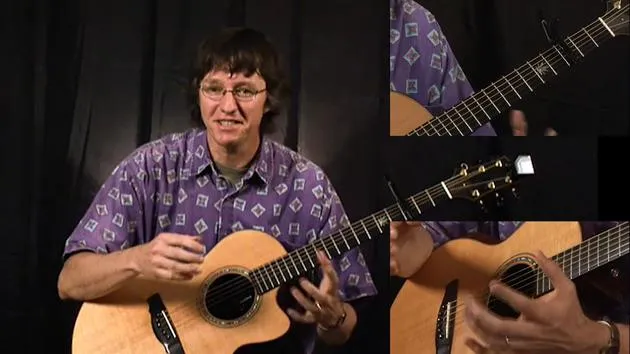
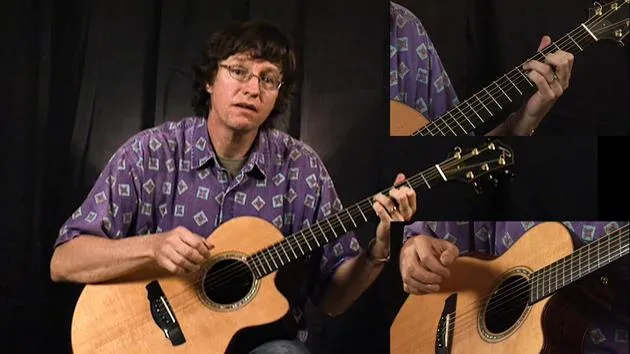
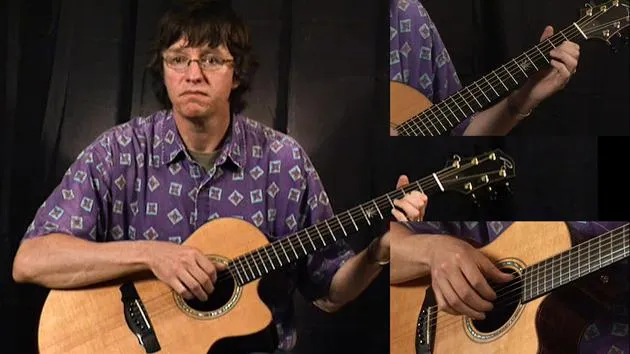
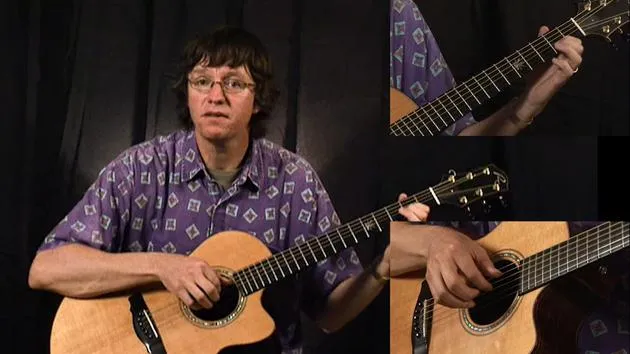
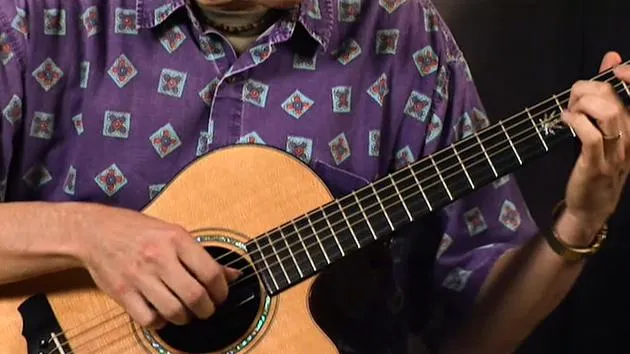
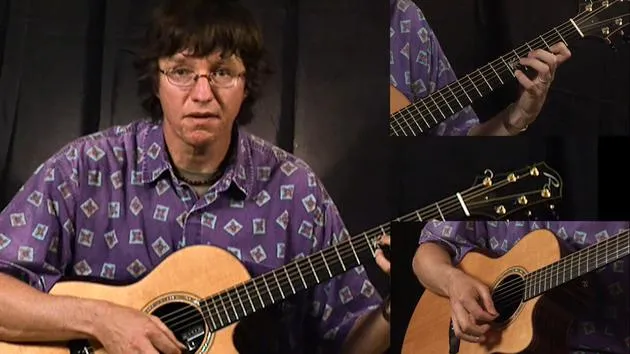
The technique I'll be using focuses on the right hand. This might be a good time to remind you about the angle function on your DVD remote. We're high tech here! You can isolate my left hand when you want to, my right hand, or just look at the full-body picture here.
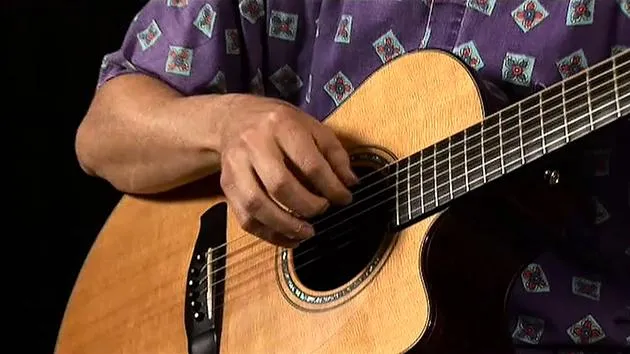
I recommend going to the right hand function because I'll be discussing a pretty important right hand technique.
Basic Pattern
That's the basic pattern. It's deceptively simple. You want to keep practicing this at home, in your car, or at work until you've internalized it.
- Technique: It involves a pinch followed by a downward pluck with the back of my fingernail.
- Effect: This gives you a flat-picking effect.
Introducing the Breton Riff
Now, I'm going to introduce the Breton riff. This is our pump primer riff for the techniques I will be showing you. It's just a little riff I came up with for this project to give you something fun to practice these techniques with.
Riff Example
Here's how the riff goes, and I'm going to play it a few times using just this basic technique.
"I could go on and on. That's really fun and really easy once you get this pattern in you."
All that sound I just made, a melody with bass happening with a groove, came from this simple technique.
Modifying the Technique
Now, I'd like to modify the technique ever so slightly. I'll keep the same groove but introduce more than one string during the first pass. It doesn't matter what strings I use yet; it's just about expanding the technique.
How It Sounds
This is how it sounds on our Breton riff. The old way becomes the new way. It fills it out, and while it doesn't necessarily make it better or worse, it's an option for your arsenal of techniques.
Important Note
It's crucial to remember, it's not important in this particular Breton riff, but when creating a right hand groove, if there's a note needed in your melody that's not in your right hand pattern, you can always grab that note with your left hand.
Counterintuitive Technique
This idea might be difficult at first, as it involves a new technique combined with a funky rhythmic style.
"Just this."
Middle Finger Thwack
Let me show you another variation on the Breton riff. This is the infamous middle finger thwack, a technique I learned from Martin Simpson. It's very useful but not necessarily suitable for an entire piece.
How It Works
- Technique: Take your middle finger, dig it into the base of your thumb, and flick it off like you're flicking a booger.
- Application: Isolate one single string for it. This can create a lot of noise and might sound awful if you don't hit the right string, but that's okay.
Riff Incorporation
Now, let me incorporate that into the riff.
"By the way, this is probably one of the most difficult patterns I'll be showing you."
If you get frustrated, don't give up! This requires practice.
Final Variation: Palm Slap
Lastly, let's explore the palm slap technique. I'll start with the very basic pattern I showed you earlier, but during the downward motion, I'll gently slap the strings.
Technique Explanation
- You want to keep the slap gentle and percussive.
- During the slap, you can either:
- Hit the string on your way down, or
- Skip the downward pluck entirely and create your melody note with your left hand.
Sound Example
What my right hand did there was simply this. I didn't need to do any downward plucking because I made the notes with my left hand.
"You can also help the melody along by keeping your downward pluck happening along with the slap."
That's really important! Thank you for participating in this lesson!
13 leçons
1h 9m de leçons vidéo structurées
Fonctions vidéo avancées
Ralentissez, bouclez un passage, suivez la partition
Mobile, tablette et ordinateur
Pratiquez où vous voulez
Satisfaction garantie à 100 %
Garantie remboursement 30 jours
Rencontrez votre guru
Rencontrez votre guru
Steve Baughman est l'un des vrais originaux de la guitare fingerstyle, un musicien dont le jeu acoustique aux accordages ouverts et aux racines celtiques a été salué par la critique des deux côtés de l'Atlantique.
« De temps à autre paraît un album capable de bouleverser votre façon de concevoir la musique de guitare ; Farewell to Orkney de Steve Baughman en fait partie... Un incontournable pour tous les amoureux de la guitare et surtout de la musique celtique. »
--Acoustic Guitar Magazine
« Une star de la guitare fingerstyle : très habile, réfléchi, discrètement audacieux, profondément lyrique et espiègle. »
--Radio National, Australie
« L'art et la musicalité de Steve sont de niveau mondial, avec une dynamique, un timing et une interprétation qui font toujours ressortir l'essence émotionnelle de la chanson. »
--Sing Out Magazine
« ...innovation technique, virtuosité et intensité. »
--Acoustic Guitar Magazine
« Une virtuosité incroyable... met en valeur la beauté paisible de la guitare acoustique aux accordages ouverts. »
--Marin Independent Journal (Dommage que ce ne soit pas le Washington Post. Mais je m'en contenterai.)
Son album Farewell to Orkney a figuré parmi les « Meilleurs albums de 2013 » d'Acoustic Guitar Magazine.
Et puis il y a cette distinction que Steve n'arrive pas vraiment à prendre au sérieux. Il figure sur la liste Digital Dream Door des 100 meilleurs guitaristes fingerstyle de tous les temps, qui inclut des musiciens décédés. « Avant, je mettais ça dans mon dossier de presse. Puis je me suis dit que ce n'était que l'avis isolé d'un type ou d'une nana quelque part dans le cyberespace. N'importe qui peut faire une liste. D'ailleurs, combien peut-il y avoir de guitaristes fingerstyle, au fond ? Ça doit être difficile de ne pas entrer dans le top 100. Je soupçonne que les places 81 à 100 sont toutes des noms inventés. Du moment que tu as sorti un CD de guitare, tu es dans le top 80. Je crois que j'étais 77e. Peut-être qu'on va me retirer de la liste maintenant que j'ai dit tout ça. Mais j'apprécie la passion de la personne qui l'a établie. Merci de m'avoir inclus, ça a impressionné ma mère. Ça ne l'impressionnera peut-être plus. »
Dans Celtic Guitar Solos, Tunes & Techniques, Steve partage les accordages ouverts et les approches fingerstyle qui se cachent derrière ce son, pour que tu puisses le jouer toi-même.







