



Parcours du morceau
Lesson time: (4min 41sec)
Mike Lovatt parcourt le morceau en se concentrant sur les phrases de réponse et la respiration qui lui donnent une authentique couleur de trompette latine.
Course preview
This lesson is part of the course Joue de la trompette latine authentique
Watch a preview of the full course below.
Lesson transcript:
Music Lesson: Answering Phrases and Fluency
In this piece, there are a couple of little answering moments which appear at the end of each phrase. It's like a little answer to the previous phrase.
First Answering Phrase
- The first one comes on the top line.
- In the last bar of the top line, you'll notice that after the double bar, there's a dotted crotchet followed by a quaver tied to a minim, which is tied to a crotchet of the next bar.
To make that little answering phrase really clear, we could take a breath at the first beat of the bar. In other words, where the crotchet is tied over to the minim on that first beat, we could take a breath there.
When I'm playing music, I use a pencil and mark a little minus one. This means "off on one." You could do that again like we've done before, with other markings to make it clearer.
So, when you come to your performance, you know exactly where you're going to take a breath. You don't have to think about it; you can just do it.
Now, I'm going to play the first two phrases, and you'll hear the little secondary answer phrase after each one.
Hopefully, you noticed that I took a breath where I mentioned, on the tied note on the first beat of the bar that has the little answer phrase in. I'm sure you noticed where the answer phrase was because I leaned towards you.
Middle Section: Fluid Quavers
In the middle section, there's a line of quavers which we really need to make sure are well placed and in time.
- These are legato, but due to the key of B major, we have to make sure that we use the valves accurately.
- This means not only pressing the valves down accurately but also releasing them accurately as well.
Be quick about this. We don't want any more resistance in the trumpet than we need. If we press the valves down in a laid-back way, we're going to get a half valve, which results in resistance in the horn and it'll sound like this: [insert sound example].
We don't want it to sound like that. We need it to sound fluid.
Final Lines and Crescendo
There's another line of fluid quavers that comes later on in the piece, towards the end. If you take a look at the last two lines of the piece, I'll play them for you.
Here, we use a crescendo to go up the scale, that is a scale of B major. Then, at the end, we have the same kind of fluid line, but this time coming down, and then we have an arpeggio to finish the piece off.
You'll notice that those last two bars are written with two Fs (fortissimo).
- We need to use a lot of air and tongue there to get those notes, especially that bottom B, to come popping out and finish the piece off properly.
- We also need to ensure that we land on that first beat of the bar again.
Importance of Fluency
So, what's the reason for getting the fluency and the flowing of these quavers?
It's so that the music sits in the time properly.
In other lessons, we've talked about the samba two-beat feel as opposed to a four-beat feel when we play the quavers:
"Baba da da ba du da ba ba da da da."
We can try, even though there's a phrase mark over all those quavers, to tongue the first of every four notes, which gives the two-beat feel of the Latin.
I could do that again so you can hear how I'm tonguing the first of every four notes, which gives it that Latin dancey feel, that two-beat feel.
About the instructor
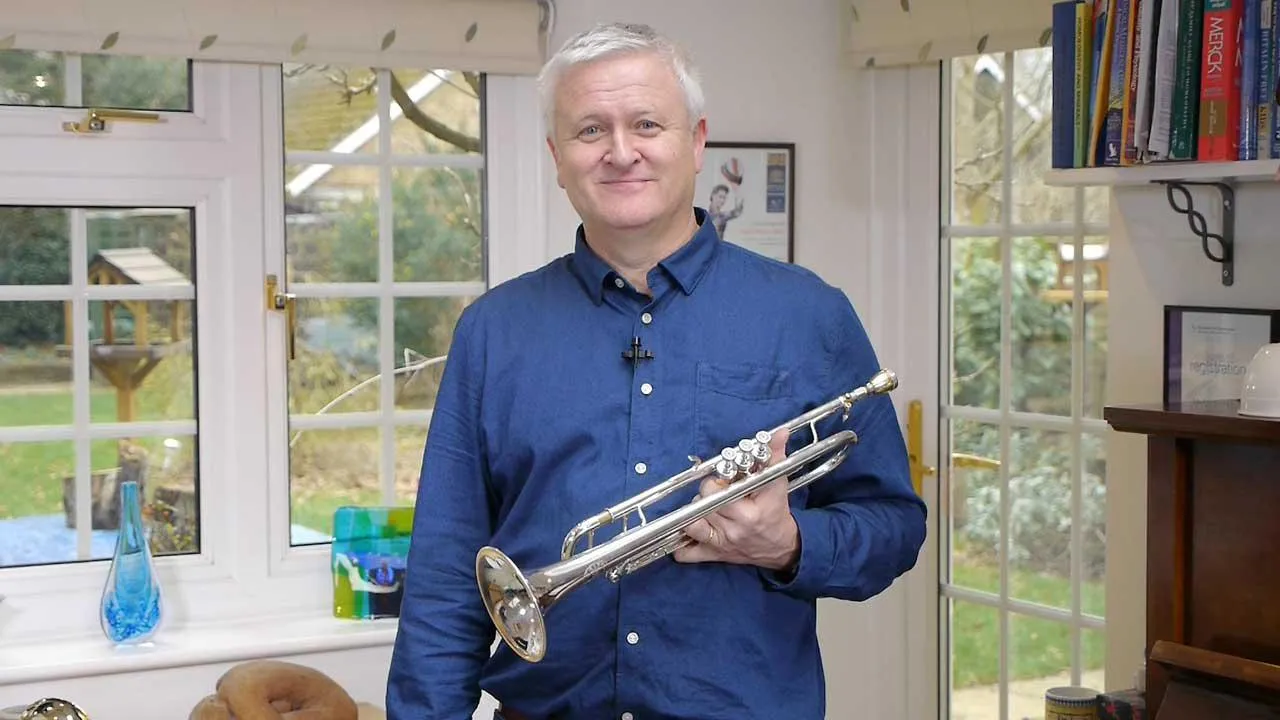
Mike Lovatt a étudié au Trinity College of Music, où il a reçu la Jon Kelly Jazz Scholarship. Il s'est produit et a enregistré dans une immense variété de styles avec des artistes tels que Quincy Jones, Robbie Williams, Eric Clapton, l'Orchestra of the Royal Opera House Covent Garden, le Royal Philharmonic Orchestra, Michael Buble, Oasis, Michel Legrand, Tony Bennett, Shirley Bassey et Danny Elfman, parmi bien d'autres. En tant que trompette solo dans le West End de Londres, Mike s'est produit dans Jesus Christ Superstar, Evita, The Producers, Billy Elliot, Guys and Dolls, Saturday Night Fever, My Fair Lady et Spamalot, entre autres. Il a joué sur des bandes originales de films dont les James Bond, Harry Potter avec le London Symphony Orchestra, le film primé Chicago, Beyond the Sea de Kevin Spacey, Charlie and the Chocolate Factory, Madagascar et The Corpse Bride. On l'entend à la trompette et au cornet dans Mrs Henderson Presents de George Fenton, et à la trompette dans Looking for Eric. Mike est trompette solo du John Wilson Orchestra, nommé aux Grammy, et a été mis en avant dans leurs célèbres concerts et enregistrements des BBC Promenade. Mike est très demandé comme professeur et clinicien, et il est professeur de trompette à la Royal Academy of Music et au Royal College of Music. En avril 2013, il a eu la fierté de se voir décerner la prestigieuse Derek Watkins' Chair of Trumpet à la Royal Academy of Music de Londres. Dans ses cours MusicGurus, Mike partage les secrets de sa polyvalence, te montrant comment maîtriser les styles authentiques de trompette swing, rock et latino afin que tu puisses jouer chacun d'eux avec assurance et le bon feeling. read more