



5. Coordination
Lesson time: (5min 5sec)
Apprends la technique de coulisse qu'utilisent les trombonistes professionnels et comment l'appliquer dans différentes situations pour obtenir la meilleure qualité de son et de feel rythmique
Course preview
This lesson is part of the course Entraînement en circuit pour trombone
Watch a preview of the full course below.
Lesson transcript:
Circuit Training Unit 5: Coordination
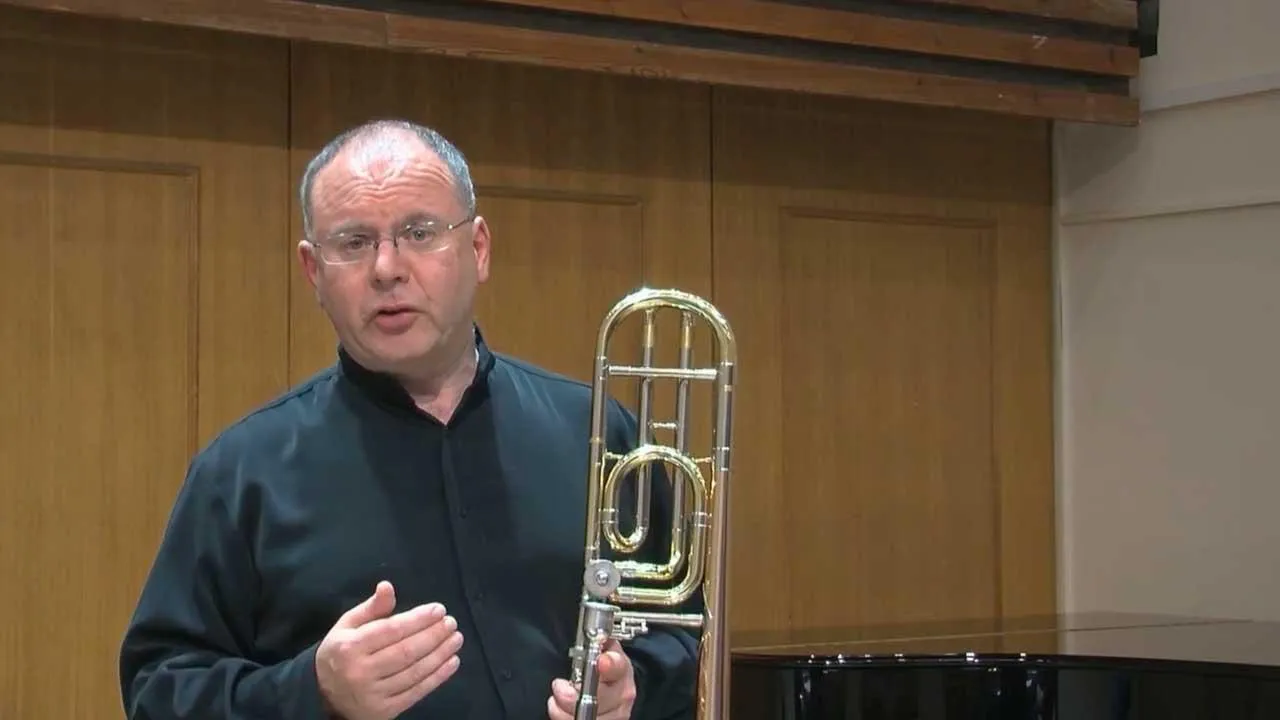
Hello and welcome to Circuit Training Unit 5, Coordination. Here at the Guildhall, we have always taught students to move the slide in rhythm with the music.
Example Play
Can you play an example, say Figure 2, page 27? This slide action will be the same for both detached and legato playing.
Notice how Chris used the same slide action for both legato and detached playing.
Center and Focus
Moving on to center and focus:
- Awkward intervals, shapes, and whole tone scales can feel quite crooked.
- Take your time to center and focus.
For the next example, I will focus on the middle pitch and use the airspeed and pitch resonance to create a line, rather than exaggerated embouchure movement.
Importance of Subdividing
Subdividing in advance is something we all have to do. Yes.
- Try to feel the subdivisions of pulse within each note to sustain correct note lengths.
Peter's Center and Focus Study
Before I play Peter's excellent center and focus study, check for:
- Seamless joins between simple and compound rhythms.
- Well-supported precision between wider intervals with embouchure control.
- Sustained note lengths to maintain pulse and melodic line, particularly at the end of phrases.
Summary
In Unit 5, Coordination, we have looked at:
- Coordination and synchronization
- Center and focus
- Rhythm subdivision to consolidate
Work through this unit once again, and don't forget that all we have talked about can be found in Circuit Training, Volume 2.
About the instructor
Peter Gane est l'un des grands spécialistes des cuivres et trombonistes de Grande-Bretagne. À 19 ans, il devient membre du London Symphony Orchestra. Il devient professeur à la Guildhall School en 1971 et l'est toujours aujourd'hui. Élu Fellow de la Guildhall School en 1981, il a été responsable du département des vents, cuivres et percussions de 1988 à 2008. Il est conseiller artistique du Combret Music Festival, en Aveyron, en France. Fondateur et ancien président de la British Trombone Association, Peter est un pédagogue reconnu. Il entretient une longue collaboration avec le National Youth Orchestra of Great Britain et l'European Union Youth Orchestra, où il est professeur de trombone depuis 1977 et 1984 respectivement. En tant que professeur, spécialiste des cuivres et chef d'orchestre, il a donné des masterclasses et des ateliers dans de nombreux conservatoires européens et auprès de groupes professionnels en Allemagne, en France, au Danemark, en Suède, en Norvège, en Espagne, aux Pays-Bas, en Autriche, en Italie et aux États-Unis. En 1996, sa réputation internationale a été confirmée par la remise du Neill Humfeld Award pour l'excellence dans l'enseignement du trombone par l'International Trombone Association. Parmi les publications de Peter figurent : The Good Brass Guide, Trombone Books 1 & 2, publié par Trinity Guildhall ; Circuit Training for Trombone, volumes 1 and 2, Slide Systems, Five Games, Guildhall 125, World in Motion, Mansion House Fanfare, tous publiés par Warwick Music ; How Trombonists Do It, publié par Brass Wind ; et Brass Medals, publié par l'Associated Board. C'est précisément cette approche du Circuit Training que Peter partage ici avec toi : des exercices ciblés et reproductibles qui développent la précision de la coulisse, le contrôle du souffle, la souplesse et la sonorité dont tu as besoin pour prendre véritablement le trombone en main, quel que soit ton niveau. read more