



Analyse de Die Zauberflöte

Lesson time: (17min 52sec)
Course preview
This lesson is part of the course Chanter Mozart : airs de Figaro, Così et La Flûte enchantée
Watch a preview of the full course below.
Lesson transcript:
Music Lesson
Instructor: Super. Really beautiful. Beautiful. Very good. German also. Are you German? No. Okay, sounds great.
Introduction
Instructor: So tell us just a little bit, who are you in the opera? What's the scene? What's going on?
Student: Well, I'm Zarastra and I'm a high priest in Egypt. The two lovers have come to the temple, and I sing this aria to essentially reassure them that I'm not evil, which is what they think I am. I explain some of the principles of the religion that I'm a priest of.
Instructor: Okay. And you also ask the gods to guide their way and keep them safe?
Student: Yes.
Technique and Challenges
Instructor: Super. I think the most challenging thing here is the intervals because it's not the most melodic and easy line to sing.
Instructor: Okay, so let's start. Just try to keep it all connected. The voice is an instrument, but you have to connect everything with the air.
Connecting Intervals
Instructor: The intervals have to be connected with the air. So let's start again.
- Instructor: You can connect it better.
- Instructor: I saw. I also saw even your...
Instructor: Okay, so it's... try to hum it for a second. It's very important to support coming down; it has to be very, very well supported.
Support and Technique
Instructor: Okay. Don't think I'm coming down. Think I bring the low note to the high note. Ok, better, but not completely.
Instructor: Make the 'O' very, very long.
- Instructor: And don't you have two vowels after each other?
- Instructor: Don't close the mouth, don't close the space.
Instructor: Okay.
- The 'oe' was great.
- Now let the 'E'.
- The 'zis' can be... ah.
Instructor: It's a bit... I feel like you're dropping your support.
Placement and Support
Instructor: Okay, bring... it's the same. You need to feel inside your mouth almost how the palate actually goes up, not coming down.
Instructor: Okay, it's better. But I really need you to support more.
- Instructor: And I'm sure you heard it before.
- Instructor: I'll try to show you.
Instructor: But I have a different voice, so I want to hear 'T' and not 'shank de shink it, dear.'
Instructor: And you have to stay on the air. You are losing it a little bit.
Instructor: May I touch you?
Student: Okay, go ahead.
Singing Practice
Instructor: So sink now 'O Y.'
- Instructor: Okay, it's really better.
- Instructor: But every time you descend in the line, I feel how your support is going down.
Instructor: Look what you're doing. You sing on the contrary. Every time the line is descending, you have to support more. I need to feel it expanding more.
Instructor: Again, I'm sorry, but if you get this first line, that's it. You have the aria.
- You're going down.
- Think that it's up, not 'ois,' not 'O easiso Easy.'
- Think you're singing an octave higher.
Instructor: It was much better. Again. You lost it.
Maintaining Support
Instructor: Vice height. Vice height. Okay, again.
Instructor: Vice height only. You're also coming from a 'V.' Now, only on the tone.
- Instructor: Okay.
- Instructor: But the breath stays under.
Instructor: Okay, again.
Continuous Improvement
Instructor: Can you sing for me here? Sing for me. Not going down.
Instructor: Okay, but think about the high note. Yeah?
Instructor: And I hear you.
- Instructor: Stretch all the vowels.
- Instructor: Do like this.
Instructor: This line, the descending line did beautifully.
Instructor: So you do know how to sing descending lines.
Instructor: I want the same.
- When you have a big interval, do this again... 'Die da vander.'
- Okay, but think that it's that.
- Can you play for me again?
Instructor: 'D I D.'
- Instructor: I swear that you're doing it.
- Instructor: Do for me a glissando.
Instructor: Okay. And support each tone in the glissando.
Final Adjustments
Instructor: Now let's rhyme. Did you feel how you went into the throat? Not... it's not out. It's try.
Instructor: Okay, now without the glissando, do you feel it in a different place?
Instructor: Okay, T's not quite there.
- Instructor: You know why?
- Instructor: Because you open your mouth a lot for the 'V.'
- Instructor: Don't do it.
Instructor: 'D.' Try with...
Instructor: Yes. Now let's try. Don't open your mouth too much for the vowel.
- Instructor: Okay. 'Shri.'
- Instructor: I cannot sing solo. The 'T' on the high note.
Encouragement and Technique
Instructor: You. Note for you.
- Instructor: Maybe it sounds like less sound, but it's more in line.
- Instructor: It's more in line.
Instructor: Okay, go on. You can release.
- Release this.
- Okay, Sterling, you're holding everything.
Instructor: Don't hold your jaw, and then you lose the overtones. You lose all of these.
Instructor: Last...
- The 'L' on the tone was somewhere... 'la C.'
- But don't stop.
- Space and only the tongue.
Instructor: Not 'la,' not 'la.' Space is there.
Instructor: Okay. And we are singing on the 'A,' not on the 'L.'
- Instructor: Don't get... I mean, we need to hear the 'L,' but don't get stuck on it.
- Instructor: Okay, space first.
Instructor: La. Seated.
Review and Conclusion
Instructor: Coming down was...
- Again, you lost your support.
- I hear you're losing your support.
Instructor: Okay. And I need more legato.
Instructor: What is last? The 'F' will help you.
Continuous Practice
Instructor: Okay, and legato. I need more vowels.
- Instructor: The consonants have to be very late.
- Instructor: Okay, language.
Instructor: Space first, and then you make the 'D.'
Instructor: Okay? Not do. It's very easy.
Instructor: You chose a very difficult aria for you because everything is descending, and it's much more difficult to support a descending line.
- Instructor: Okay?
- Instructor: So the jaw has to be released.
- Instructor: The tongue has to be released.
Instructor: And here, you really, really have to work.
- Whatever if you support in the front, if you support in the back, but you really have to keep the air moving.
- And for the 'L,' you don't need to go.
Instructor: Okay. And I'm already going.
- Instructor: When you go to grab, don't go to grab.
- Instructor: Lift it up to you.
Instructor: Okay.
Instructor: Try to open your mouth less for the 'gra.'
Final Advice
Instructor: Try for a second.
- Instructor: Okay, start better.
- Instructor: Start with space, start with support.
- Instructor: It's a closed 'O.'
Instructor: Okay, let's try on the tongue.
Instructor: And for the 'L,' you don't need to close the mouth.
- Instructor: And for the 'T,' you don't need to close the mouth.
- Instructor: 'Z.'
Instructor: Start. Better. Support your consonants.
Instructor: Support your consonants.
- Instructor: Yes.
- Instructor: 'Zol.'
- Instructor: To get.
Instructor: Great. You lost it.
Instructor: Support to the end of the phrase again.
- Instructor: 'Sol.'
- Instructor: Love.
- Instructor: You're getting higher and higher.
Instructor: So the breath stays down. The sound is up, but don't lift the text.
- Instructor: Okay? Because... Yes, you are going.
- Instructor: Don't lift the text.
Conclusion
Instructor: Okay, so let's do again.
- Instructor: Super. Really nice. Much better.
- Instructor: Okay, go on, Nancy.
- Instructor: Okay, sing for me.
Instructor: Super. Now correct the right way.
- Instructor: Yes.
- Instructor: I know you think you get more sound, and you probably one day will be able to open it.
- Instructor: But you're opening, and it's not quite in the right place.
Instructor: So once the voice will be in the right place, you can open.
Instructor: Okay. Try to practice everything that goes down. Take it up.
Instructor: Perfect. Beautiful voice. Really great. Bravo. Bravo.
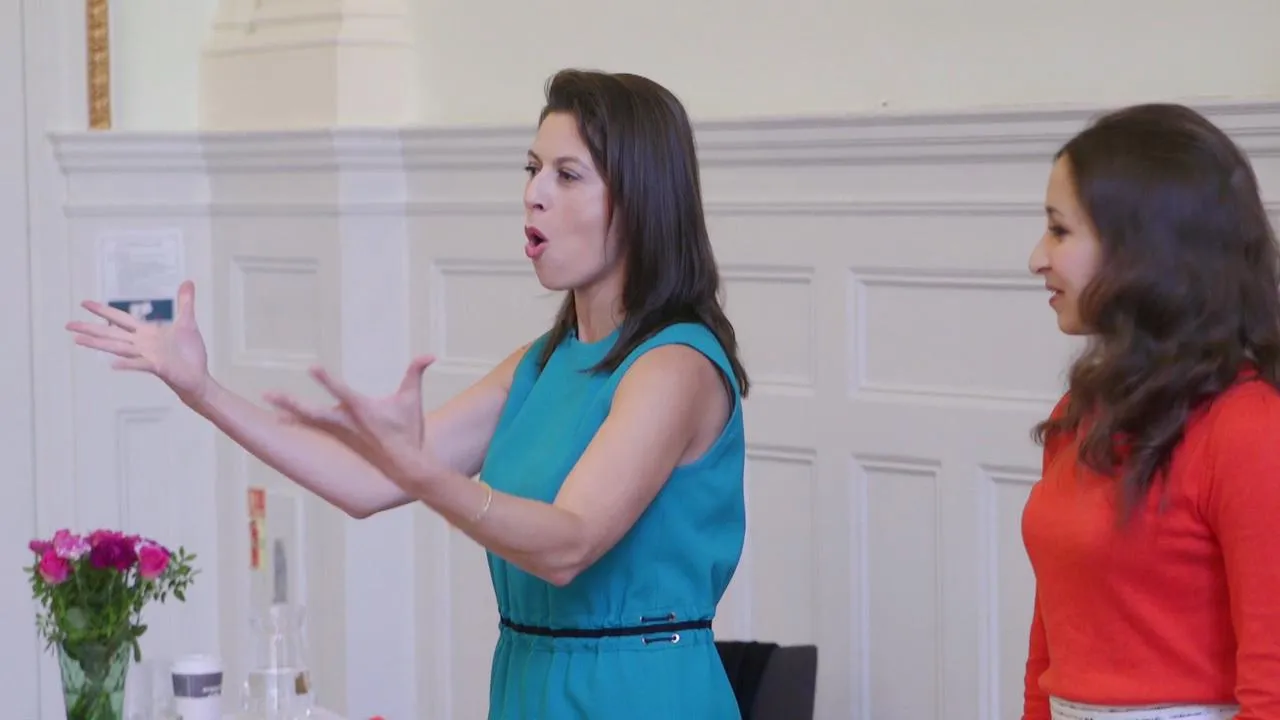
About the instructor
La soprano israélienne Chen Reiss a chanté des rôles principaux sur nombre des plus grandes scènes lyriques du monde, parmi lesquelles : Wiener Staatsoper Bayerische Staatsoper Théâtre des Champs-Élysées Teatro alla Scala Semperoper Dresden Deutsche Oper Berlin Hamburgische Staatsoper Wiener Festwochen Maggio Musicale Fiorentino Opera Company of Philadelphia The Israeli Opera Son répertoire lyrique comprend, entre autres, Pamina, Adina, Gilda, Nannetta, Oscar, Rosina, Servilia, Blonde, Susanna, Zerlina, Despina, Euridice, Marie (La Fille du régiment), Sophie (Der Rosenkavalier) et Adele. Sur son dernier album, "Die Nachtigall und die Rose", elle présente un programme romantique aux côtés du célèbre pianiste Charles Spencer. En concert, elle s'est produite à Salzbourg, Lucerne, au Wiener Musikverein, à Berlin, Leipzig et Munich. Elle a fait ses débuts au Wiener Staatsoper en 2009 dans le rôle de Sophie et y a depuis chanté des rôles tels que Pamina, Elvira, Waldvogel, Adina, Servilia, Ilia, Xenia et Füchslein Schlaukopf. read more