



Analyse de Così fan tutte

Lesson time: (30min 29sec)
Course preview
This lesson is part of the course Chanter Mozart : airs de Figaro, Così et La Flûte enchantée
Watch a preview of the full course below.
Lesson transcript:
Music Lesson
Introduction
Really great, beautiful singing! Do you know what you're singing about?
Character and Style
- I've seen your face, I've seen your body. You're in character now.
- I think we can get a little bit more out of you.
- If you go to audition for this aria, from the first moment, you need to be the spina.
You got there, but a few minutes after, and you have three minutes, maybe, to convince us from the beginning.
Importance of Style in Mozart
- The spina and the singing are extremely important, always, because it's Mozart.
- It has to always be beautiful and in style.
But remember, the acting and the character are just as important. We are in opera buffa, right? She is a servant, which is very important because later on in the masterclass, we will have singers who will be, for example, Ilia (a princess) or Tamino (a prince).
In Mozart's operas, he was very fascinated with the relationships between different classes, between the servants and the aristocracy.
Body Language and Interpretation
- We need to see it in your body language and hear it in the voice and the spina.
For me, of all the characters in Mozart, she's the most calculating. Everything she sings, everything she says, every recit, she thinks, "What's in it for me?"
You need to consider: those two girls are aristocracy.
In Mozart, the servants always outwit the aristocrats. That, I think, was his goal in life. At that time, you couldn't be as free as today. You can't just say, "The prime minister is terrible," or "The president shouldn't be there."
Mozart couldn't say it boldly. So he did it in his music and operas, this criticism. And we need to see how you are, in a way. Yes, you want to convince them to cheat on their lovers, which is a terrible thing to do, but there is something in it for you.
Character Approach
You are a very elegant lady, and you're very beautiful, and that's great, but you need to be beautiful and sexy while also being a bit down-to-earth. Again, I don't want you to lose the elegance in the sound because Mozart always demands that the style be present.
Challenges of Mozart's Style
That's the hard thing about Mozart: it has to be precise, elegant, and beautiful, but with a lot of emotion and drama.
So, from the first chord of the piano, if you were Fiordeligi, the orchestra would play this chord in a different way. But you are the spina.
Performance Improvement
- Now use the text.
- Great! Much better beginning. You're connected to your breath immediately.
Feminism and Empowerment
Donna, I want to hear really a lot of N.
You aren't just saying, "Oh, well, a woman is a woman." You're being so feminist. You're giving now a message to all women.
Attention to Detail
Let's correct some details.
- Every time you have "Donna," which is double N, and "Anni," which is double N, remember that with Mozart, there are no coincidences.
- He chose the best librettist. He had the best texts, and that's one reason why his operas are performed more than any of his contemporaries.
Operas of Salieri or Haydn were also great, but they did not choose wonderful librettists.
Singing Techniques
Every time you sing a double N, you don't need to close your mouth to do it. You can do it only with your tongue.
When you sing "Anni," and you close your mouth, it doesn't sound very Italian, and you also close the sound.
When you sing, there should be always space between the back teeth.
Example:
- Always knee.
- Not Anni. You don't close your mouth.
Always sing on the breath.
Expression and Meaning
Super. Great! The sound is great. The line? Amazing line: "Dove el diavolo a la coda."
I want to see in your eyes that there's a lot of meaning to "where the devil has his tail." Use your imagination! Think about men and women and what you think about men.
I want to see even if you don't think about it, but she does. Because she wouldn't sing, "Where is his?"
Movement and Energy
You can move. Don't hold back.
Where is it? Great! You can start with "diabolo" there.
- Super!
- Great!
Performance Tips
Don't stress the "bene." It's not "bene," it's "bene." Enjoy it! She is so fun.
From the minute she's on stage, she has fun. She's not Fiordeligi or Dorabella. No, she is fun!
Enjoyment in Singing
Now, let's do "Mal." It has double L, right? And double T.
Italian is a great language!
We need more movement here. We have sixteenth notes, and it's different. Up to now, it was more formal.
Look, enjoy this! Don't go to chest voice unless you want to.
Some people say it sounds better to bring it up to you; it's a personal choice.
Vocal Techniques and Breathing
Okay, be careful while singing. There are many ways to sing, and if it doesn't hurt, you can do it. But you can also choose to bring this tone up.
Look for movement, it's crucial.
Expressive Singing
With the orchestra, know that it's short. You need to convey how to fake a smile and how to fake crying.
It's not about a fake laugh; it's more elegant. Do them differently. You can do the first one loud and the second one soft.
I like that you use different colors. Just don't stretch the last syllable of the word.
Sixteenths are going down. Intonation can be better and more precise.
Character Reflection
Consider how to express the meaning of "inventar" and the reason behind a fake smile. Just think about it, and don't think technically.
- Same character.
- She's always thinking.
Connecting Vowels and Breath
With "per," don't close your mouth; you can sing back without closing it.
Always connect to the breath when you sing; that's essential.
Text and Communication
I need much more text. Momento, D, so double R, double T.
"Centocole pupille." Again, don't think of it technically.
Your Ds are slightly not 100% Italian; there's a bit of air in them.
When you start with D, the space has to be there initially. Don't open the mouth as you start.
Attention to Language
We can have more R at the end. You have that ability!
Bring the low note to the high note, but not too much. Enjoy it.
Your br has to be faster.
Conclusion of Lesson
Feel free to sing siemelio brutal on the high note as well.
Don't hold the last note because it's only an eighth note, and it's "gusto," not "gusto."
The first time you say, "Viva Despina que sacervir," you repeat the words in Mozart, but the meaning changes.
The first one acknowledges being a servant; the second one means knowing how to serve the message.
- Your D when you start sounds a bit Russian or Slavic.
- We can have more T everywhere; it will help you.
Bring low notes to high notes. Keep the breath low but don't lift the words up.
Superb singing!
Remember, everything you sing should have the same lightness.
Final Remarks
The last line was the best. Thank you!
For everything, I'll sing like that! For the rest, I'll fly.
Thank you!
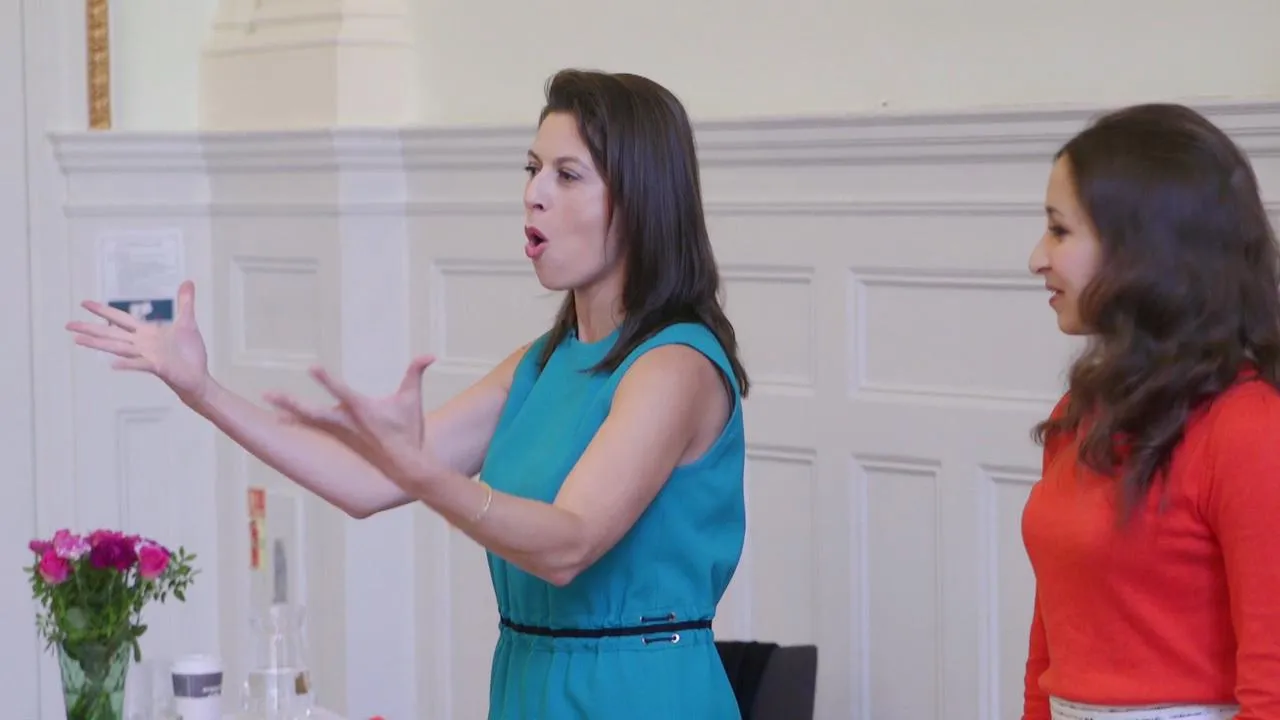
About the instructor
La soprano israélienne Chen Reiss a chanté des rôles principaux sur nombre des plus grandes scènes lyriques du monde, parmi lesquelles : Wiener Staatsoper Bayerische Staatsoper Théâtre des Champs-Élysées Teatro alla Scala Semperoper Dresden Deutsche Oper Berlin Hamburgische Staatsoper Wiener Festwochen Maggio Musicale Fiorentino Opera Company of Philadelphia The Israeli Opera Son répertoire lyrique comprend, entre autres, Pamina, Adina, Gilda, Nannetta, Oscar, Rosina, Servilia, Blonde, Susanna, Zerlina, Despina, Euridice, Marie (La Fille du régiment), Sophie (Der Rosenkavalier) et Adele. Sur son dernier album, "Die Nachtigall und die Rose", elle présente un programme romantique aux côtés du célèbre pianiste Charles Spencer. En concert, elle s'est produite à Salzbourg, Lucerne, au Wiener Musikverein, à Berlin, Leipzig et Munich. Elle a fait ses débuts au Wiener Staatsoper en 2009 dans le rôle de Sophie et y a depuis chanté des rôles tels que Pamina, Elvira, Waldvogel, Adina, Servilia, Ilia, Xenia et Füchslein Schlaukopf. read more