



Explorer le manche pour élargir la tessiture

Lesson time: (10min 27sec)
Doug MacLeod explore des accords plus haut sur le manche, dont une forme partielle de grand E, et les réunit dans un blues complet à 12 mesures.
Course preview
This lesson is part of the course 101 fondamentaux de la guitare blues
Watch a preview of the full course below.
Lesson transcript:
Guitar Lesson: Exploring Chords and the 12 Bar Blues
Introduction
Now all of a sudden this guitar is shortening. The neck on this guitar is shortening down. We can work from here to here, comfortably. Comfortably. Because I'm going to show you now the three chords that are in the middle part of the guitar.
The Big E Chord
Check this out:
- Big E Chord: We partialize this one. Remember from the first time we used this one.
- Now you want to put the third in. Take your social finger and put it right there.
- Now you have the third; you hit the low E. There you go.
Introducing the A7 and B7 Chords
Now we're looking for the A7 chord:
- We can use this one. We can use this one.
- This is available to us.
- This one is available with the open, the double opens, the B7.
- We can use this one. And then, of course, we come on back to the E.
Understanding B to B7 Transition
This is a B chord. I'll make it a B7.
- Question: Why is that from a B to a B7?
- That's not a bad question!
This is just a B chord because there's no seventh in it. Remember we talked about going up the scale? It's the same deal when you add a seventh to a chord. What you're doing is adding the seventh note of the scale to the basic triad, which is like B D sharp and F sharp.
- So if you add the A, that's the seven.
That's all that means. Simple, your A7 and then the E7.
Voicing Chords in Higher Positions
Alright, up here we got the same thing happening:
- There's our E, right?
- There's the E7.
- Now A7.
There are some cool A7's in here. Listen to this one:
- Look at that one.
- That's a cool one.
- Make sure you get the left hand on that.
Now, if this is available, what else is available?
- If this is available, what else is available?
- If you know this is an A7, a B7's got to be two frets up right there.
There's your B7, there's your A7, there's your E7.
Exploring Turnarounds in the Blues
You can also voice lead, meaning that you don't have to go up the scale. You can also go down. Check this out:
- Let's say we're playing a little blues up here.
- I'm going to start the 12, I'm going to do an eight bar.
- I don't want to do that yet. I want to give you the 12 bar.
So we're going to the B7 here. Let's do it like this:
- There's the A7 going down to the E.
- What is this? Oh, man. This is the turnaround. Remember this one?
All I did now was take this finger off and put it up here. Because I'm doing that thing again.
- What's available?
I got this chord. That note's available, isn't it? Yeah. So I go like this, and I got another turnaround just like that.
Or I could have gone like this. And let's say that the song calls for the B7 to come back again. Instead of going back up, let's go down because we know this B7 is there. Then we go to this A7. And then we go down to this E7.
And we're on the walk down. And we got it done.
Playing the 12 Bar Blues
So let's play a 12 bar blues:
- We'll take it in the first position.
- We'll take it in the middle position.
- Then we'll take it up in the high position.
- And we'll make some music together.
Let's start with a little bass run; maybe get that groove going.
- Check out that little bass front. That's a good sound, the little trill.
Now we're going to move up to the A. You can also half step approach the A.
- Check this out. Use that rhythm back on the E.
- A little bass run there.
- What was that? That was a little thumb slap down here on the low string, running right on up here to the beat.
We can walk down. There's our turnaround. Now we work it.
- Let's go up here.
- Remember, this was a turnaround, right?
- But now we're going to use it as part of the lead.
We're going to voice lead down to the A7, like a big Bill Brunsy kind of thing.
- What I did there was I took my finger off so I got that sound.
- You can check out the right hand, too, with the left hand.
Keeping the Groove
Now I'm on tomato. Always the groove. John Lee Hooker once said:
"Just get the beat. Leave those fancy chords alone."
I believe he was right. Just get the beat. We're working. All the things we talked about earlier are right in here.
And I'm just down on the low part. I'm gonna go up on the high part.
- Now we'll work up here.
- Now I'm gonna make the A.
- And I'm holding that top note.
Now if you make a mistake, just like I did, the cool thing is how do you get out of it?
A Little Trick
I'll show you a little trick here. When I come around, there's that principle of going the other way on the chord:
- We do it like this, right?
- The one will work like this.
Now I'm gonna hit that same mist. It's gonna make it sound like I meant to do that.
- That's only when you're playing live, you know?
- Don't let them know you made a mistake.
Just look like,
"Yeah, that's exactly what I heard."
Final Thoughts
Now let's go up here. Remember that turnaround thing we were doing?
- Now I've got that G string ringing in there.
- I'm taking the B.
- I'm gonna take the D.
Now I'm gonna run up here on this George Benson lick.
- Whoa. That was the dynamic, making the octaves.
- We're working now.
Here's the D. Now I'm gonna go up to the A7.
- Now I'm gonna go up to the E.
The Hammond Organ Lick
And this reminds me, I'm gonna show you a very cool little lick right here.
- It's what I call the Hammond Organ lick or B3 lick.
- Oh, that's love!
I used to love guys like Jimmy McGriff, man, and Richard Groove Holmes. I said, "Man, I wish I could do that."
You know how organ players do it, right?
- They'd grab that note and then get one stuff going on the bottom like this, and the whole place would be rocking.
Incorporating the Lick on Guitar
How can you do that on the guitar?
- Well, you can do it a little bit with this lick.
- Let's say you remember that octave thing we talked about.
Okay, we got the octave here. This is the E chord.
- And again, we're going to talk about availability: if this is available.
Here's the octave. Here's the G sharp from the E7 chord.
- What's available here? Well, I know I can run up these notes.
So how about if I did this?
- It's sort of like a Hammond organ.
Get a good groove there. Now, when you go to the IV chord, just slide this down.
- Because the G sharp is not going to work on that four chord.
Be really careful about that!
- That's got to be approached because it changes the sound of the chord.
Check this out. Here's a seven.
- That sounds blues.
- When you make it major seven, it sounds like this.
That's not going to work, man. So you got to be very careful with that.
- You don't get this when you want that.
Wrapping Up
So we can't have this on a four chord, which means we can only be a fret away.
- We go down here and hit it like this.
We're grooving again. We go back to the B7. We go down to that A7.
- Now we're going to use that as a turnaround.
Listen, you know what else we can do?
- We can harmonize that.
If this is available, there's got to be chords available.
- Of course, there are chords available.
We got this chord, we got this chord.
- We got this chord and we got this chord.
And that's available. That's a turnaround, too.
- You can also go down.
Does that sound like Robert Johnson to you a little bit?
- Well, yeah, it's like harmonized Robert Johnson.
Sometimes it runs a little havoc here on the strings. I think we got it.
- Checking that out.
Alright, we go down here. You can even keep on going down.
- Maybe you want to use it as an introduction.
You're not done yet; somebody's still not out on the dance floor. We're owning it.
Conclusion
So that's what's available. That's what's so cool.
- Don't get locked into licks like we talked about at the very beginning.
- Don't get locked into licks and say, "Well, I'll put this lick with that lick."
With this lick again, you're licking; you're not making music.
- The thing to do is to say,
"Alright, if this is available, what else is available?"
Let me grow from that.
Final Performance
I think what I'll do right now is I'll play a song and sing it that will exemplify the 12 bar blues form, and I'll get to it directly.
About the instructor
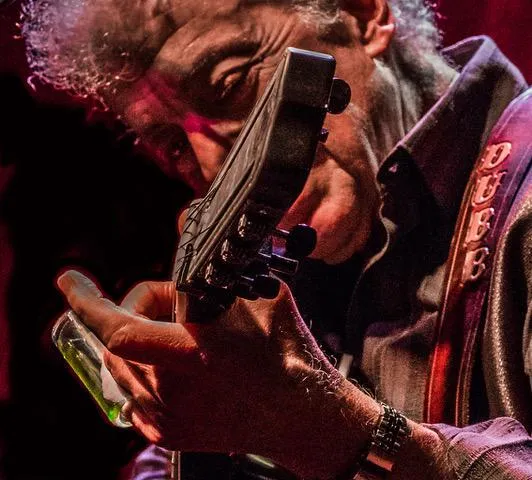
Doug MacLeod est connu pour ses superbes compositions, sa maestria à la guitare, sa voix chaleureuse et pleine d'âme, son esprit et ses inoubliables concerts. Au cœur d'un concert de Doug MacLeod, il y a son don de conteur, qui donne vie de manière saisissante à des personnages allant des anonymes aux légendaires. Doug a remporté plusieurs Blues Music Awards, dont le Blues Music Award 2020 de l'artiste acoustique de l'année et le Blues Music Award 2018 de l'album acoustique de l'année pour 'Break The Chain', et a été nommé au Blues Music Award 2021 de l'artiste acoustique de l'année. Son album avec le producteur Jim Gaines est sorti en 2021. Dans 101 Blues Guitar Essentials, Doug transmet les fondements de son art - les grooves, les techniques et le feeling qui sous-tendent l'authentique guitare blues acoustique - pour que tu puisses te constituer un véritable vocabulaire sur l'instrument et commencer à raconter tes propres histoires à travers lui. « Comme tous les grands bluesmen, MacLeod vit sa musique, et les chansons ne sont pas seulement au bout de ses doigts et de sa langue, elles ne font qu'un avec son être. » - Blues Music Magazine « L'un des grands artistes de blues... point final ! » - Jorma Kaukonen read more