



You Really Got Me – Van Halen (Análisis)
Pete Riley desglosa la parte de batería de 'You Really Got Me' de Van Halen, un groove de corcheas a tempo rápido que se mueve por energía y un feel arrollador.
Qué incluye el curso
26 lecciones (2h 36m) · 1 gratis
01. Standard – Stormzy
1:28
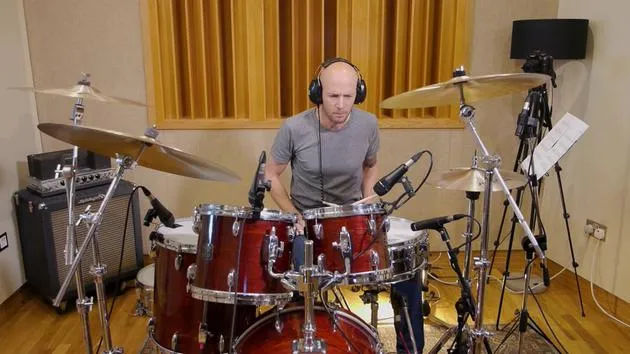
02. You Really Got Me – Van Halen
1:36
03. Word Up – Cameo
1:55
04. Rapper’s Delight – Sugarhill Gang
1:56
05. Smooth – Santana
2:01
06. Play That Funky Music – Wild Cherry
1:57
07. Overrated
1:59
08. Old Bones Blues
1:57
09. Indecisive
1:53
10. Maiden Voyage
2:01
11. Reggae Island
Lección gratis1:56
12. Fallout
2:01
01. Word Up – Cameo (Análisis)
8:13
02. Standard – Stormzy (Análisis)
10:23
03. You Really Got Me – Van Halen (Análisis)
Estás aquí10:31
04. Rapper’s Delight – Sugarhill Gang (Análisis)
11:17
05. Smooth – Santana (Análisis)
7:46
06. Play That Funky Music – Wild Cherry (Análisis)
10:26
07. Overrated (Análisis)
15:30
08. Old Bones Blues (análisis)
11:41
09. Indecisive (Análisis)
15:20
10. Maiden Voyage (Análisis)
16:46
11. Reggae Island (Análisis)
2:54
12. Fallout (Análisis)
8:39

Transcripción de la lección
You Really Got Me - Lesson
Introduction
Hi! Here we're looking at "You Really Got Me," Van Halen's arrangement of the Kinks classic. The track is based around an eighth note feel and is relatively up-tempo at 136 BPM.
One of the key ingredients is having energy and a driving feel throughout.
Main Pattern
The main pattern consists of:
- Eighth note hi-hat pattern
- Bass drum following the guitar riff:
- Played on:
- Beat 1
- The and of Beat 1
- The and of Beat 2
- Played on:
- Snare played on beats 2 and 4
Sound Technique
For a sound like this, play with:
- A slightly looser hi-hat (less pressure for a thicker sound)
- The backbeat as a rim shot sound (more in keeping with the hard rock genre)
Fills
In addition to the eighth note feel, there are several 16th note fills that run throughout the track. Let's take a look at them.
First Fill
The first 16th note fill appears after the first two bars:
- After the drums enter, cycle through the first two bars.
- Use the flam snare to start the piece.
Fill Example:
- Guitar (2 bars)
- Drums enter on the end of Beat 3 with the bass drum and snare on Beat 4.
For fills like this, use a single stroke approach instead of a double stroke for volume.
Additional Fill
Further down the page in Bar 12, there's another 16th note fill, a slight variation moving from the rack tom down to the floor tom.
Let's try that in context.
Chorus Section (Bar 17)
At Bar 17, we reach Letter C, which is essentially the chorus featuring:
- The same basic groove
- Variations of 16th note fills
One specific variation involves playing 16th notes on:
- Rack Tom
- Floor Tom on Beats 3 and 4
Crash Cymbal Technique
To end a fill like this, it makes sense to crash on that side of the kit. While challenging to get back to the hi-hat, it's easier than transitioning from the floor tom to the crash cymbal.
Section C Performance
Let's play the whole of Section C.
Uncredited Fill
Notice that the fill in Bar 24 isn't notated. This indicates it's at our discretion, as denoted by the time slashes indicating a fill for the duration of a bar.
Suggested Approaches
For those last two bars of Section C:
- A simpler choice could be 16th notes on all drums for all four quarter notes.
- Alternatively, I chose a more syncopated rhythm similar to Alex Van Halen's original feel, utilizing the snare and toms.
Guitar Solo (Bar 25 - Letter D)
Moving to Bar 25 at Letter D, you'll notice a shift in the bass drum pattern:
- Adding the and of Beat 3 to the bass drum pattern.
Rest remains unchanged.
Bar 25 Groove:
(Provide groove example here)
Back to Chorus (Letter E)
After the 12-bar guitar solo, we return to Letter E:
- It's the chorus pattern again, 8 bars long, similar to Letter C.
- Includes the same collection of fills and ends with a fill at our discretion.
A Different Fill
In Bar 44, my fill ended slightly differently than at Section C, focusing more on syncopated quality.
Useful Figure
This fill can be thought of as a four-stroke rough with:
- Fourth note on bass drum
- First three notes: Snare, High Tom, Low Tom
When played quickly, it has a descending quality: (Include demonstration here)
Final Section (Letter F)
Bringing us to Letter F, the final four bars end with:
- The first four eighth notes of the bar played between the floor tom, snare, and bass drum simultaneously.
Timing and Execution
For this figure, precision is key to avoid flamming.
Last Four Bars:
(Provide last four bars example)
Conclusion
Those are all the parts that make up "You Really Got Me." I think you'll have a lot of fun playing along to this classic hard rock track. Enjoy creating some fills to go into those spaces as well!
26 lecciones
2h 36m de lecciones en vídeo estructuradas
Funciones de vídeo avanzadas
Ralentiza, repite un pasaje, sigue la partitura
Móvil, tablet y ordenador
Practica donde quieras
Garantía de satisfacción 100%
30 días de garantía de devolución







