



Smooth – Santana (Análisis)
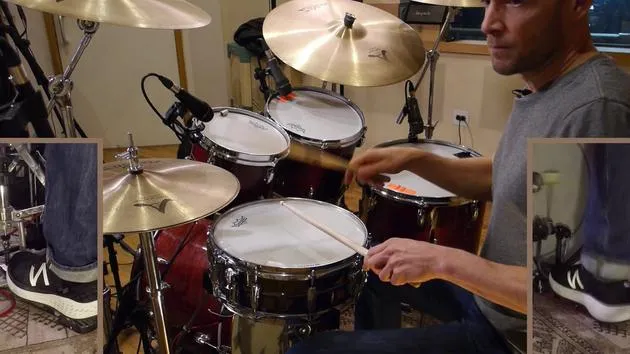
Pete Riley desglosa el groove de rock latino de Smooth de Santana: el patrón de bombo cha-cha-cha bajo corcheas contundentes y un backbeat con rim-shot.
Qué incluye el curso
26 lecciones (2h 36m) · 1 gratis
01. Standard – Stormzy
1:28
02. You Really Got Me – Van Halen
1:36
03. Word Up – Cameo
1:55
04. Rapper’s Delight – Sugarhill Gang
1:56
05. Smooth – Santana
2:01
06. Play That Funky Music – Wild Cherry
1:57
07. Overrated
1:59
08. Old Bones Blues
1:57
09. Indecisive
1:53
10. Maiden Voyage
2:01
11. Reggae Island
Lección gratis1:56
12. Fallout
2:01
01. Word Up – Cameo (Análisis)
8:13
02. Standard – Stormzy (Análisis)
10:23
03. You Really Got Me – Van Halen (Análisis)
10:31
04. Rapper’s Delight – Sugarhill Gang (Análisis)
11:17
05. Smooth – Santana (Análisis)
Estás aquí7:46
06. Play That Funky Music – Wild Cherry (Análisis)
10:26
07. Overrated (Análisis)
15:30
08. Old Bones Blues (análisis)
11:41
09. Indecisive (Análisis)
15:20
10. Maiden Voyage (Análisis)
16:46
11. Reggae Island (Análisis)
2:54
12. Fallout (Análisis)
8:39
Transcripción de la lección
Music Lesson: "Smooth" by Santana
Introduction
Hi! Here we're looking at "Smooth" by Santana. This piece has a Latin rock vibe, characterized by an underlying feel that resembles a cha cha cha rhythm, which is an Afro-Cuban rhythm. This is translated in this instance to the bass drum pattern within the eighth note rock feel.
Basic Pattern
The main things to focus on within the basic pattern are:
- Even driving eighth notes from the hi-hat.
- Solid backbeat.
I've chosen to play the backbeat with a rim shot sound for a more cutting snare sound while maintaining the bass drum pattern.
Important Note
Watch out! Within the chart, the bass drum doesn't always play the same pattern. Occasionally, it will miss out on the and of beat three. However, the basic feel that you'll see running throughout most of the piece is:
- Eighth notes on the hi-hat
- 2 and 4 on the snare
- Beat 1
- The and of beat 2
- Beat 3
- The and of beat 4 on the bass drum
As I mentioned, try to get those eighth notes on the hi-hat driving and straight. Occasionally, you will need to open the hi-hats on the last eighth note of the bar, which will coincide with the eighth note on the bass drum. This requires a bit of coordination.
The Fill Figure
Before we delve into time playing, let's address the figure that appears at the top of the piece and reappears at a couple of points later on. This figure moves between sixteenth notes and eighth note triplets, played between the floor tom and snare drum. It sounds like this:
For a thicker, slightly more aggressive sound, play it as a flam.
This means the floor tom should fall slightly before the snare drum.
Fill in Context
Let's hear that fill in context. I'll play it from the beginning of the piece down to letter B.
Transition from Letter C to Letter D
Now, let's take a closer look at the two bars that create the transition from letter C to letter D (bars 30 and 31).
- There's an anticipation midway through those bars.
- We build up slightly, opening the hi-hats, and then crashing on the end of beat four of bar 30.
These are the last two bars of letter C.
Changes in Feel: Letter D
Letter D features a variation in feel:
- The underlying bass drum and snare drum pattern remains the same.
- However, within the eighth notes on the hi-hat, we're opening the hi-hats on the quarter notes.
To execute this effectively, we're stepping the upbeat eighth note with the hi-hat: 1 and 2 and 3.
Comfort with Hi-Hat
This is generally most comfortably done if you stay heel down on the hi-hat, allowing you to feel a little more grounded. Here's that basic pattern.
At the end of letter D, the drums drop out for one bar, and then we hit that same figure that we had during the intro. So, I'll play the last four bars of letter D (from bar 37): 2, 3, 4.
Opening Hi-Hat: Letter E
In letter E, we have a few different points where we're opening the hi-hat:
- An open hi-hat landing on the downbeat of the bar at the beginning of letter E.
- Occasionally within the middle of the bar, where it's not notated, you would close it.
I would probably leave the hi-hats open through the rest of the bar. When we open the hi-hat on beat one, it almost acts like a crash, which we then choke off.
Playing Letter E
I'll play the whole of letter E to demonstrate how that sounds.
Letter F: Improvisation
This brings us to letter F and the final five bars of the piece. At this point, we have some space to improvise as we play the figures that are notated.
- First, I'll play just to show where the figures land.
- The next time, I'll start to fill in between them while hopefully still hitting the notated figures.
This time, I'll incorporate some solo ideas within those spaces, or you could try some other ideas.
Conclusion
That covers all the parts in the track! It's a great piece to play along with, especially with those solo fill opportunities at the end.
So have fun playing along!
26 lecciones
2h 36m de lecciones en vídeo estructuradas
Funciones de vídeo avanzadas
Ralentiza, repite un pasaje, sigue la partitura
Móvil, tablet y ordenador
Practica donde quieras
Garantía de satisfacción 100%
30 días de garantía de devolución







