



Qué es una escala y demostración

Con
Talia Girton
Qué incluye el curso
19 lecciones (0h 33m) · 1 gratis
01. Qué es una escala y demostración
Estás aquí2:27
02. Llamada y respuesta
0:58
03. Ejemplo 1 de llamada y respuesta
1:09
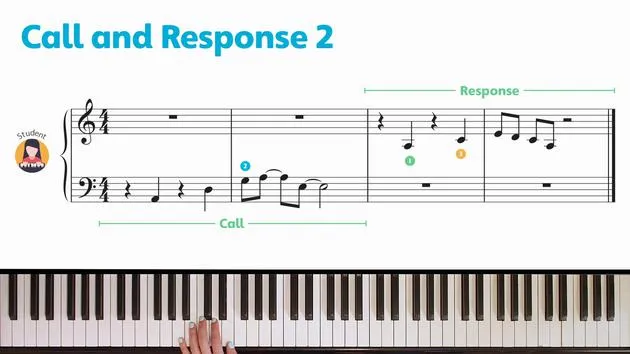
04. Ejemplo 2 de pregunta y respuesta
1:25
05. Improvisar con la pentatónica mayor
1:49
06. Jam con pentatónica mayor (interpretación)
1:05
07. Jamming con la pentatónica menor
1:48
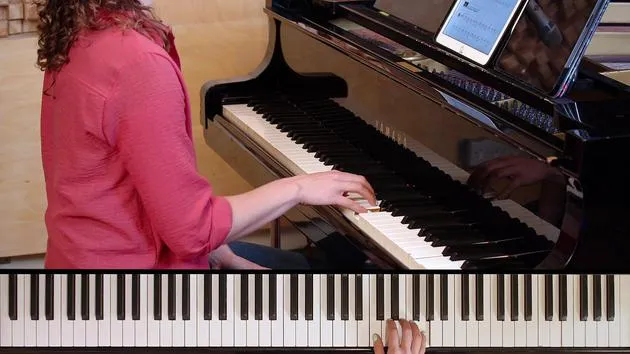
08. Minor Pentatonic Jamming (interpretación)
0:49
Transcripción de la lección
Understanding Pentatonic Scales
Scales are patterns of notes that work in a sequence. Today, we're going to take a closer look at pentatonic scales.
C Major Pentatonic
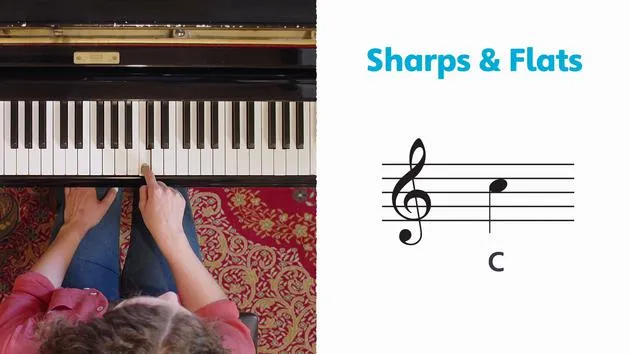
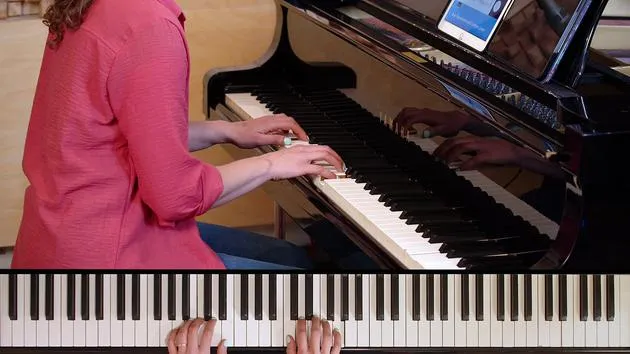
The first one we'll explore is the C major pentatonic. It looks like this:
- You can also play it up to the next octave.
- If you'd like to do it that way, I recommend starting with your two finger on C.
Common Uses
Pentatonic scales are quite common in popular music. You might recognize them in songs like:
- Amazing Grace
- Shape of You by Ed Sheeran
A Minor Pentatonic
Next, let's have a look at the A minor pentatonic.
- It's got the same notes as C major pentatonic, but we will start on A.
- If you want to play that in the full octave, once again, I recommend starting with your two finger on A.
Helpful Tips
A helpful tip for memorizing the notes for these two scales is to remember that they don't have B or F. You can just skip over these notes.
Major vs. Minor
You may have noticed that:
- Major pieces tend to have an uplifting or happy quality. They follow a specific sequence of semitones and whole tones.
- Minor pieces, on the other hand, sound a bit more melancholy or even scary. They will also follow a specific set of semitones and tones.
We'll learn more about this later on.
Black Keys and Improvisation
Interestingly, the black keys on the piano also form a pentatonic scale.
- You can do some great improvisation just by playing the black keys.
- Explore the black notes to find some fantastic little improvisational tunes!
19 lecciones
0h 33m de lecciones en vídeo estructuradas
Funciones de vídeo avanzadas
Ralentiza, repite un pasaje, sigue la partitura
Móvil, tablet y ordenador
Practica donde quieras
Garantía de satisfacción 100%
30 días de garantía de devolución
Conoce a tu gurú
Conoce a tu gurú
Talia Girton es músico y musicoterapeuta registrada en el HCPC, y fundadora de The Cycling Music Teachers. Su trabajo une la musicoterapia, el asesoramiento y la educación, y da clases a nivel internacional en el curso de formación en musicoterapia de la UDELAS en Panamá, además de contribuir al desarrollo profesional con la European Piano Teachers Association (EPTA). En MusicGurus imparte los cursos Piano Method y Piano Foundations, guiando a principiantes absolutos desde los primeros pasos a través del ritmo, ambas manos, la teoría y la interpretación.







