



Aprende a hacer slap en el bajo
Con
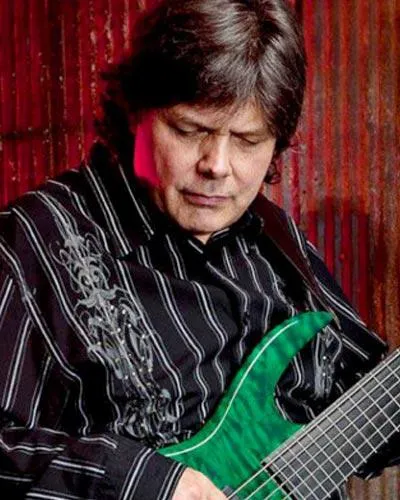
Roy VogtRoy Vogt enseña los fundamentos del slap bass: la técnica del pulgar, la posición de la mano y los backstops que dan a slap y pop su pegada.
Qué incluye el curso
5 lecciones (3h 17m) · 1 gratis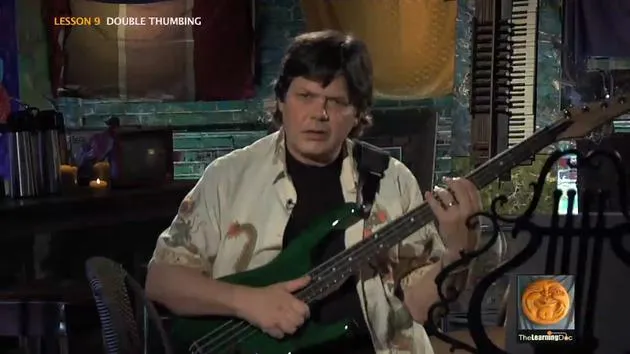
Transcripción de la lección
Welcome Back to Chateau Groove: Learning Slap Bass
Introduction to Slap Bass
Alright, welcome back to Chateau Groove. Today, let's look at how to play slap bass.
Using Your Thumb
I'm going to show you how to use your thumb and then we're going to incorporate that for the warm-up.
What is Slap Bass?
When you're playing slap bass, what you're really doing is hitting the strings with your thumb and then hitting the fingerboard.
- I could do anything to hit the fingerboard and I would get a slap sound like that, ow! Maybe that wasn't so smart.
- Typically, I use the thumb.
Hand Position
- My hand position for the thumb is as follows:
- I hold my thumb in a thumbs-up position.
- I hook these fingers into a little curve.
Now, I'm going to drop that thumb down. Remember when we were playing pick style and I had the thumb going parallel to the string? I'm going to apply the same concept here.
Backstops
- I'm putting the thumb right up against the end of the fingerboard.
- This creates two backstops with what I'm doing:
- If I hit the E string, one backstop is the next lower string.
- The second backstop is the fingerboard.
You can see that the thumb is making contact with both the fingerboard and the lower string.
Moving Across Strings
Let's look at that again as I move to different strings:
- A string: Same technique
- D string: Same technique
- G string: Here, I don't have any backstops available, so I use the body of the bass guitar as a backstop.
First Exercise: The Four by Four
Now, let's revisit that very first exercise we did in lesson one: the four by four.
Count:
1, 2, 3, 4.
1, 2, 3, 4.
1, 2, 3, 4.
1, 2, 3, 4.
Now, I'm going to use downstrokes with my thumb.
- It goes like this:
1, 2, 3, 4.
I'm starting with half notes, just getting used to this.
Notice Your Technique
I want you to notice something:
- I'm not using my thumb muscle at all.
- If you're watching my right hand, the thumb is like a drumstick.
- I'm just letting my wrist rise up and curve, then hitting the thumb into the string.
Now, I'll do that again with half notes.
Moving to Quarter Notes
Let's do quarters:
1, 2, 3, 4.
Double Thumbing Technique
Now, I'm going to treat that thumb like a guitar pick.
- I'll perform: downstroke with the thumb and upstroke with the thumb.
This technique is called double thumbing. Notable players who use this style include:
- Victor Wooten
- Stanley Clarke
- Marcus Miller
Actually, it'll feel like I'm playing with a guitar pick. The same movements apply: down, up, down, up, down, up.
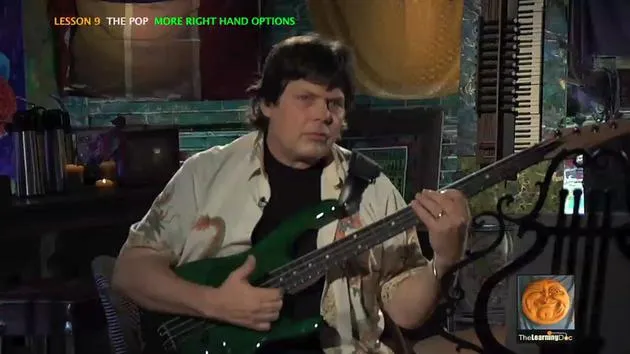
Key Point
- The only difference is that I'm using just my thumb and not a pick.
- Remember, what creates the sound of the slap is really the string hitting the fingerboard, so I'm utilizing those backstops.
Eighth Notes Exercise
I'll do eighth notes now. This is kind of advanced. You might want to save this and work on it a little bit later as you get more comfortable with slap bass.
Here's the four by four exercise with double thumbing!
5 lecciones
3h 17m de lecciones en vídeo estructuradas
Funciones de vídeo avanzadas
Ralentiza, repite un pasaje, sigue la partitura
Móvil, tablet y ordenador
Practica donde quieras
Garantía de satisfacción 100%
30 días de garantía de devolución
Conoce a tu gurú
Conoce a tu gurú
La carrera de Roy Vogt abarca una extraordinaria variedad de escenarios, desde el Headbanger's Ball de MTV, el Montreux Jazz Festival y el Montreal Jazz Festival hasta el London Palladium, el Grand Ole Opry y el Kremlin. Del punk al funk, de la sencillez del country y el blues a la complejidad del HyperJazz y el World Beat, lo ha tocado todo.
Roy fue la primera persona en obtener un máster en Interpretación de Bajo Eléctrico, en la prestigiosa escuela de música de la University of Miami, y lleva más de cuarenta años dedicado al arte del bajo. Ha sido mentor de decenas de profesionales de éxito, incluido el legendario Willie Weeks. Eléctrico, sin trastes, contrabajo - lo que quieras: si toca notas graves y tiene cuerdas, Roy es un maestro tocándolo, y enseñando a otros a hacer lo mismo.
A lo largo de su carrera de cuatro décadas, Roy ha grabado o actuado con una asombrosa lista de estrellas de primer nivel, entre ellas Larry Coryell, Victor Wooten, Dave Weckl, Tom Scott y la LA Express, Chester Thompson, Miroslav Vitous, Glen Campbell, BJ Thomas, Chet Atkins, Engelbert Humperdinck, Dickey Betts, Tony Joe White, Charlie Daniels, Jerry Reed y muchísimos más.
Roy lleva treinta años enseñando a nivel universitario. Desde 1983 ocupa la cátedra de Bajo en la prestigiosa Belmont University (Nashville, TN), una de las poquísimas escuelas que ofrece un programa de grado en música comercial diseñado para convertir a los estudiantes en músicos profesionales que trabajen en lo más alto de la industria. Los alumnos de Roy han girado y grabado con estrellas notables como Trisha Yearwood, Faith Hill, Little Texas, Michael W. Smith, Lady Antebellum, Chick Corea, Sir Tom Jones, Blood Sweat and Tears, Yanni e incontables iconos más de la música.
Su serie Teach Me Bass Guitar te acerca ese mismo enfoque de nivel universitario, llevándote desde un arranque rápido para principiantes absolutos (vol. 1), pasando por los fundamentos del ritmo (vol. 2), la búsqueda de tu propio estilo (vol. 3) y una musicalidad seria (vol. 4), hasta un kit de herramientas de intérprete profesional (vol. 5), para que desarrolles habilidades reales paso a paso.







