



Análisis, explicación y demostración con Håkan Hardenberger
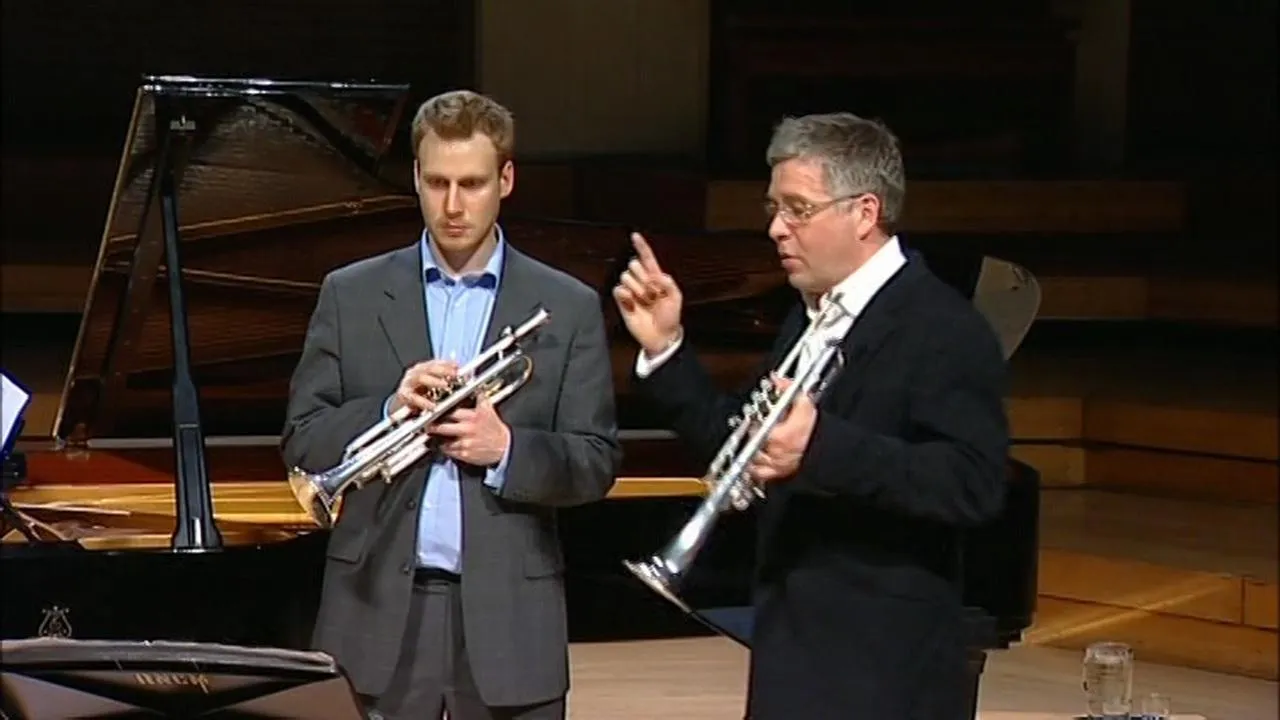
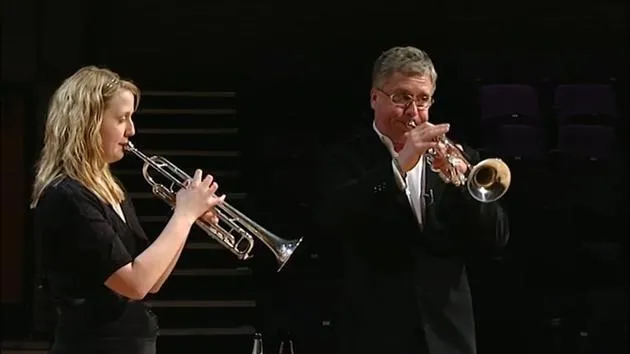
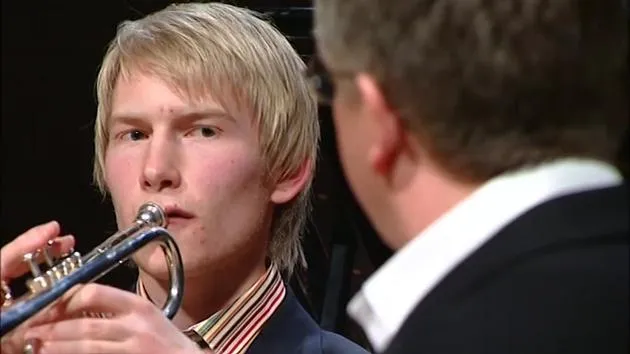
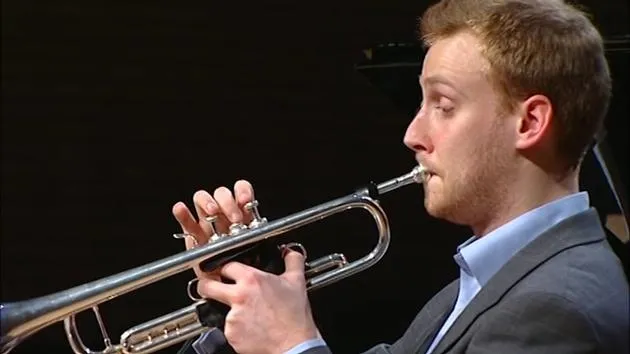
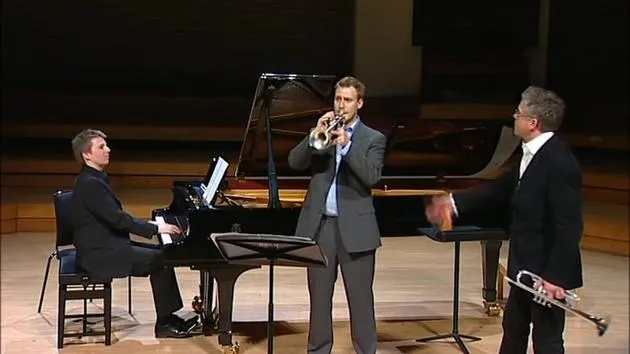
Håkan Hardenberger guía a un estudiante a través de la Sonatina para trompeta sola de Henze, abordando el tempo, la precisión y cómo dominar el escenario en una pieza sin acompañamiento.
Qué incluye el curso
6 lecciones (2h 13m) · 1 gratis
Transcripción de la lección
Music Lesson
Introduction
"That's good. I see also that you have the good edition. Yeah, it's great. They made a second one that's full of mistakes, sadly. But this one is good."
Solo Performance Insights
"You know, when you have a solo piece like this, it's a very unusual situation, I'm sure, for you to have a completely unaccompanied one. You should do more of your... you know, once you start playing it more in public, also for your own sake, you know, collect the silence and then explode.
It's very funny, this little first movement, you know, because we want it to be really precise. It's vital to find the right tempo for you, which I think you did very well.
Now, it's easy to sort of go that stumble in that you did very well. But you could do more, you know, when you come on stage and you take your bow and then use the silence, you know, so that... what is going to happen? You have to make them wonder, 'What is this?' That's what I would like you to do. And that comes with experience. But think about what it means to them that you are standing there alone. Yeah. And enjoy that."
The Importance of Silence
"He specifically writes. Again, he writes a silence first. Now, what do you think that means? It's arrest, isn't it? So the piece begins with silence. Yeah, but what does that imply? I don't really know if I played without.
If I ignore this. Okay. Oh, it implies that it's a pop. Pop. Pop it. Yes. And that's also, you've written a three above it.
Oh, I didn't write that. That was already there. Oh, sorry. Okay. But I meant it, you know, it sounded a bit like you played it without the sound. When you played, you played. You know, it sounded like that."
Embodying the Toccata
"Now I would like it to sound. It's a difference, isn't it? Yeah. Because then it leads to the... be natural, like an upbeat and no looking back.
And you know the meaning of 'toccata'? No? You should. I should. Yeah, I know it's one of your responsibilities, learning a piece of music. There's one indication.
Is it dance? No, sorry. Good guess. But it's not. It comes from 'tocare,' which means touch or, you know, hit. Right. Okay.
It's a bit more percussive, the style. And a little bit. You're right with the dancing. I like that image. You could do more of the reason he writes, you know, groups. He writes the little crescendos. Do them."
Technical Aspects of Playing
"Yeah. I haven't practiced this for years. Now, take your tempo. I mean, I'm not going to force you to. What is your tempo? Start with that. I just want to hear that.
Yes. You know, it's too sloppy. And don't forget your trigger because if you don't pull the trigger out, it sounds like something else. You know, that's the problem with so-called modern music. If we disrespect the things that should always be there, people think it's rubbish. But if we play it as any music, which you, you... you were doing a good job with that."
Continuing the Process
"So I shouldn't. Yes, good. Yeah, it's very good if you can get the C sharp. Yeah, good. You see? Then it starts to dance.
Yeah. That's the first one of each group. It's coming. You have to be a little... it's a difficult balance because you have to be very firm and loose at the same time.
It's better. Can you keep the same quality of articulation all the way? It's a bit harder work. And give yourself a good trampoline.
It was going really well. Are you doing that? No. Do the... Yes. Yeah, good. Now, so that becomes the point then that you come from there, you know, and there's... it shouldn't be a smile.
I think you had a very cute smile. But I think for this, it makes a big impact if you do that."
Phrasing and Rhythm
"Yeah. And it is. He writes for... and you know, it should be tough. Okay, so next phrase.
So, one, two, three. One, two, three, four, five. One, two, three, four, five. Yeah. Beam bomb. Play with the rhythms more. We're getting there.
Sounding good. It comes too early. Now when you do the slurs, it's a little bit out of rhythm and crescendo. But nice notes.
It's hard to do like this, splitting it all up. I know. Now again you do the G sharp on one. Okay. Because if you have the crossed instrument in this, it's not good.
Yeah. So you need... are you doing it all double? I was singling it then, but I'm... yeah. Then do it also slow double."
Practicing with Precision
"And then give the top one bit more. More accent on that one. And then. Are you playing the right notes? It's very important when you do the slow practice that you don't let any fish through the net. Not even the small ones.
Right? Yeah, yeah. Good. So even in the slow practice, you have the same. You know, you get used to where the impulse comes a little faster.
Yeah, it's just strange doing it like that. But it's a lot easier. Yeah, it is. Yeah. You know, you're not doing that one at all. Anyway, the end."
Concluding Thoughts
"Yeah. So don't play that too like you did before. You played it very freely. Yeah, I think it's much more effective.
It comes. If you like, you can do just the C and the B flat. That's what I should have done if I was clever. And then don't do what you just did.
Now, that's again, that's like the beginning, you know? And then you take your mute or whatever you do slowly. Move slowly. The piece is still. The ideal is, of course, if you have the mute very close by, so you keep the tension, you know."
Rhythm and Blues
"Now, this movement, also be a little bit more strict about rhythm first. And it will work better. It's like a mixture of the blues and the wooden trumpet.
In Tristan, you cut one beat, you know. Sorry. Be natural.
Yeah, yeah. Keep the beat moving. There's no hurry, you know? And the wobbliness should have a meaning.
Yeah. You know, not sa. Don't hurry, sa. It's completely normal music. Sing the dynamics. Now here, it's like it doesn't know where it's going.
So that you create something for the ending. Now you're starting to build up for that. If you're going to play pianissimo here, you can't play pianissimo there. They're not so fast, you know?
And you can sh. Take time there. Yeah, very good. Now, physical things like this, it's so much easier if you know exactly what you're doing.
Yeah. It's like karate, you know, there's no doubt. Boom. Yeah."
Final Adjustments
"Now, I don't like your choice of mute, by the way. Okay. I think it's much nicer with a Harmon without stem or something like that for this one.
No, for the previous one, and for this one, you need something that sounds more metallic. Yeah. Fortissimo. You know, it's a...
How are you tonguing that? Those. No, these double. I'm going. Yeah, that's good. You can do. You can prepare it a little bit more. You can do.
Now you have to nail the low one. Just confusing me now. Yeah, do it slowly once. No, it's your F sharp.
F sharp, yes. So that you can really do it. Fortissimo. You know, your mind has to be very, very simple. Thomas Stevens always said, 'To be a trumpet player, you should not be intelligent.'
Yeah. Practice it like that. More. Yeah, much more measured you were doing. Now it's a simple march. Yes. No, and then.
That's too early. I'm your metronome. But you, you're not starting with my beat. You're starting anywhere. One, two. That's it. N. No.
Pa, pa, pa, pa. You see, that's the danger with unaccompanied modern music. We think we can do what we want. They're not going to hear it anyway.
Surprise, surprise. You know, if they feel uncomfortable because you are not, you know, then that's what we get then.
Yeah, we don't like modern music. Make them like it. Sing it. Sing it. Sing it. That's it."
Closing Remarks
"One too many. 1, 2, 3, 4, 5. Do you know how many you're playing? Almost. So that's like the first movement, yeah?
Yeah. Yes. Good. Yeah. So the work is very good, but you, to take the next step, you know, really look what is there. Because as the karate, when you know exactly how to time it, that's when you'll be able to play it. Really impressive.
Yeah. Yeah, I know. You will do it. I will, yeah. Good. Cheers. Thanks very much. Thank you."
6 lecciones
2h 13m de lecciones en vídeo estructuradas
Funciones de vídeo avanzadas
Ralentiza, repite un pasaje, sigue la partitura
Móvil, tablet y ordenador
Practica donde quieras
Garantía de satisfacción 100%
30 días de garantía de devolución
Conoce a tu gurú
Conoce a tu gurú
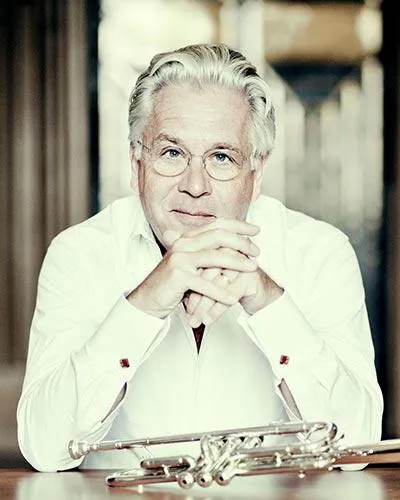
Håkan Hardenberger nació en Malmö, Suecia. Empezó a estudiar la trompeta a los ocho años con Bo Nilsson en Malmö y continuó sus estudios tanto en el Conservatorio de París, con Pierre Thibaud, como en Los Ángeles con Thomas Stevens.
Está considerado el mayor solista de trompeta de la actualidad. Junto a las interpretaciones del repertorio clásico, es el pionero más destacado de nuevas obras para trompeta. Muchas de ellas, escritas para Hardenberger y defendidas por él, figuran hoy como hitos clave del repertorio, entre ellas obras de Sir Harrison Birtwistle, HK Gruber, Hans Werner Henze, Rolf Martinsson, Olga Neuwirth, Arvo Pärt y Mark-Anthony Turnage.
Entre las obras de nuevo encargo de la temporada 2007/08 figuraron un concierto de Luca Francesconi con la Accademia Nazionale di Santa Cecilia dirigida por Antonio Pappano (coencargado con la VARA/Netherlands Radio Philharmonic y la Gothenburg Symphony), un concierto de Kurt Schwertsik estrenado y encargado por la Tonkünstler Orchestra y Kristjan Järvi en el Musikverein de Viena, y una nueva obra de HK Gruber para trompeta, banjo y orquesta de cámara (coencargada por la Amsterdam Sinfonietta y la Swedish Chamber Orchestra).
Håkan Hardenberger actúa con las principales orquestas del mundo, entre ellas la Los Angeles Philharmonic, la Chicago Symphony, la Vienna Philharmonic, la London Philharmonic, la London Symphony Orchestra, el Orchester des Bayerischen Rundfunks, el Orchestre National de France y la NHK Symphony Orchestra. Entre los directores con los que colabora se cuentan Pierre Boulez, Thomas Dausgaard, Alan Gilbert, Daniel Harding, Neeme Järvi, Ingo Metzmacher, Esa-Pekka Salonen, John Storgårds y David Zinman.
En el recital, Hardenberger mantiene varias asociaciones clave: con los pianistas Aleksandar Madžar y Roland Pöntinen; una singular colaboración con el poeta sueco Jacques Werup y el pianista de jazz Jan Lundgren; y con el percusionista Colin Currie. A Hardenberger y a Currie se les puede escuchar en un CD publicado en 2007, y ha actuado junto a Currie por primera vez en Estados Unidos (San Francisco), donde también regresa para actuar con la Cincinnati Symphony y Paavo Järvi.
De la extensa discografía de Hardenberger en los sellos Philips, EMI y BIS Records, en 2006 se publicaron dos discos más: obras para solo para BIS, y un disco de obras de Turnage, Gruber y Eötvös con la Gothenburg Symphony Orchestra y Peter Eötvös para Deutsche Grammophon, que ha recibido merecidamente grandes elogios.
En su clase magistral de trompeta, Hardenberger comparte el arte que hay detrás de esa reputación, trabajando sobre Bohuslav Martinů, Hans Werner Henze y Georges Enescu para mostrarte cómo moldea el sonido, el fraseo, la respiración y la interpretación, de modo que puedas aportar el mismo pensamiento musical a tu propia forma de tocar.







