



Groove de un acorde

Lesson time: (8min 30sec)
Doug MacLeod enseña un groove contundente de un solo acorde a la guitarra acústica, centrándose en la potencia de la mano derecha: apagar las cuerdas graves y el rasgueo con pulgar y dedos al estilo Lead Belly.
Course preview
This lesson is part of the course 101 fundamentos de la guitarra de blues
Watch a preview of the full course below.
Lesson transcript:
One Chord Groove Lesson
Alright, we're going to get started on the one chord groove. Before we get to the groove, though, I want to make something clear to you.
Right Hand Techniques
And that's with the right hand. I forgot to cover this in the first part, and I want you to get a handle on it. Here are two things I do with my right hand to add power:
-
Muffling Technique:
- I use the back of my hand on the low three strings (the E, A, and D) to muffle them. This adds some drive.
- Demo: When I take my hand off, it sounds like this: [demonstration].
- That's not as driving, is it?
-
Basic Strum:
- I learned this as the Lead Belly strum:
- Thumb goes down, picking finger comes up.
- Thumb goes down, picking finger comes up.
- That's it!
When you hear the old Lead Belly stuff, that's all he was doing. And while it may sound simple, there's a lot of music packed in there.
- I learned this as the Lead Belly strum:
Strumming Variations
This basic strum includes two main variations:
- Pinch or
- Alternating
Remember, the human hand can only do these two things or a combination of both.
Playing the One Note Groove
Now, if you got that in mind, let's play a one note groove.
- Get that E moving.
- Put the meat of your right hand back on those strings so you can feel it.
- Now, take your third finger off that D string.
And now we got that funky E because we've got that seventh distance.
Double Stopping
Next, we're going to do some double stopping. A double stop is two notes that work well together.
- One of the most famous double stops in blues comes from Lightnin' Hopkins:
- We're going to take our second finger and go up to the fourth fret of the G string.
- Our first finger goes up to the third fret of the B string, and we will worry it so it sounds like this: [demonstration].
What I just did was a slide:
- I slid down from the fourth fret to the second.
You can also pull off to achieve a similar sound. So, it sounds like this: [demonstration]. Now you can feel the groove!
- Hit that high E when you're doing that and smash that hand down to get the groove going again.
Groove and Feel
Now we're down in the low part of the guitar.
- We'll stay a little longer.
- Pick like that.
Remember those notes we talked about earlier? We're rolling down.
What's that? Oh, that was a thumb snap. Let me stop for a minute and explain that:
Thumb Snap Technique
- Charlie Patton was famous for that.
- A thumb snap is where you take your thumb, put it underneath the string, pull it up until the string falls off. It's that easy!
How fast you bring your thumb to your hand shows the attack of it:
- If you do it slow and gently, it sounds like this: [demonstration].
- But if you come up fast, you get that gunshot sound: [demonstration].
You can do that on any of the strings. If you worry a string like I just did, it sounds fantastic!
Feeling the Groove
When we started this DVD, we discussed the feeling, didn't we? And that's what we're going after now.
- Last time down in what I call the low part of the guitar, keep that deadened sound.
- We're grooving!
Move Up the Neck
Now it's time to move up to the middle.
New Chord Position
Take a good look at this chord:
- I have my third finger on the seventh fret of the G string.
- My first finger is on the fifth fret of the B string.
- My pinky is on the seventh fret of the E string.
There's no third in this chord, which gives us some freedom. It's a good-sounding chord because we're just using that one chord groove now.
- Now we move to B.
- Then to A flat, down to A, and finally G.
We can make a lot of music right here.
Just make sure when you hit it, hit it like you believe it. An old man told me, "Don't ever play a note you don't believe."
It's not about how many notes you play; it's about playing the right note. Worry it, hold it, live with it.
Exploring the Neck
Get the notes inside because that's where the feeling is. Now, we're going to roll up a little bit in this middle position.
- Does that sound familiar to you?
Well, you know why? Because it's this, just on a different set of strings.
Remember what I said:
"If you can find it here on the guitar, where else can you find it?"
Don't lose that thought; it's important. Don't be afraid to get lost on the guitar!
When you get lost and find your way back, what you discover is uniquely yours.
Building Melodies
Now, let's get to my left hand:
- Here's the B, B flat, A, G, and E.
We've got this groove right here.
- Hit the chord.
- We're doing what I call motive.
A motive is when you make a melody. Start easy like this: [demonstration].
Developing the Melody
Now we're going to build on it. We're not just copping licks; we're playing melodies from the heart.
- Worrying the notes, trilling the notes, maybe even snap a note.
- Drop back here if we get the big chord.
Still got the groove going!
Top of the Neck
Now we're going to go up to the very top.
- Up here at the top, we're going to change it.
- Think you're going to hear something different? [demonstration]
Now you can hear something different.
What you just heard was an E7.
I'm going to break this down and show you what that chord is now.
About the instructor
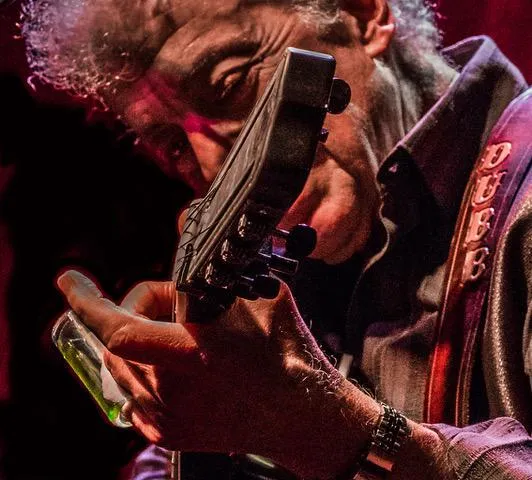
Doug MacLeod es conocido por sus magníficas composiciones, su virtuosismo a la guitarra, su voz cálida y llena de alma, su ingenio y sus inolvidables actuaciones en directo. En el corazón de una actuación de Doug MacLeod está su don para contar historias, dando vida de forma asombrosamente real a personajes que van de los anónimos a los legendarios. Doug ha ganado múltiples Blues Music Awards, entre ellos el Blues Music Award 2020 al Artista Acústico del Año y el Blues Music Award 2018 al Álbum Acústico del Año por 'Break The Chain', y ha sido nominado al Blues Music Award 2021 al Artista Acústico del Año. Su álbum con el productor Jim Gaines se publicó en 2021. En 101 Blues Guitar Essentials, Doug transmite los fundamentos de su oficio -los grooves, las técnicas y el feeling que sustentan la auténtica guitarra de blues acústico- para que puedas construir un verdadero vocabulario en el instrumento y empezar a contar tus propias historias a través de él. "Como todos los grandes bluesmen, MacLeod vive su música, y las canciones no están solo en la punta de sus dedos y de su lengua, sino que son una sola cosa con su ser." - Blues Music Magazine "Uno de los grandes artistas del blues... ¡y punto!" - Jorma Kaukonen read more