



Lerne, You Are The Universe zu spielen
Lesson time: (9min 59sec)
Andrew Levy zerlegt die Basslinie von 'You Are The Universe' der Brand New Heavies – wie er sie geschrieben hat und wie sich Strophe und Refrain unterscheiden.
Course preview
This lesson is part of the course Entfessle dein Funk-Bass-Potenzial mit The Brand New Heavies
Watch a preview of the full course below.
Lesson transcript:
Breakdown of "You Are the Universe"
Introduction
This is one of my favorite songs, You Are the Universe. Lots of people like it, and it goes down so well on stage. I'm going to break it down a little and talk about how it was written and what it sounds like today.
Writing the Song
I wrote the bass line over a drum loop back in probably '95 or '96. I then added the chords, very simple, as I'm not a pianist, but I knew what they should sound like in my head. Later, Neil Cowley played the piano on the album version, giving it more life and adding nuances that differentiated the verse from the chorus.
Verse and Chorus Dynamics
A classic thing the Brand New Heavies do is keep the verse very similar to the chorus, with slight changes. In this song, the verses get a little darker, but it's a lovely song. It was written like clockwork; I had all the music ready on a cassette tape and sent it to Syeda Garrett, my co-writer. She incidentally wrote "Man in the Mirror" for Michael Jackson, so she's an absolute professional songwriter.
We flew her over just to write songs for Shelter, which is where this song is from. She ended up being our singer, and it was a match made in heaven. She wrote another song called "Sometimes" and taught us a lot.
Learning from Syeda
She taught me the importance of slightly changing the bass line on the penultimate bar to give it a beginning and an ending. For example, on the fourth bar, I would use the same bass line but with a slight twist.
Creation Process
I sent the track on a cassette to her while she was staying in Manchester Square. Two days later, she biked the cassette back with written lyrics and the song sung onto the tape machine. I was completely blown away; it was perfect, the lyrics and harmonies were all there. I knew it would be one of our special songs.
Working Through the Song
I want to start working through the song, starting with the chorus since it's what I wrote first.
Chorus Insights
Take a listen to the chorus now. I'm going to point out a couple of grace notes and percussive elements in the bass line that give it that extra funky feel. When I return to the beginning of the bass line, I do a dead note, which acts like another percussion instrument. It helps me shorten the note as well.
Here's how it sounds:
- Clear downbeat
- Offbeat dead note: It's completely dead, with no tune, and gives a great feel.
Breaking Down the Verse
Now, I'm going to work on breaking down the verse, which is similar to the chorus but has half the chord changes. This allows the verse to breathe lyrically and gives the singer a bit of space. Remember, it's about the song and the singer, not just you.
When slowing down on the verse, I employ a lot of in-between notes. This technique partially comes from my background in drumming. It helps with timekeeping and adds a nice sound, similar to playing a conga. I'll play the bass line now, while you listen for the moments when I'm not playing a note and instead hitting the string.
The Solo
This song features one of the only solos I play, which has evolved into more of a section in the song. In the studio, we always had a bass breakdown where everyone goes crazy on the dance floor. This was my moment! I came up with a melody, and everyone loved it.
Saida, who sings lead vocals, introduces me with a line, saying "play it, Andrew." I was initially embarrassed about this, but it has become a cherished part of the song. Even when I hear covers on YouTube, they sing that line with my name, which my kids love.
Playing the Solo
I'll play the solo slowly so you can hear all the nuances and dead notes throughout.
Bass Details
You Are the Universe is one of the few songs where I play a five-string bass, specifically a Warwick Streamer Stage One. It has a unique, cool disco paint job and was custom made for me in '96.
Although it's heavy to play, it's handed to me just before the song starts, usually as our last song of the set. People sometimes laugh, as I only play it once throughout the whole set, but it's a theatrical moment.
Playing Dynamics
I try not to play too low on stage, as it can make the whole place rumble and muddy the sound, especially with a full band. I tend to stay away from the low B string, but using it sparingly can be quite powerful.
About the instructor
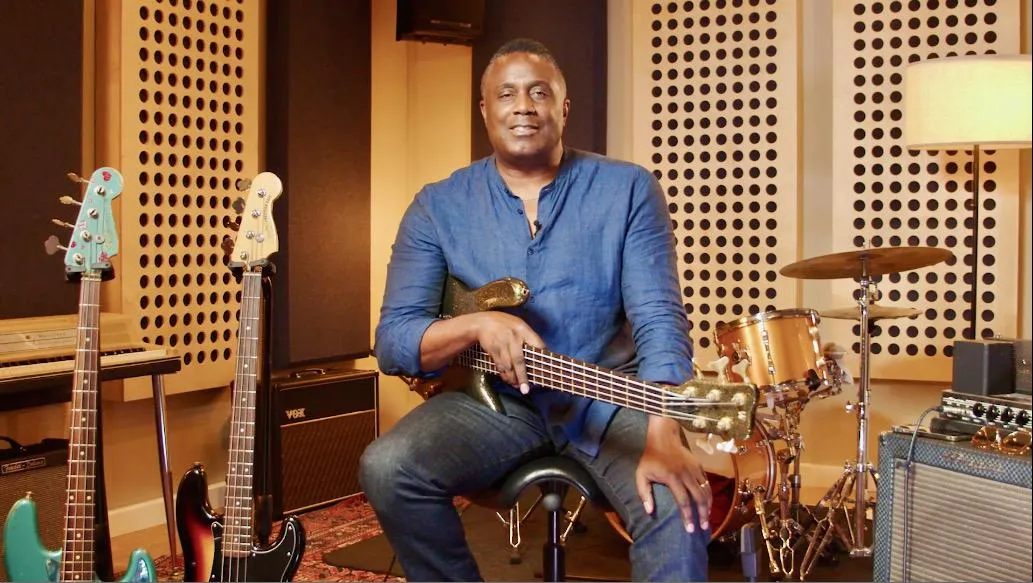
Andrew Levy ist Gründungsmitglied und Bassist der Acid-Jazz-Gruppe The Brand New Heavies. Außerdem schreibt er gemeinsam mit Simon Bartholomew die eigene Musik der Band. Als autodidaktischer Musiker wuchs Andrew mit Reggae, britischem Pop-Radio, klassischer Musik, Jazzfunk, 'Lovers' Rock', Jazzfusion, House, amerikanischem Folk, Hip-Hop und Acid House auf – eine eklektische Mischung, die daraus entstand, in London mit Eltern aus Jamaika aufzuwachsen! Seine größten musikalischen Einflüsse sind James Brown, Vicki Anderson, Earth Wind and Fire, Level 42, Shalamar, Chic, Herbie Hancock, George Duke, George Benson, Marvin Gaye, Thin Lizzy, Miles Davis und Phyllis Hyman. In seinem Kurs verrät Andrew, was Funkbass wirklich in Bewegung bringt: wie du dich mit dem Schlagzeug verzahnst, tief im Pocket sitzt und den Groove als Teil einer eng verzahnten Rhythmusgruppe hältst – das Feel, die Disziplin und die Entscheidungen hinter dem Sound, der The Brand New Heavies berühmt machte. Andrew lebt im Südwesten Londons mit seiner Frau Melissa und ihren beiden Söhnen. Über The Brand New Heavies The Brand New Heavies, gegründet von Andrew Levy und Simon Bartholomew, waren Wegbereiter der Acid-Jazz-Szene der 1990er Jahre. Die beiden lernten sich 1985 in der Schule in Ealing kennen, bevor sie Top-10-Alben in Großbritannien, den USA und Japan veröffentlichten und 2020 einen siebenstelligen Vertrag mit dem internationalen Label Edel Records unterschrieben, um fünf neue Alben zu produzieren – das erste erschien im Frühjahr 2022. Die Band ist stolz darauf, echte Instrumente zu spielen – keine computer-synthetisierte oder programmierte Musik. Deshalb hat sie viele namhafte Fans in der Musikindustrie, darunter Superproduzent Mark Ronson, der ihr gleichnamiges Album zu seinen 10 besten Platten aller Zeiten zählt und der Band zuschreibt, ihn Anfang der 1990er vom Rock zum Funk gebracht zu haben. Ronson produzierte die 2019 erschienene Coverversion der Band von Kendrick Lamars "These Walls", die auf Radio 2 eine treue Kult-Anhängerschaft gewann. read more