



Wie du dein Blattspiel verbesserst
Das steckt im Kurs
29 Lektionen (2h 45m) · 1 gratis
01. Control – Chase & Status
3:12
02. Law – Richard Spaven
3:11
03. Cry Me A River – Justin Timberlake
3:06
04. Family Affair – Mary J Blige
3:27
05. What Is Hip? – Tower of Power
3:19
06. Techno – John Scofield
3:13
07. Razorhead
3:17
08. Buena Havana
2:38
09. The Bean
3:19
10. Eastern Adventure
Gratis-Lektion2:48
11. Full English Breckerfest
2:35
12. Kita's Five
2:59
01. Control – Chase & Status
13:17
02. Cry Me A River – Justin Timberlake (Lesson)
15:05
03. Family Affair – Mary J Blige (Lesson)
11:59
04. Law – Richard Spaven (Lektion)
6:05
05. Techno – John Scofield (Lesson)
10:43
06. What Is Hip? – Tower of Power (Lektion)
10:54
07. Razorhead
7:23
08. Buena Havana
7:17
09. The Bean
9:50
10. Eastern Adventure
6:01
11. Full English Breckerfest
5:45
12. Kita's Five
7:03

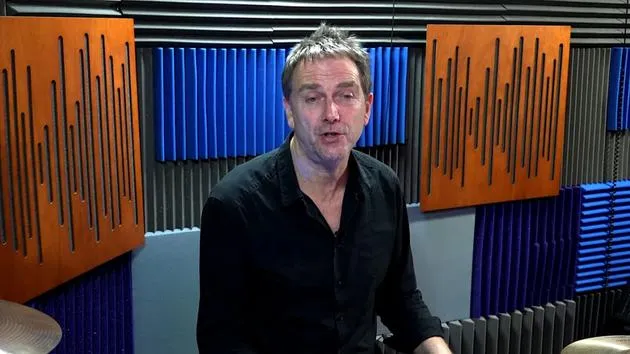
Transkript der Lektion
Music Lesson on Sight Reading and Interpretation
In grades one to five, students are required to choose between sight reading and interpretation/improvisation. You might ask the question, "Why do I need to read?" Well, sight reading is a really important professional skill with many benefits.
If you find yourself in a professional context where you receive a chart, the ability to read that chart becomes essential. At Rock School, we emphasize that this is a crucial criterion in the examination package.
Tips for Sight Reading
The first thing I'm going to do is provide you with tips on navigating through:
- Single Line Reading
- Composite Groove Reading
These will help you with interpretation and improvisation. Here are some practice systems and advice to improve your skills.
Understanding Sight Reading
The process of sight reading typically involves:
- Looking at Notes
- Putting Notes Together into Phrases
- Recognizing Those Phrases in a Sight Reading Situation
Initially, when you work on these phrases, you break them down slowly and piece them together.
Example: 16th Note Phrase
Consider the following 16th note phrase:
1, 2, 3, 4...
When you first look at that phrase:
- You must understand what it looks like.
- You need to know why it's written that way.
Hearing the Sound
You can hear that phrase as:
"1 and a 2 and a 3 and a 4 and a 1."
Eventually, you'll develop an automatic response to that rhythm when you see it written on the page.
Similar to reading sentences, we string the notes together and understand phrases in the same way you'd automatically string words together when speaking or reading. You're not figuring out the actual words; you simply read them in context.
Phrase Structuring
Every subdivisional note, pulse, and metric system has a kind of phrasing system attached to it.
Eighth Notes Example
If you're working on eighth notes, let's take a tempo of:
1, 2, 3, 4...
There aren't many ways to break the eighth notes down:
- Quarter Note: 1, 2, 3, 4
- Half Beat: 1 and 2 and 3 and 4
- Two Eighth Notes: 1 and 2 and 3 and 4
These combinations of eighth notes come together to produce phrases.
Triplet Phrases
When required to play triplet phrases, remember to break down those triplets into groups:
"1, 2, 3, 4, 1, 2, 3..."
You can subdivide those groups into different phrases.
Example with Triplets
Let's take the first two triplets:
- 1 triplet
- 2 triplet
- 3 triplet
- 4 triplet
You may choose to play:
- The last two, three, or the first and the third triplet.
Recognizing Note Values
In sight reading, recognition is key. We recognize note values and phrases to enhance our performance.
16th Note Phrases
As we look at 16th note phrases, remember:
- The more notes you have per beat, the more phrases you'll encounter in sight reading.
Example with 16th Notes
Let's try playing four 16th notes with the tempo:
1, 2, 3, 4:
1 E and A
2 E and A
3 E and A
4 E and A
You can break those 16th notes into various phrases. A few examples include:
- Common 16th Note Phrases:
- "1, 2, 3, 4: 1 and a 2 and a 3 and a 4..."
- "1 E and 2 E and 3 E and 4 E..."
Practice Requirements
The key is to recognize how those notes look and how those rhythms sound. Through consistent practice, you will improve your sight reading skills in a musical and professional context.
Additionally, you can work on 16th note triplets and 32nd notes as you progress through the higher grades. Keep focusing on how these phrases fit together, along with the concept of recognition, note values, and subdivisions.
29 Lektionen
2 Std. 45 Min. strukturierte Videolektionen
Erweiterte Videofunktionen
Verlangsamen, Passagen loopen, mitlesen
Handy, Tablet & Desktop
Üben, wo du willst
100 % Zufriedenheitsgarantie
30 Tage Geld-zurück-Garantie







