



Fallout (Analyse)
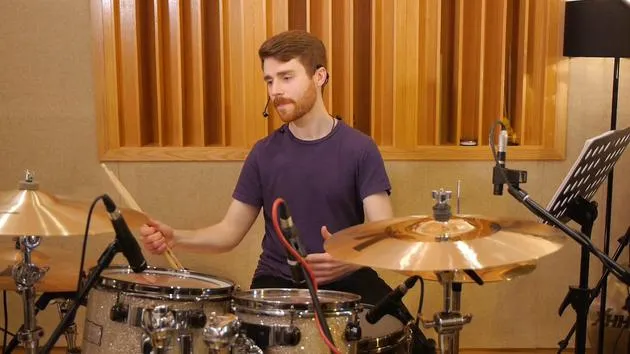
Rich Hawking schlüsselt das Rockschool-Drums-Stück 'Fallout' auf, einen Heavy-Metal-Track mit soliden Grooves und einem kniffligen Double-Time-Feel, und geht seine Struktur durch.
Das steckt im Kurs
26 Lektionen (2h 36m) · 1 gratis
01. Standard – Stormzy
1:28
02. You Really Got Me – Van Halen
1:36
03. Word Up – Cameo
1:55
04. Rapper’s Delight – Sugarhill Gang
1:56
05. Smooth – Santana
2:01
06. Play That Funky Music – Wild Cherry
1:57
07. Overrated
1:59
08. Old Bones Blues
1:57
09. Indecisive
1:53
10. Maiden Voyage
2:01
11. Reggae Island
Gratis-Lektion1:56
12. Fallout
2:01
01. Word Up – Cameo (Analyse)
8:13
02. Standard – Stormzy (Analyse)
10:23
03. You Really Got Me – Van Halen (Analyse)
10:31
04. Rapper’s Delight – Sugarhill Gang (Analyse)
11:17
05. Smooth – Santana (Analyse)
7:46
06. Play That Funky Music – Wild Cherry (Analyse)
10:26
07. Overrated (Analyse)
15:30
08. Old Bones Blues (Analyse)
11:41
09. Indecisive (Analyse)
15:20
10. Maiden Voyage (Analyse)
16:46
11. Reggae Island (Analyse)
2:54
12. Fallout (Analyse)
Du bist hier8:39
Transkript der Lektion
Music Lesson: Understanding the Track "Fallout"
Okay, so Fallout, let's talk about this one!
Track Overview
- We've got a nice heavy metal feeling track.
- Solid grooves with:
- Ride cymbals
- Slurred hi-hats
- An interesting double time feel to wrap your head around.
This is going to be great for developing solid feelings, whether in normal time or double time. You'll need to think ahead and anticipate changes so we don't get caught behind and let the tempo slip.
Structural Breakdown
Let's make this easy to understand by breaking it down. If we start with the structure, it becomes less daunting. Here's how it's organized:
- Main Theme
- Verse
- Main Theme again
- Verse again
- Double Time Section (Only a slight variation on the verse theme)
- Back to the Main Theme
Through this breakdown, you can see it's based on just two ideas. This is great because it simplifies the learning process, aside from the fills and accents.
Learning the Main Theme
First up, let's internalize the first section:
- Instruments: Crashes, ride
- Tip: Lock into your ride cymbal.
- All crashes come off that ride.
- Lead with your riding hand (right hand or whichever hand you use).
- Alternate between the ride and the cymbals to keep the bass drum even.
Use your left hand on the snare just to precede the hits. Spend some time with your teacher understanding the hits, and lock into that ride pattern. We're talking solid eighth notes.
Verse Pattern
Moving on, let's look at the verse pattern in section B:
- It's a solid feel with slurred hi-hats.
- While it's eighth note oriented, maintain a quarter note feel with the foot and hand.
- Incorporate a couple of little off-beat accents, but stay solid on the quarter note feel.
Developing Your Timing
- You might've noticed I pulled back a little when playing the verse pattern. This was intentional.
- It's important to play bang on the beat, but sometimes you'll want to be slightly ahead or behind to change the feel.
- Being just a bit ahead or behind allows you to adjust the feel of the beat depending on the scenario.
Example
The reason I pulled back on the beat in this verse section was to create a weighty feeling, still solid because of the quarter note pulse. With the guitar riff in the background, it gives room for the guitar to ring out.
Influences
Many drummers use this technique:
- Dave Grohl from Nirvana occasionally plays behind the beat.
- Charlie Watts from the Rolling Stones is another classic example of playing behind the beat, enhancing feel without detracting from it.
Experimentation
Try this:
- Put on the metronome or the backing track.
- Instead of hitting the click dead on, experiment with playing slightly behind or ahead of it.
- Work on this with your teacher.
Transitioning to the Double Time Section
Then, we move into the double time section. Notice it's just the same idea as the verse. Once you internalize the guitar riff, you can think about it with a different pulse:
- Count it as:
- 1 and 2 and 3 and 4 (for normal time)
- Transition to: 1, 2, 3, 4
Bridging the Feels
To develop this ability further:
- Play the verse part as the normal feel, straight into the double time feel, no stopping.
- Try two to four bars of one, followed by two to four bars of the other.
Other than a few drum fills and decorations, that's it for the double time section. We then end on that main theme again, which you should be familiar with at this point.
Final Tips
The sooner you internalize both pieces of the song, the quicker you can apply yourself and understand everything.
Cymbal Setup
Consider your cymbal setup:
- Choose different sticking for some cymbal hits or fills to help with transitions to your left-hand crash.
Example
For the fill in bar 32:
- Usually played as right, left, right, right.
- You might want to try ending on a double right to free up your left hand for the crash before going back to the hi-hat.
Conclusion
That's about it for this one! Have lots of fun, enjoy the different feels, dig in, and let's play some solid time.
26 Lektionen
2 Std. 36 Min. strukturierte Videolektionen
Erweiterte Videofunktionen
Verlangsamen, Passagen loopen, mitlesen
Handy, Tablet & Desktop
Üben, wo du willst
100 % Zufriedenheitsgarantie
30 Tage Geld-zurück-Garantie







