



Shuffles
Lesson time: (11min 18sec)
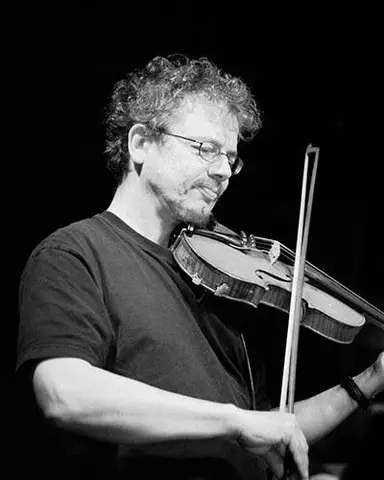
Chris Haigh stellt die Country-Rock-Fiddle und die dahinterstehenden Shuffle-Bogenmuster vor, darunter den Nashville- und den Georgia-Shuffle.
© 2011 Schott Music Ltd, London
Course preview
This lesson is part of the course Rock-Violine: Stile & Performance
Watch a preview of the full course below.
Lesson transcript:
Country Rock Music Lesson
Hi. In this lesson, we're going to talk about country rock.
What is Country Rock?
Country rock is a phrase that basically includes any country music that has rock rhythms in it. Contemporary mainstream country music is probably mostly country rock, if you come down to it. The stuff we're going to talk about here is relevant to most contemporary country music.
Topics Covered
A couple of things that we're going to be covering are:
- Shuffles: This is what we're going to do in this lesson.
- Drones and Double Stops: To some extent.
Understanding Shuffles
Shuffles are something that belong in the old-time country fiddling from, let's say, the early 20th century. Before that, they were part of the rhythmic drive of the music. Traditionally, in the Appalachians, a fiddler would play alone for a dance, providing not only the melody but also the rhythm.
Types of Shuffles
There are two main shuffles that we've got to look at:
- Nashville Shuffle
- Georgia Shuffle
The Nashville Shuffle
The Nashville Shuffle is basically a pattern of down, up, down, up, down, up, down, up:
- It's an alternating long and short pattern.
- We're pushing a long note and then two shorts, and then pushing in the opposite direction.
If you try to do this with bows that are too long, it won't work. When I say long and short, I actually mean short and very short.
You probably recognize this sound, as it's often used as the introduction to a hoedown. It finds its way into melodies and solos as well.
Example: Here's a tune called Old Joe Clark, which is entirely based on the Nashville Shuffle.
- It's just a coincidence that this tune uses the Nashville Shuffle so prominently.
At the moment, you might assume that the long note has the emphasis, but in a rock context, this places the rhythm in entirely the wrong place. We want the backbeat to be the opposite accent.
Playing with Drones
Let's do the same thing with an open string drone:
- We'll play a cross, an A and an E at the same time.
Now, let's make it a bit more complex with changing chords:
- A chord
- D chord
For this, we've got an F sharp and a D:
- A with a C sharp
- A with an E above it
- B with an E above it
- C sharp with an E above it
- D with an F sharp above it
Full example: 2, 3, 4... and that's the kind of thing we can use as backing for all sorts of tunes or songs.
Note: The reason it's called the Nashville Shuffle is that this was the rhythm that fiddle players used in the early days of the Nashville recording industry. Record companies would discover singers, often without their own bands, and session musicians would create the backing for that song, making it sound timeless.
Adding a Slide
Now, let's add a slide to the Nashville Shuffle:
- With most of these, we keep one note steady, like the E, and slide the C against it.
- You can either slide both notes or keep the D steady and slide the first finger.
Example Playing: Let me do that up to speed.
You'll notice that while this may sound dissonant on its own, in context, it sounds perfectly fine.
Now let's do the same thing, but we're going to do two of these per bar.
Up to Speed:
The Nashville Shuffle is a really useful pattern for either an intro, as background for a singer, or integrated into a melody.
The Georgia Shuffle
The Nashville Shuffle has one disadvantage: the accent alternates between the down and the up. It's often preferable to have all accents in the same direction for greater consistency, and that's where the Georgia Shuffle comes in.
- Start off just before the bar line, with a slur down: 1, 2, 3, 4.
With this, the accents are all on the up, providing a smoother sound due to having three notes slurred together most of the time instead of two.
Example Tune
One example that lends itself beautifully to the Georgia Shuffle is The 8th of January.
I'll play this through slowly and then at a faster tempo.
- You can see that it provides significant drive and consistency to the tune.
Note: The accent can work either way, either on an up or a down stroke.
Practice Routine
Your assignment for this lesson is:
- Practice all of these shuffles until you master them.
- Try both shuffles in a different key. Instead of doing them in A, try doing them in D, as you'll find different slides and lower notes you can use.
- Find a traditional old-time tune at random and try playing both shuffles over that tune to see which one works best.

About the instructor
Chris Haigh ist seit 25 Jahren professioneller Fiddle-Spieler mit Erfahrung in vielen verschiedenen Genres. Er hat auf über 75 Alben gespielt und dabei mit Künstlern wie Alison Moyet, Bob Geldof, All About Eve, Michael Ball, David Soul, Oumou Sangare, The Quireboys, Riverdance, Morcheeba, James Galway und Steps zusammengearbeitet. Er hat Swing-Jazz mit The Kimbara Brothers, Diz Disley, Le Jazz, The Hot Club of London und den Quecumbar Allstars gespielt und leitet die siebenköpfige sowjetische Swing-Band The Kremlinaires. Chris gibt Unterricht und Workshops zur Jazzgeigen-Technik und hat Jazzgeige an den Universitäten Middlesex, Brunel und Newcastle sowie am Truro College unterrichtet. Zu seinen Veröffentlichungen zählen neun Fiddle-Bücher, darunter The Fiddle Handbook. Außerdem betreibt er Fiddling Around (fiddlingaround.co.uk), vermutlich die umfassendste und meistbesuchte Quelle für Fiddle-Wissen im Netz. read more